
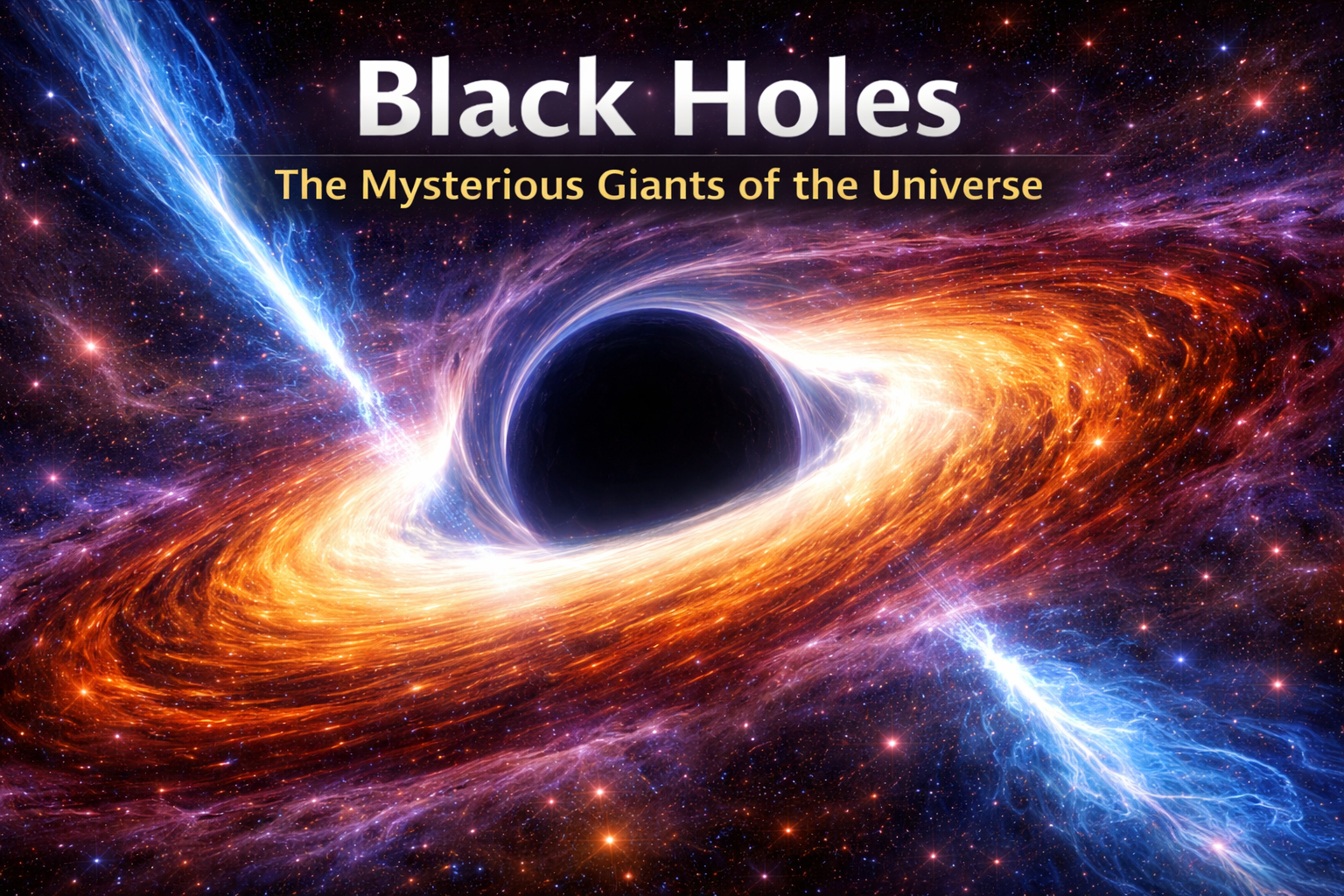
Among the most fascinating and enigmatic objects in the universe are black holes. Invisible yet immensely powerful, black holes represent regions of space where gravity is so strong that nothing—not even light—can escape.
Once considered purely theoretical, black holes are now firmly established as real cosmic phenomena that shape galaxies and influence the structure of the universe itself.
From stellar remnants to supermassive giants at the centers of galaxies, black hole’s challenge our understanding of physics, time, and space. In this article, we will explore what black holes are, how they form, their types, structure, and their role in cosmic evolution.
Contents
- 1 What Is a Black Hole?
- 2 How Black Hole’s Form
- 3 Types of Black Holes
- 4 The Structure of a Black Hole
- 5 Detecting Black Holes
- 6 Black Holes and Einstein’s Theory
- 7 What Happens If You Fall Into a Black Hole?
- 8 Do Black Holes Destroy Everything?
- 9 Black Holes and Galaxy Evolution
- 10 Hawking Radiation and Black Hole Evaporation
- 11 Black Holes and the Future of the Universe
- 12 Myths and Misconceptions
- 13 Why Black Holes Matter
- 14 Conclusion
- 15 FAQs
- 16 ❓ 1. What is a black hole?
- 17 ❓ 2. How do black-holes form?
- 18 ❓ 3. Can light escape a black-hole?
- 19 ❓ 4. Are black holes dangerous to Earth?
- 20 ❓ 5. How do scientists find black holes?
What Is a Black Hole?
A black hole is a region in space where matter has collapsed into an extremely small area, creating a gravitational field so intense that escape is impossible beyond a certain boundary.
This boundary is known as the event horizon. Once anything crosses this limit, it cannot return. The reason black holes appear “black” is because not even light can escape.
Despite their name, black holes are not empty holes. They are incredibly dense objects formed from compressed matter.
How Black Hole’s Form
Black hole’s are typically born from the death of massive stars.
Stellar Collapse
When the life of a big star comes to an end:
- It exhausts its nuclear fuel
- Fusion reactions stop
- Gravity overwhelms internal pressure
- The core collapses
If the remaining core is massive enough, it compresses into a singularity—a point of nearly infinite density.
The outer layers of the star may explode in a supernova, while the collapsed core becomes a black hole.
Types of Black Holes
Black hole’s come in different sizes and categories.
1. Stellar-Mass Black Holes
These form from collapsing stars and typically have masses between 5 and 100 times the mass of the Sun.
They are scattered throughout galaxies and are often detected by observing their interaction with nearby stars.
2. Supermassive Black Holes
The majority of galaxies, including our own, have supermassive black holes at their cores.
They can contain:
- Millions
- Or even billions of times the mass of the Sun
Their origin is still being studied, but they likely formed from the merging of smaller black hole’s and the accumulation of matter over billions of years.
3. Intermediate Black Holes
These black holes fall between stellar and supermassive sizes. They are rarer and more difficult to detect but provide important clues about black hole growth.
4. Primordial Black Hole’s (Theoretical)
Some theories suggest that tiny black holes may have formed shortly after the Big Bang due to density fluctuations. However, their existence remains unconfirmed.
The Structure of a Black Hole
Although black hole’s cannot be observed directly, scientists understand their structure through physics and observation.
1. Singularity
At the center lies the singularity, where matter is thought to be compressed into an infinitely small point.
Current physics cannot fully explain what happens inside a singularity.
2. Event Horizon
The point beyond which nothing can escape is known as the event horizon. Its size depends on the black hole’s mass.
3. Accretion Disk
Matter falling toward a black hole forms a swirling disk called an accretion disk. This disk heats up due to friction and emits intense radiation.
4. Relativistic Jets
Some black hole’s produce powerful jets of energy that shoot out from their poles at nearly the speed of light.
Detecting Black Holes
Since black hole’s do not emit light, scientists detect them indirectly.
Gravitational Effects
Black hole’s influence nearby stars and gas. By observing unusual motions, astronomers can infer their presence.
X-ray Emissions
When matter in the accretion disk heats up, it emits X-rays, which can be detected by space telescopes.
Gravitational Waves
When black hole’s merge, they create ripples in space-time known as gravitational waves, first detected in 2015.
Direct Imaging
In 2019, astronomers captured the first image of a black hole’s shadow, confirming decades of theoretical predictions.
Black Holes and Einstein’s Theory
Black hole’s are closely tied to Albert Einstein’s theory of general relativity.
According to general relativity:
- Massive objects warp space-time
- Extreme mass can create gravitational collapse
- Space and time behave differently near black hole’s
Time slows down near a black hole, and space becomes severely curved.
What Happens If You Fall Into a Black Hole?
One of the most intriguing questions is what would happen to someone falling into a black hole.
Near the event horizon:
- Gravity becomes stronger with proximity
- The difference in gravitational pull between head and feet would stretch the body
This effect is often called “spaghettification.”
However, from an outside observer’s perspective, the falling object would appear to slow down and fade near the event horizon due to time dilation.
Do Black Holes Destroy Everything?
While black hole’s consume matter that gets too close, they are not cosmic vacuum cleaners sucking up everything around them.
If a black hole of the same mass were to take the place of the Sun:
- Earth would continue orbiting normally
- Only light and heat would disappear
Black hole’s influence only their immediate surroundings unless they are actively feeding on nearby material.
Black Holes and Galaxy Evolution
Galaxies are largely shaped by supermassive black hole’s.
They:
- Regulate star formation
- Influence galactic structure
- Produce energetic jets
When actively consuming matter, they form what is known as an active galactic nucleus (AGN), which can outshine entire galaxies.
This interaction suggests black hole’s and galaxies evolve together.
Hawking Radiation and Black Hole Evaporation
In 1974, physicist Stephen Hawking proposed that black hole’s are not completely black.
According to quantum mechanics:
- Particle pairs form near the event horizon
- One particle falls in
- The other escapes
This process, known as Hawking radiation, implies black hole’s slowly lose mass over extremely long timescales.
Small black hole’s would evaporate faster, while supermassive ones would take longer than the current age of the universe.
Black Holes and the Future of the Universe
In the far future:
- Stars will burn out
- Galaxies will fade
- Black holes may dominate the cosmos
Eventually, even black-holes could evaporate through Hawking radiation, leaving a dark and quiet universe.
Myths and Misconceptions
Myth 1: Black Holes Are Portals
There is no scientific evidence that black holes act as gateways to other universes.
Myth 2: They Wander Destroying Everything
Black-holes move according to gravity and only affect nearby objects.
Myth 3: They Are Completely Invisible
While the black hole itself is invisible, its effects are highly observable.
Why Black Holes Matter
Black holes help scientists:
- Test theories of gravity
- Understand galaxy formation
- Study extreme physics
- Explore quantum mechanics
They represent the meeting point between general relativity and quantum physics—two fundamental but not yet unified theories.
Conclusion
Black holes are among the most powerful and mysterious objects in the universe. Born from dying stars or formed in galactic centers, they warp space-time, regulate galaxies, and challenge our understanding of reality itself.
Far from being simple cosmic destroyers, black-holes are key players in the universe’s evolution. As technology advances and research continues, they may unlock answers to some of the deepest questions about space, time, and existence.
In the vast cosmic landscape, black holes stand as silent giants—hidden yet profoundly influential, mysterious yet essential to the universe’s grand design.
FAQs
❓ 1. What is a black hole?
A black-hole is a space object with gravity so strong that nothing, not even light, can escape.
❓ 2. How do black-holes form?
They form when massive stars collapse after running out of fuel.
❓ 3. Can light escape a black-hole?
No, light cannot escape once it passes the event horizon.
❓ 4. Are black holes dangerous to Earth?
No, all known black holes are far from Earth and pose no threat.
❓ 5. How do scientists find black holes?
They detect black holes by observing nearby stars, X-rays, and gravitational waves.