
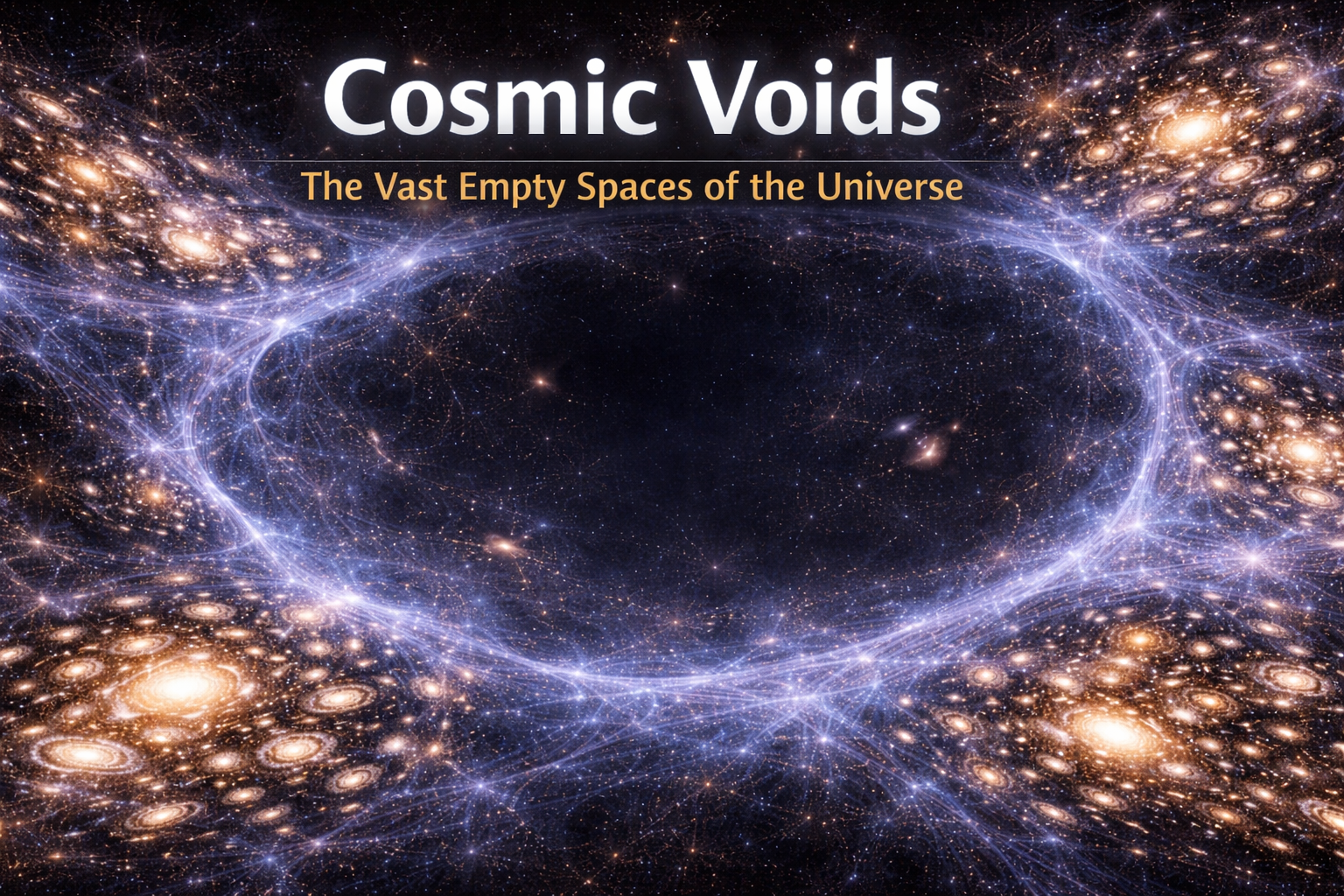
Cosmic Voids: When people imagine the universe, they often think of dazzling galaxies, glowing nebulae, and massive clusters of stars. Yet, some of the most important structures in the cosmos are not the bright, crowded regions—but the enormous empty ones.
These immense regions, known as cosmic voids, make up a significant portion of the universe and play a crucial role in shaping its large-scale structure.
Though they appear empty at first glance, cosmic voids are far from insignificant. They influence how galaxies form, how matter moves, and how the universe evolves over billions of years. This article explores what cosmic voids are, how they formed, their properties, and why they are essential to modern cosmology.
What Are Cosmic Voids?
Cosmic voids are vast regions of space with extremely low densities of galaxies and matter. Compared to galaxy clusters or filaments, voids contain very few galaxies—sometimes only a handful spread across millions of light-years.
Voids are not completely empty. They contain:
- Sparse galaxies
- Dark matter
- Low-density gas
- Dark energy effects
However, their matter density can be 10 to 100 times lower than the cosmic average, making them the emptiest known structures in the universe.
Size and Scale of Cosmic Voids
One of the biggest structures in the universe is the cosmic vacuum. Their sizes typically range from 20 million to over 300 million light-years in diameter. Some of the largest known voids span distances comparable to superclusters of galaxies.
Despite being “empty,” voids occupy most of the universe’s volume. While galaxies and clusters contain most of the universe’s matter, voids dominate its space.
Discovery of Cosmic Voids
The existence of cosmic voids was confirmed in the late 20th century through large galaxy surveys. When astronomers mapped the three-dimensional distribution of galaxies, they noticed enormous empty regions surrounded by dense walls and filaments of galaxies.
These observations revealed a sponge-like structure:
- Dense regions formed filaments and clusters
- Large gaps between them formed voids
This pattern became known as the cosmic web, with voids acting as the empty bubbles between the web’s strands.
How Cosmic Voids Formed
Origins in the Early Universe
Shortly after the Big Bang, matter was distributed almost uniformly, with small fluctuations in density. Over time:
- Slightly denser regions pulled in more matter
- Less dense regions lost matter to their surroundings
These underdense regions gradually expanded, becoming cosmic voids.
Expansion Over Time
As gravity pulled matter toward dense filaments and clusters, voids continued to grow larger and emptier. The expansion of the universe accelerated this process, stretching voids and making them increasingly dominant in volume.
In essence, voids are regions where gravity lost the competition for matter.
Structure of Cosmic Voids
Cosmic voids are not simple, spherical holes in space. They have complex shapes and internal structures.
Void Boundaries
Voids are surrounded by:
- Galaxy filaments
- Walls of galaxies
- Dense clusters
These boundaries form where matter accumulates after flowing out of voids.
Inside a Void
Within voids:
- Galaxies are rare and often isolated
- Galaxies tend to be smaller and gas-rich
- Star formation may continue longer due to fewer interactions
Voids provide some of the calmest environments for galaxy evolution.
Galaxies Inside Voids
Although voids are sparsely populated, they do contain galaxies known as void galaxies.
Characteristics of Void Galaxies
Void galaxies often:
- Are small and faint
- Have irregular or spiral shapes
- Contain abundant gas
- Experience fewer mergers
Because they live in isolation, void galaxies evolve slowly and preserve primitive features that may resemble early galaxies in the universe.
The Role of Dark Matter in Voids
Dark matter plays a crucial role even in the emptiest regions of space. While voids have less dark matter than average, it still exists in diffuse form.
Dark matter:
- Shapes void boundaries
- Influences galaxy motions
- Helps define the cosmic web structure
Studying dark matter in voids helps astronomers test theories about its nature and behavior.
Voids and Dark Energy
Cosmic voids are particularly valuable for studying dark energy, the mysterious force driving the accelerated expansion of the universe.
Because voids are dominated by space rather than matter:
- The effects of dark energy are more noticeable
- Voids expand faster than denser regions
- Their shapes and growth rates provide cosmological clues
Some scientists consider voids to be natural laboratories for understanding dark energy.
Cosmic Voids vs. Other Cosmic Structures
| Structure | Matter Density | Main Feature |
|---|---|---|
| Galaxy Clusters | Very high | Hundreds or thousands of galaxies |
| Galaxy Filaments | Moderate | Long, thread-like structures |
| Galaxy Walls | High | Flat, sheet-like structures |
| Cosmic Voids | Very low | Vast, empty regions |
Voids complete the cosmic web by occupying the space between all other large-scale structures.
Why Cosmic Voids Matter
Despite their emptiness, cosmic voids are extremely important in astronomy and cosmology.
1. Mapping the Universe’s Structure
Voids help define the shape and scale of the cosmic web. Without voids, the large-scale structure of the universe would not exist as we observe it.
2. Testing Cosmological Models
The size, shape, and distribution of voids match predictions made by modern cosmological simulations. Studying them helps confirm theories about:
- Dark matter
- Dark energy
- Gravity
3. Understanding Galaxy Evolution
By comparing galaxies in voids to those in dense clusters, astronomers can isolate the effects of environment on galaxy formation.
Observing Cosmic Voids
Detecting voids requires mapping enormous volumes of space. Astronomers use several methods:
Galaxy Redshift Surveys
These surveys measure galaxy positions and distances, revealing empty regions.
Gravitational Lensing
Void regions slightly distort background light, providing clues about mass distribution.
Computer Simulations
Simulations recreate void formation and evolution over billions of years.
Together, these tools allow scientists to study voids in remarkable detail.
The Largest Known Voids
Some cosmic voids are among the largest known structures in the universe. These supervoids can influence cosmic microwave background radiation and even affect how light travels across vast distances.
The existence of such enormous voids highlights the incredible scale and complexity of the universe.
The Future of Void Research
Future telescopes and surveys aim to:
- Discover smaller and more distant voids
- Study void evolution over cosmic time
- Measure dark energy effects with greater precision
- Understand matter distribution inside voids
As observational technology improves, cosmic voids will become increasingly important in solving fundamental cosmological mysteries.
Conclusion
Cosmic voids may seem like empty gaps in the universe, but they are essential components of the cosmic structure. These vast regions shape how matter is distributed, influence galaxy evolution, and provide unique insights into dark matter and dark energy.
By studying voids, astronomers gain a deeper understanding of how the universe formed, how it continues to evolve, and how its largest structures came into being. In the grand design of the cosmos, emptiness is just as important as abundance—and cosmic voids prove that even nothingness has a powerful role to play.