
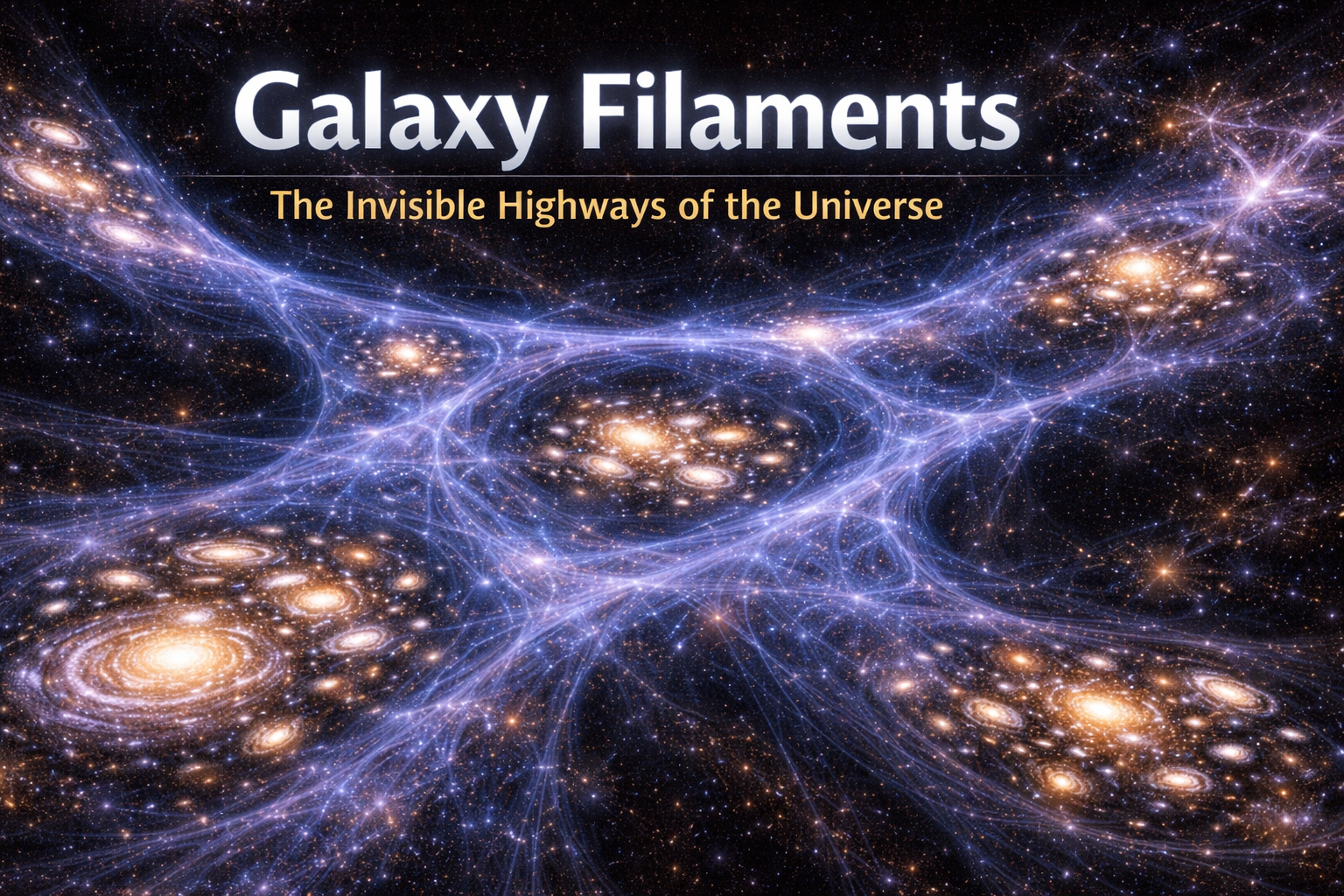
Galaxy Filaments: When astronomers first began mapping the large-scale structure of the universe, they expected to find galaxies scattered more or less evenly through space. Instead, they discovered something astonishing: galaxies are arranged in vast, interconnected patterns resembling threads, walls, and knots.
Among these structures, galaxy filaments stand out as the longest and most extensive formations in the cosmos. Often described as the “cosmic highways” of the universe, galaxy filaments connect galaxy clusters across immense distances and form the backbone of the cosmic web.
This article explores what galaxy filaments are, how they formed, their composition, their role in cosmic evolution, and why they are crucial to our understanding of the universe.
What Are Galaxy Filaments?
Galaxy filament’s are enormous, thread-like structures composed of galaxies, gas, and dark matter. They stretch across hundreds of millions of light-years, linking dense regions such as galaxy clusters and superclusters. Between these filaments lie vast empty regions known as cosmic voids, where very few galaxies exist.
Together, filaments, clusters, walls, and voids form a gigantic network called the cosmic web, which defines the large-scale structure of the universe.
Unlike individual galaxies or galaxy groups, filaments are not tightly bound objects. Instead, they are elongated regions where matter density is higher than average, shaped primarily by gravity and dark matter.
Discovery of Galaxy Filament’s
The existence of galaxy filament’s became evident in the late 20th century with large redshift surveys such as the CfA Redshift Survey and later the Sloan Digital Sky Survey (SDSS). These surveys mapped the three-dimensional positions of millions of galaxies, revealing a striking sponge-like pattern.
Rather than random distribution, galaxies formed:
- Long filaments
- Flat sheets (walls)
- Dense nodes (clusters)
- Large empty voids
This discovery fundamentally changed our understanding of cosmic structure and confirmed predictions made by cosmological simulations.
How Galaxy Filaments Formed
Origins in the Early Universe
Galaxy filaments trace their origins back to the early universe, shortly after the Big Bang. At that time, matter was distributed almost uniformly, with tiny density fluctuations.
Over billions of years:
- Slightly denser regions attracted more matter through gravity
- Dark matter collapsed first, forming a skeletal framework
- Ordinary matter (gas) followed this dark matter structure
- Galaxies formed along these dense pathways
The result was a vast network of filaments connecting massive concentrations of matter.
The Role of Dark Matter
Dark matter is the primary architect of galaxy filaments. Although invisible, it makes up most of the mass in filaments and determines their shape and evolution.
Key roles of dark matter in filaments include:
- Providing gravitational scaffolding
- Guiding the flow of gas and galaxies
- Connecting clusters over cosmic distances
Without dark matter, galaxy filaments as we observe them today would not exist.
Composition of Galaxy Filaments
Galaxy filaments are not made up of galaxies alone. They contain multiple components:
1. Galaxies
Filaments host a wide variety of galaxies, including spiral, elliptical, and irregular types. Galaxies within filaments tend to align along the filament’s direction, reflecting the flow of matter.
2. Gas
A significant fraction of the universe’s ordinary matter exists as warm-hot intergalactic medium (WHIM) within filaments. This gas is extremely diffuse and difficult to detect, but it plays a key role in galaxy formation.
3. Dark Matter
Dark matter dominates the mass of filaments and controls their gravitational influence.
Galaxy Filaments as Cosmic Highways
One of the most fascinating aspects of galaxy filaments is their role as transport channels for matter.
Matter Flow Along Filaments
Gas and galaxies flow along filaments toward dense regions like galaxy clusters. This process:
- Feeds clusters with fresh material
- Triggers galaxy mergers
- Sustains star formation
Clusters at filament intersections grow faster than isolated clusters because they receive matter from multiple directions.
Influence on Galaxy Evolution
The environment within a galaxy filament significantly affects how galaxies evolve.
Star Formation
Galaxies in filaments often show higher star formation rates than those in dense clusters but lower than completely isolated galaxies. Filaments provide a steady supply of gas without the extreme conditions found in clusters.
Galaxy Orientation
Studies show that galaxies tend to align their spins with the direction of the filament, suggesting that large-scale structure influences galaxy rotation.
Pre-processing of Galaxies
Before galaxies enter clusters, they often pass through filaments. During this phase, known as pre-processing, galaxies experience:
- Mild gravitational interactions
- Gradual gas loss
- Morphological changes
This means filaments shape galaxies even before they reach the most crowded environments.
Observing Galaxy Filaments
Detecting galaxy filaments is challenging due to their low density, but astronomers use several techniques:
1. Galaxy Surveys
Large-scale surveys map galaxy positions and reveal filamentary patterns.
2. Gravitational Lensing
Filaments bend light from distant galaxies, allowing astronomers to infer the presence of dark matter.
3. X-ray and Ultraviolet Observations
Hot gas in filaments emits faint radiation, helping detect the WHIM.
4. Computer Simulations
Cosmological simulations reproduce filamentary structures and help interpret observations.
The Largest Known Galaxy Filaments
Some galaxy filaments are among the largest known structures in the universe. They can extend over a billion light-years, challenging our understanding of cosmic scale.
These enormous structures demonstrate that the universe has order on scales far larger than individual galaxies or clusters.
Galaxy Filaments vs. Other Cosmic Structures
| Structure | Description |
|---|---|
| Galaxy Filaments | Long, thread-like structures connecting clusters |
| Galaxy Clusters | Dense collections of hundreds or thousands of galaxies |
| Galaxy Groups | Smaller collections of a few dozen galaxies |
| Cosmic Voids | Vast empty regions with very few galaxies |
Galaxy filaments act as bridges between clusters and surround cosmic voids, shaping the entire cosmic web.
Why Galaxy Filaments Matter
Galaxy filaments are crucial to astronomy and cosmology for several reasons:
Understanding the Universe’s Structure
They reveal how matter is distributed on the largest scales.
Testing Cosmological Models
The properties of filaments match predictions from the standard model of cosmology, supporting theories about dark matter and dark energy.
Locating Missing Matter
A large fraction of the universe’s ordinary matter is believed to reside in filaments, solving the long-standing “missing baryon” problem.
The Future of Filament Research
With next-generation telescopes and surveys, astronomers aim to:
- Map filaments in greater detail
- Measure gas temperature and composition
- Study filament evolution over cosmic time
- Understand the role of filaments in galaxy growth
As technology improves, galaxy filaments are expected to provide deeper insights into the fundamental forces shaping the universe.
Conclusion
Galaxy filaments are the unseen threads that hold the universe together. Stretching across unimaginable distances, they form the backbone of the cosmic web and guide the movement of galaxies, gas, and dark matter.
Far from being empty space, filaments are dynamic environments where galaxies grow, interact, and evolve. By studying galaxy filaments, astronomers gain a clearer picture of how the universe formed, how it continues to evolve, and how its largest structures came into existence.
In many ways, galaxy filaments are the universe’s grand design—silent, massive, and essential to the cosmic story.