
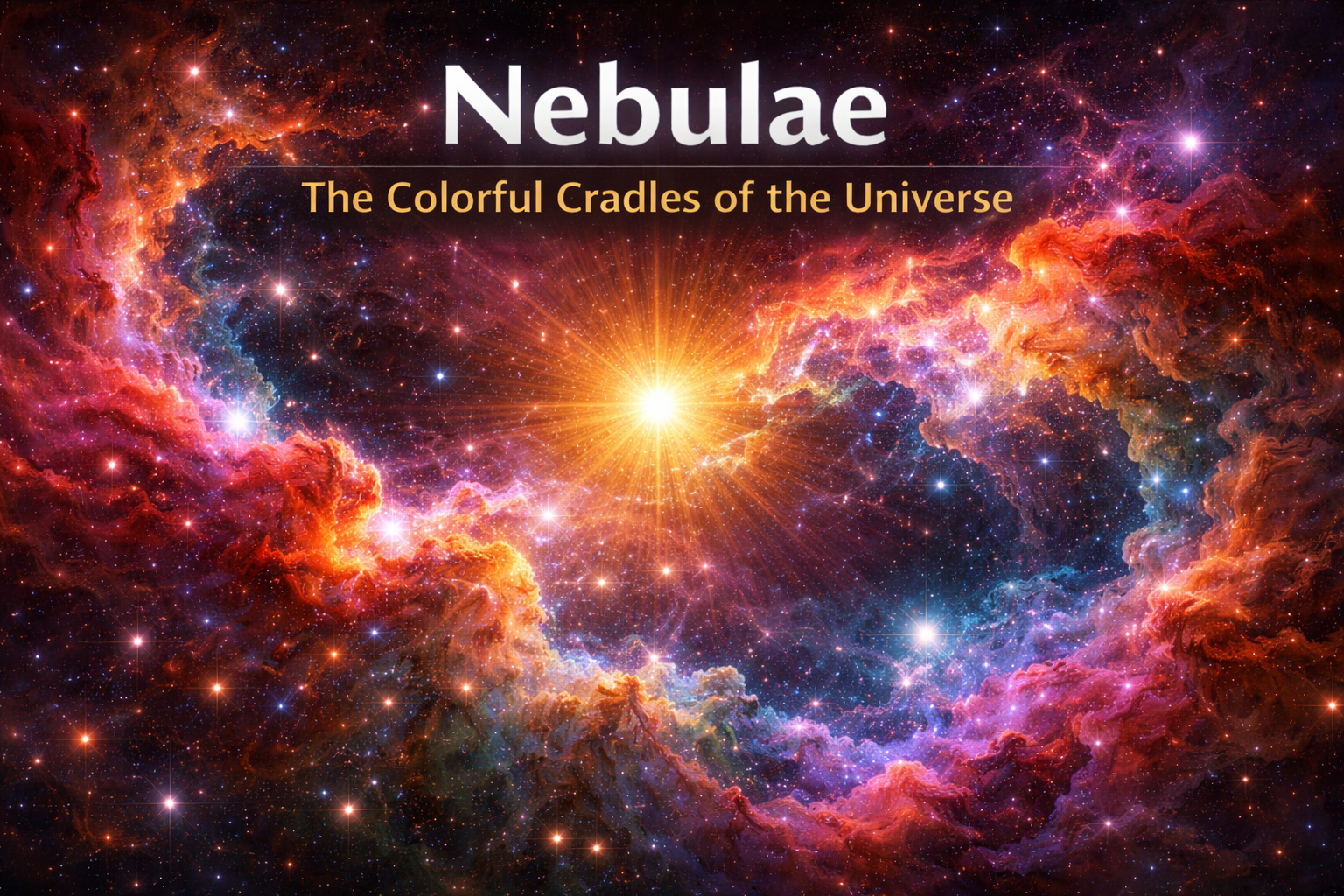
Among the most breathtaking objects in the cosmos are nebulae—vast clouds of gas and dust drifting through space. These magnificent formations glow in brilliant colors, stretch across light-years, and serve as both the birthplaces and graveyards of stars.
While nebulae may appear delicate and artistic through telescope images, they are powerful regions shaped by gravity, radiation, and stellar explosions.
They play a fundamental role in cosmic evolution. They are responsible for star formation, chemical enrichment of galaxies, and some of the most spectacular astronomical phenomena ever observed. In this article, we will explore what these are, how they form, their different types, and why they are essential to understanding the universe.
What Is a Nebula?
An enormous cloud of gas and dust in space is called a nebula (plural: nebulae). The word “nebula” comes from the Latin term for “cloud,” which accurately describes their appearance.
Nebulae are primarily composed of:
- Hydrogen (the most abundant element in the universe)
- Helium
- Trace amounts of heavier elements
- Microscopic dust particles
Although this may appear dense in photographs, they are extremely diffuse. Even the densest these are far less dense than the best vacuum chambers on Earth.
The Importance of Nebulae in the Universe
They are not merely beautiful cosmic decorations. They serve critical functions in the universe:
- Birthplaces of stars
- Remnants of dying stars
- Chemical factories for heavy elements
- Indicators of galactic evolution
Without nebulae, stars—and therefore planets and life—would not exist.
How This Form
Depending on their kind, this can originate in a variety of ways.
1. From Interstellar Gas Clouds
Large regions of space contain diffuse gas and dust known as the interstellar medium. When gravity pulls this material together, it forms giant molecular clouds, which can become this.
2. From Stellar Death
When stars reach the end of their lives, they often eject their outer layers into space. This expelled material forms glowing this that mark the final stage of stellar evolution.
3. From Supernova Explosions
In spectacular supernova explosions, massive stars die. The explosion blasts material outward, creating expanding these filled with heavy elements.
Types of Nebulae
this come in several distinct types, each with unique characteristics and origins.
1. Emission
Emission this glow brightly because nearby hot stars energize the gas within them. Ultraviolet radiation from these stars excites hydrogen atoms, causing them to emit visible light—often in shades of red or pink.
Usually, these they are areas where star production is active.
Characteristics:
- Bright and colorful
- Often reddish due to hydrogen emission
- Found in spiral arms of galaxies
2. Reflection Nebulae
Reflection they do not produce their own light. Instead, they reflect and scatter light from nearby stars.
They often appear blue because shorter blue wavelengths scatter more efficiently through dust particles.
Characteristics:
- Blue in appearance
- Found near young stars
- Do not emit radiation themselves
3. Dark Nebulae
Dense clouds of gas and dust that obscure light from things behind them are known as dark nebulae. Instead of glowing, they appear as dark patches against bright star fields.
Despite their ominous appearance, dark nebulae are often stellar nurseries where new stars are forming inside hidden regions.
Characteristics:
- Opaque and shadow-like
- Extremely dense compared to other nebulae
- Often associated with star formation
4. Planetary Nebulae
Planetary nebulae form when medium-sized stars (like the Sun) exhaust their nuclear fuel. The star sheds its outer layers, creating a glowing shell of gas around a hot core.
Planetary nebulae are not related to planets, despite their name. Early astronomers gave them this name because they appeared round and planet-like through small telescopes.
Characteristics:
- Symmetrical and often circular
- Created by dying stars
- Contain white dwarf cores
5. Supernova Remnants
Supernova remnants are formed after massive stars explode. These nebulae expand rapidly and contain elements such as iron, gold, and uranium created during the explosion.
They are among the universe’s most dynamic and active objects.
Characteristics:
- Expanding shock waves
- Complex filamentary structures
- Rich in heavy elements
Nebulae as Stellar Nurseries
One of the most important roles of this is star formation.
Inside dense molecular clouds:
- Gravity pulls gas and dust together
- Regions collapse into protostars
- Nuclear fusion begins
Over time, these new stars clear away surrounding gas with radiation and stellar winds.
This cycle of birth and dispersal ensures that galaxies continue producing stars for billions of years.
Chemical Enrichment of the Universe
These are responsible for spreading heavy elements throughout galaxies.
Inside stars, nuclear fusion produces elements heavier than hydrogen and helium. When stars die—especially in supernova explosions—these elements are expelled into space.
This enhanced material is used to produce stars and planets in future generations. Ancient nebulae previously contained the carbon in your body and the oxygen you breathe.
The Colors of Nebulae
The vibrant colors seen in these are not random. They depend on:
- The type of gas present
- The energy of nearby stars
- The interaction of light with dust
For example:
- Hydrogen emits red light
- Oxygen can glow green or blue
- Sulfur can produce reddish tones
These colors reveal important information about temperature, composition, and physical processes.
Nebulae and Galaxy Evolution
these are closely tied to the life cycle of galaxies.
In spiral galaxies:
- Star-forming nebulae are often found in spiral arms
- Supernova remnants distribute elements
- Gas clouds recycle material
Galaxies without sufficient gas eventually stop forming stars, leading to gradual aging.
Observing Nebulae
These can be observed using different wavelengths of light:
Optical Telescopes
Reveal glowing gas and dust.
Infrared Telescopes
See through dust to detect forming stars.
Radio Telescopes
Map cold molecular gas clouds.
X-ray Observations
Detect hot gas in supernova remnants.
Modern space telescopes have captured stunning images of these, allowing astronomers to study their structure and composition in extraordinary detail.
Nebulae and Human Inspiration
Throughout history, these have sparked imagination and artistic expression. Their dramatic shapes and brilliant colors have inspired:
- Science fiction
- Space art
- Scientific discovery
- Philosophical reflection
These remind us that the universe is dynamic and constantly evolving.
The Future of Nebula Research
With advanced telescopes and observatories, scientists continue to:
- Study star formation in greater detail
- Map chemical elements
- Understand dust behavior
- Examine early galaxy development
As technology improves, they will provide even deeper insights into cosmic history.
Conclusion
One of the universe’s most intriguing structures is a nebula. They are both beginnings and endings—cradles of newborn stars and remnants of stellar death. Through their gas and dust, these shape galaxies, create elements, and drive cosmic evolution.
Far from being empty clouds, nebulae are vibrant, active regions that reveal the universe’s life cycle. By studying them, astronomers uncover the processes that have shaped everything from distant galaxies to our own solar system.
In the grand cosmic story, nebulae are the pages where stars are written into existence—and where their final chapters are recorded in glowing light.