
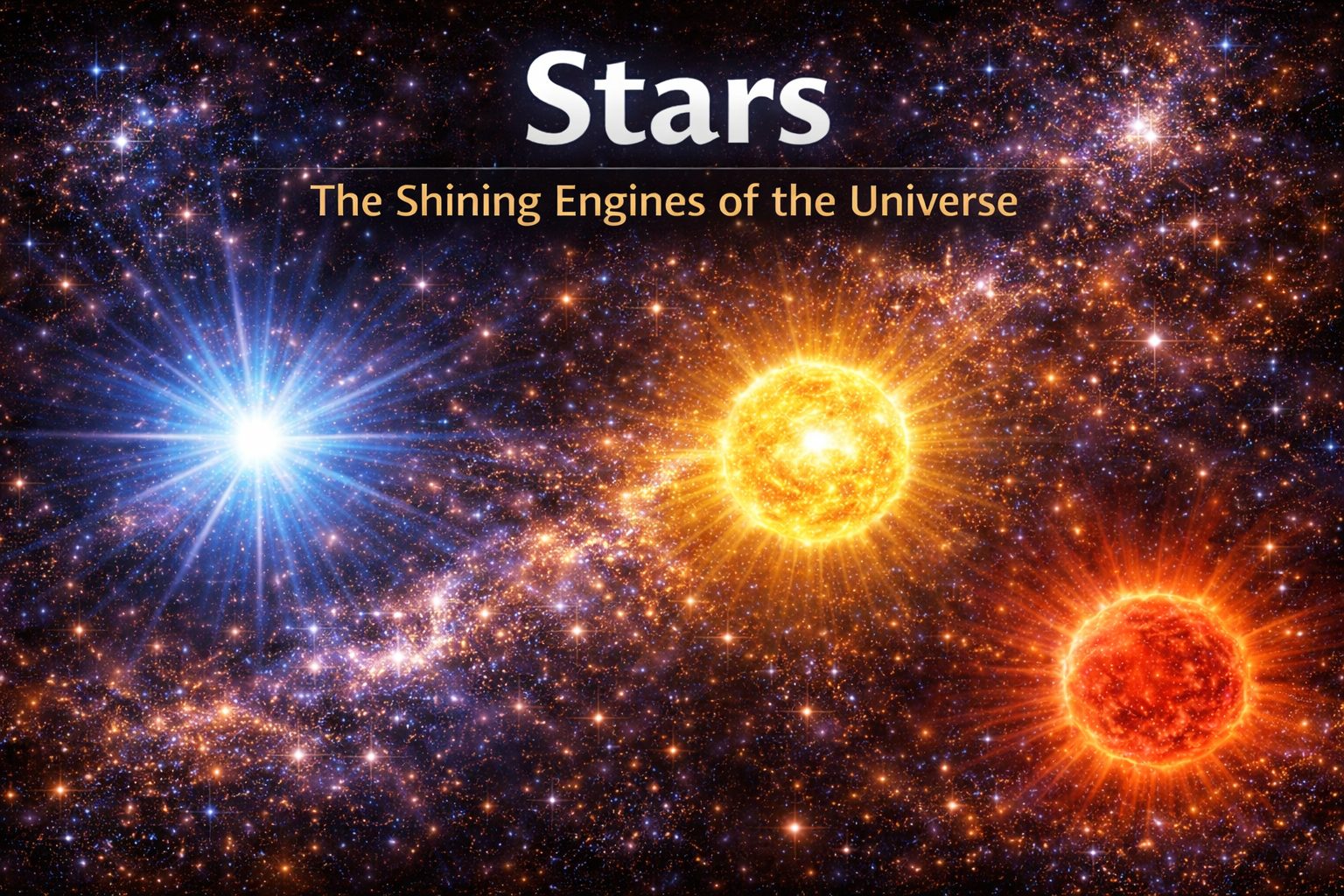
Stars: One of the universe’s most fundamental and interesting objects is the star. From the earliest human civilizations to modern space science, star’s have inspired curiosity, guided navigation, shaped calendars, and revealed the secrets of cosmic evolution.
Though they appear as tiny points of light in the night sky, star’s are massive, powerful spheres of energy that influence galaxies, planetary systems, and even the origin of life itself.
This article explores what star’s are, how they form, their life cycles, different types of star’s, and why they are essential to understanding the universe.
What Are Stars?
A star is a huge, bright ball of heated plasma that is held together by gravity. At its core, nuclear fusion converts hydrogen into helium, releasing enormous amounts of energy in the form of light and heat. This energy travels outward and radiates into space, making stars visible across vast cosmic distances.
Stars vary widely in:
- Size
- Temperature
- Color
- Mass
- Brightness
- Lifespan
Despite these differences, all star’s follow the same basic physical principles.
The Birth of Stars
Stellar Nurseries
Nebulae, also referred to as molecular clouds, are enormous clouds of gas and dust where stars are created. These regions are rich in hydrogen, the primary fuel for star’s.
Star formation begins when:
- A region of the cloud becomes denser than its surroundings
- Gravity causes the gas and particles to compress inward.
- A protostar is created as the collapsing material warms up.
As the protostar continues to gather mass, its core temperature rises dramatically.
Ignition of Nuclear Fusion
When the core temperature reaches about 10 million degrees Celsius, nuclear fusion begins. Hydrogen atoms fuse into helium, releasing energy. At this moment, a star is officially born.
The balance between:
- Gravity pulling inward, and
- Energy pushing outward
creates a stable star that can shine for millions or billions of years.
The Life Cycle of a Star
The life of a star depends primarily on its mass. Massive stars live fast and die young, while smaller star’s burn their fuel slowly and live far longer.
Main Sequence Stage
Most star’s, including our Sun, spend the majority of their lives in the main sequence stage. During this phase:
- Hydrogen fusion occurs in the core
- The star remains stable
- Light and heat are steadily produced
This stage can last from millions to trillions of years, depending on the star’s size.
How Star’s Die
When a star runs out of hydrogen fuel, its fate depends on its mass.
Low- and Medium-Mass Stars
Star’s similar in size to the Sun evolve into red giants as their cores contract and outer layers expand. Eventually:
- The outer layers drift away
- A glowing shell called a planetary nebula forms
- The core becomes a white dwarf
White dwarfs slowly cool over time, fading into darkness.
Massive Star’s
Very large stars undergo a much more dramatic end:
- They expand into red supergiants
- Their cores fuse heavier elements up to iron
- When fusion stops, the core collapses
This collapse triggers a powerful supernova explosion, briefly outshining entire galaxies.
After the explosion, the core becomes either:
- A neutron star, or
- A black hole
Types of Stars
Star’s come in many varieties, each with unique properties.
1. Red Dwarfs
- Small, cool, and dim
- Most common type of star
- Extremely long lifespans
- Burn fuel very slowly
Red dwarfs may live longer than the current age of the universe.
2. Yellow Dwarfs
- Medium-sized stars like the Sun
- Stable and long-lived
- Ideal environments for planetary systems
3. Blue Giants and Supergiants
- Extremely hot and massive
- Bright blue or white color
- Short lifespans
- End in violent supernovae
4. White Dwarfs
- Stellar remnants
- Very dense
- No longer undergoing fusion
5. Neutron Stars
- Ultra-dense stellar cores
- Can spin rapidly
- Often detected as pulsars
Color and Temperature of Stars
A star’s color reveals its surface temperature:
| Color | Temperature | Example |
|---|---|---|
| Blue | Very hot | Young massive stars |
| White | Hot | Bright main sequence stars |
| Yellow | Moderate | The Sun |
| Orange | Cooler | Aging stars |
| Red | Coolest | Red giants and dwarfs |
Despite appearing red, red stars are still incredibly hot by everyday standards.
Star’s and Chemical Elements
Star’s are cosmic factories that create the elements essential for life.
Stellar Fusion
Inside star’s:
- Hydrogen fuses into helium
- Heavier star’s fuse elements up to iron
Supernova Nucleosynthesis
During supernova explosions:
- The formation of heavy elements like uranium, silver, and gold
- These elements are scattered into space
Every atom of carbon, oxygen, and iron in your body was once forged inside a star.
Stars and Planetary Systems
Star’s are often surrounded by planets, asteroids, and comets. These form from leftover material after star formation.
The properties of a star determine:
- The number of planets
- Their orbits
- Potential habitability
Stable star’s with long lifespans are considered the best candidates for hosting life-bearing planets.
Stars as Distance Markers
Astronomers use stars to measure cosmic distances.
Standard Candles
Certain types of star’s have predictable brightness, allowing scientists to calculate how far away they are by measuring how bright they appear from Earth.
This method has helped map:
- The Milky Way
- Nearby galaxies
- The expanding universe
Stars in Human Culture
Star’s have played a vital role throughout human history.
Navigation and Timekeeping
- Ancient sailors used star’s for navigation
- Constellations marked seasons and agricultural cycles
Mythology and Art
Star’s appear in myths, religions, literature, and art across cultures, symbolizing:
- Destiny
- Hope
- Eternity
Even today, stars continue to inspire wonder and imagination.
The Study of Stars: Astronomy and Astrophysics
The scientific study of star’s, known as stellar astronomy, helps answer fundamental questions:
- How do star’s form and evolve?
- How do galaxies develop?
- How did the elements originate?
Modern telescopes and space observatories allow scientists to observe stars across the entire electromagnetic spectrum, from radio waves to gamma rays.
Why Stars Matter
Star’s are essential to the universe because they:
- Provide light and heat
- Create chemical elements
- Shape galaxies
- Enable planetary systems
- Make life possible
Without star’s, the universe would be a dark, lifeless place filled only with cold gas and dust.
Conclusion
Stars are much more than only far-off spots of light. They are powerful engines of creation, shaping the universe on every scale. From their dramatic births in stellar nurseries to their spectacular deaths as supernovae, star’s drive cosmic evolution and enrich space with the elements needed for planets and life.
As we continue to explore the cosmos, star’s remain our greatest teachers—revealing the past, illuminating the present, and guiding us toward a deeper understanding of the universe and our place within it.