
Contents
- 1 Introduction to Superclusters
- 2 What Are Superclusters?
- 3 Superclusters and the Cosmic Web
- 4 How Superclusters Formed
- 5 Famous Superclusters in the Universe
- 6 Laniakea Supercluster
- 7 Virgo Supercluster
- 8 Shapley Supercluster
- 9 Are Supercluster’s Gravitationally Bound?
- 10 Importance of Superclusters in Cosmology
- 11 Mapping the Universe
- 12 Testing Cosmological Models
- 13 Understanding Galaxy Evolution
- 14 Superclusters vs Galaxy Clusters
- 15 How Scientists Study Supercluster’s
- 16 The Future of Superclusters
- 17 Conclusion
- 18 FAQs
- 19 ❓ 1. What are supercluster’s in space?
- 20 ❓ 2. How do supercluster’s come into existence?
- 21 ❓ 3. Why do astronomers study superclusters?
- 22 ❓ 4. What exists inside a supercluster?
- 23 ❓ 5. How large can a supercluster be?
Introduction to Superclusters
Superclusters: The universe is vast beyond imagination, filled with billions of galaxies, each containing billions of stars. While individual galaxies are awe-inspiring, they are not isolated objects drifting alone in space. Galaxies group together under gravity to form clusters, and these clusters themselves assemble into even larger cosmic structures known as supercluster’s.
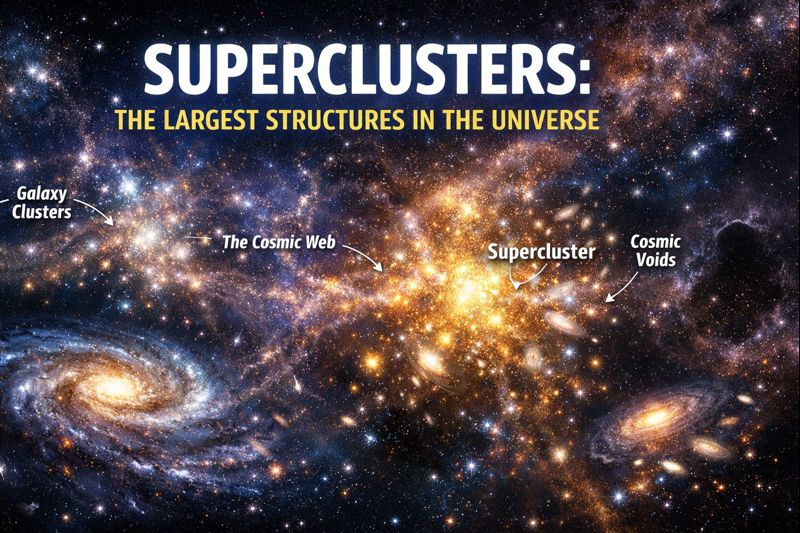
Superclusters are the largest known structures in the observable universe. They represent massive regions of space where galaxy clusters and galaxy groups are concentrated along immense filaments, separated by enormous cosmic voids. Studying superclusters helps astronomers understand the large-scale structure of the universe, the role of gravity, and the evolution of cosmic matter since the Big Bang.
What Are Superclusters?
A supercluster is a vast collection of galaxy clusters, galaxy groups, and individual galaxies bound together by gravity—though often only loosely. Unlike smaller galaxy clusters, supercluster’s are not always gravitationally stable systems. Some parts may still be expanding due to the ongoing expansion of the universe.
Key characteristics of superclusters include:
- Enormous size, often spanning hundreds of millions of light-years
- Contain thousands of galaxies
- Connected by filamentary structures of dark matter and gas
- Surrounded by large, empty regions called cosmic voids
Supercluster’s form the largest nodes in what scientists call the cosmic web, a vast network of matter that shapes the universe on its grandest scales.
Superclusters and the Cosmic Web
The universe is not randomly organized. On the largest scales, matter is arranged in a sponge-like or web-like pattern known as the cosmic web. This structure consists of:
- Filaments: Long, thread-like formations of galaxies and dark matter
- Nodes: Dense regions where filaments intersect (supercluster’s and galaxy clusters)
- Voids: Huge, nearly empty spaces with very few galaxies
Superclusters lie at the intersections of these filaments, acting as the densest regions in the cosmic web. This large-scale structure formed from tiny density fluctuations in the early universe, amplified over billions of years by gravity.
How Superclusters Formed
Origin After the Big Bang
Shortly after the Big Bang, the universe was nearly uniform, with slight variations in density. Over time, gravity caused denser regions to attract more matter, forming stars, galaxies, and eventually clusters of galaxies.
Role of Dark Matter
Dark matter plays a crucial role in supercluster formation. Although invisible, it makes up most of the universe’s mass and provides the gravitational framework upon which galaxies and clusters form. Supercluster’s trace massive concentrations of dark matter, revealing its large-scale distribution.
Ongoing Evolution
Unlike smaller gravitational systems, many supercluster’s are still evolving. Some are slowly collapsing, while others are being stretched apart by cosmic expansion driven by dark energy. This makes superclusters valuable laboratories for studying the balance between gravity and cosmic expansion.
Famous Superclusters in the Universe
Astronomers have identified several notable supercluster’s that help us understand the structure of the universe:
Laniakea Supercluster
Our home galaxy, the Milky Way, is part of a massive supercluster known as Laniakea, which contains over 100,000 galaxies. It spans roughly 520 million light-years and is defined by the motion of galaxies flowing toward a central gravitational region.
Virgo Supercluster
Previously thought to be our primary cosmic neighborhood, the Virgo Supercluster includes the Virgo Cluster and surrounding galaxy groups. It is now known to be a smaller component within the larger Laniakea Supercluster.
Shapley Supercluster
One of the most massive known structures in the nearby universe, the Shapley Supercluster exerts a strong gravitational influence on surrounding galaxies and plays a role in shaping local cosmic flows.
Are Supercluster’s Gravitationally Bound?
A key scientific question is whether supercluster’s are truly gravitationally bound structures. The answer is complex:
- Galaxy clusters within superclusters are usually gravitationally bound.
- Superclusters as a whole may not be fully bound due to dark energy driving cosmic expansion.
- Some dense cores of superclusters may eventually collapse, while outer regions drift apart.
This makes superclusters transitional structures between bound systems and the expanding universe.
Importance of Superclusters in Cosmology
Supercluster’s are more than just large collections of galaxies—they are essential tools for understanding the universe.
Mapping the Universe
By studying superclusters, astronomers can map the large-scale distribution of matter and better understand the geometry of the universe.
Testing Cosmological Models
The size, shape, and distribution of supercluster’s provide critical tests for cosmological theories, including:
- The Big Bang model
- Dark matter distribution
- Dark energy and cosmic acceleration
Understanding Galaxy Evolution
Galaxies inside superclusters experience different environments compared to isolated galaxies. Interactions, mergers, and gas dynamics within these dense regions influence how galaxies evolve over time.
Superclusters vs Galaxy Clusters
While often confused, supercluster’s and galaxy cluster’s are very different in scale and structure.
| Feature | Galaxy Cluster | Supercluster |
| Typical Size | 5–10 million light-years | 100–500 million light-years |
| Gravitational Binding | Strongly bound | Weakly or partially bound |
| Number of Galaxies | Hundreds to thousands | Thousands to tens of thousands |
| Role | Local structure | Large-scale cosmic structure |
This distinction highlights why supercluster’s represent the upper limit of known cosmic organization.
How Scientists Study Supercluster’s
Galaxy Surveys
Large astronomical surveys map the positions and motions of millions of galaxies, revealing supercluster structures across vast distances.
Redshift Measurements
By measuring galaxy redshifts, astronomers determine distances and trace how galaxies move within supercluster’s.
Computer Simulations
Cosmological simulations help scientists recreate the formation of superclusters from the early universe to the present, offering insights into future cosmic evolution.
The Future of Superclusters
As the universe continues to expand, dark energy will increasingly dominate over gravity. Over extremely long timescales:
- Supercluster’s will become more isolated
- Distant regions will move beyond the observable universe
- Only local, gravitationally bound structures will remain connected
Studying supercluster’s today allows scientists to capture a snapshot of the universe during a critical phase of its evolution.
Conclusion
Superclusters are the largest known structures in the universe, representing the pinnacle of cosmic organization. They connect galaxy clusters into vast networks shaped by gravity, dark matter, and the expansion of space itself. By studying supercluster’s, astronomers gain invaluable insights into the origin, structure, and ultimate fate of the universe.
From our place within the Laniakea Supercluster to the most distant cosmic structures ever observed, supercluster’s remind us that the universe is not only vast but also intricately connected on scales that challenge human imagination.
FAQs
❓ 1. What are supercluster’s in space?
Supercluster’s are enormous formations made up of multiple galaxy clusters connected across the universe.
❓ 2. How do supercluster’s come into existence?
They develop over billions of years as gravity pulls galaxy clusters into large interconnected regions.
❓ 3. Why do astronomers study superclusters?
Studying supercluster’s helps scientists understand the universe’s large-scale structure and evolution.
❓ 4. What exists inside a supercluster?
Supercluster’s contain clusters, galaxy groups, gas, and vast amounts of dark matter.
❓ 5. How large can a supercluster be?
Some supercluster’s extend for hundreds of millions of light-years, making them among the biggest known cosmic structures.