
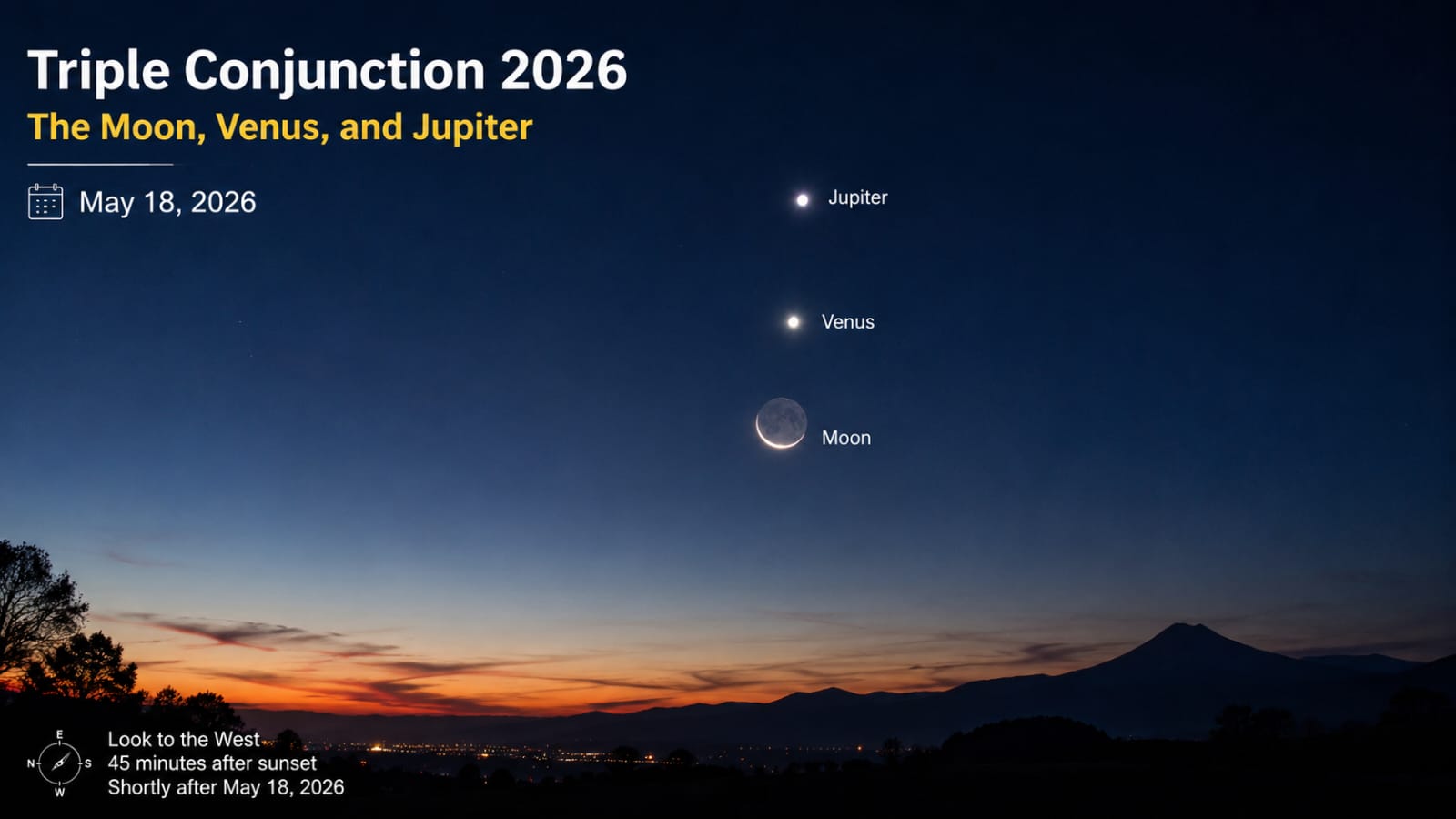
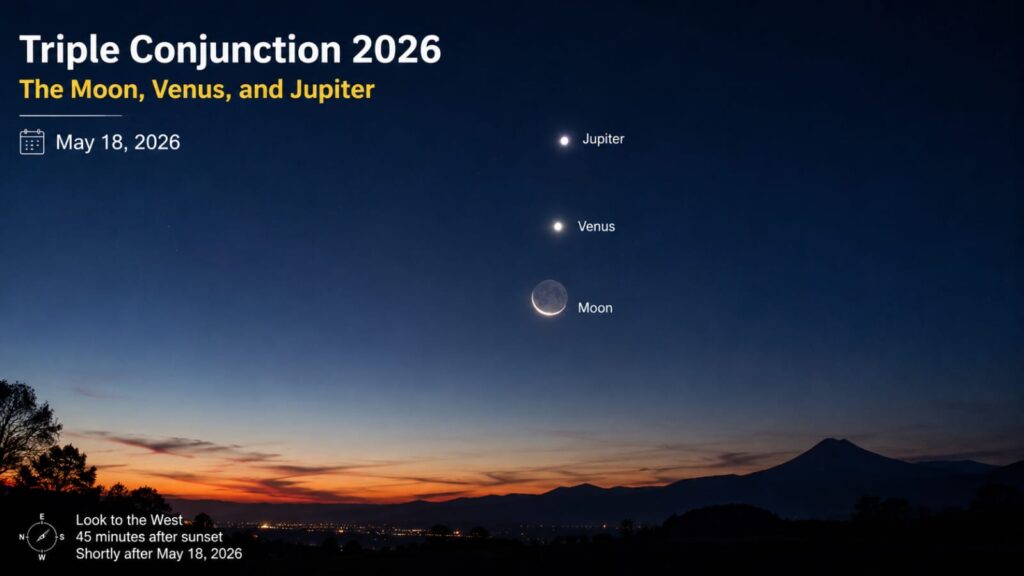
Triple Conjunction 2026: Skywatchers are in for a breathtaking celestial treat on May 18, 2026. Just after sunset, a delicate waxing crescent Moon will appear alongside dazzling Venus and giant Jupiter in a rare and beautiful alignment visible to the naked eye. This spectacular event, often called a triple conjunction, will create one of the most photogenic and memorable night-sky displays of the year.
Whether you are an astronomy enthusiast, a casual stargazer, or simply someone who enjoys natural wonders, this cosmic gathering is worth stepping outside for. The best part? You do not need expensive equipment or a telescope to enjoy it. With clear skies and a good view of the western horizon, anyone can witness this magical evening performance.
In this detailed guide, we will explore everything you need to know about the Moon-Venus-Jupiter conjunction of May 2026, including what causes it, when and where to watch, photography tips, scientific significance, and why events like this continue to inspire people around the world.
Contents
- 1 What Is Happening in the Sky on May 18, 2026?
- 2 Understanding a Triple Conjunction
- 3 Why This Sky Event Is Special
- 4 Best Time to Watch the Triple Conjunction
- 5 Where to Look
- 6 Can You See It Without a Telescope?
- 7 How to Photograph the Event
- 8 Why Venus Appears So Bright
- 9 Jupiter: The Giant of the Solar System
- 10 The Science Behind Planetary Alignments
- 11 The Role of the Constellation Gemini
- 12 Why Stargazing Events Matter
- 13 Tips for the Best Stargazing Experience
- 14 Will This Event Be Visible Worldwide?
- 15 Other Exciting Sky Events in 2026
- 16 Final Thoughts
- 17 FAQs
What Is Happening in the Sky on May 18, 2026?
On the evening of May 18, 2026, three bright celestial objects will appear close together in the constellation Gemini:
- A thin waxing crescent Moon
- Venus will glow brightly as the most visible planet in the evening sky.
- Jupiter, This is a big planet in our solar system and it will shine very brightly nearby.
This alignment will create a striking triangular pattern shortly after sunset. The bright Moon, Venus, and Jupiter will be easy to see, even from many city areas with moderate light pollution.
The event will occur low above the western horizon approximately 30 to 60 minutes after sunset. During this short viewing window, the sky will still hold traces of twilight, creating a beautiful backdrop for the glowing planets and crescent Moon.
Understanding a Triple Conjunction
In astronomy, a triple conjunction occurs when two or more celestial objects appear close to each other in the sky when viewed from Earth. Although these objects are actually separated by millions of kilometers in space, they seem near one another because of their positions along the ecliptic — the path the Sun, Moon, and planets follow across the sky.
In this case, the Moon, Venus, and Jupiter will form a rare visual grouping often referred to as a triple conjunction. Events involving Venus and Jupiter are already eye-catching because they are among the brightest planets visible from Earth. Adding a slender crescent Moon makes the scene even more spectacular.
These triple conjunctions are not extremely rare in astronomical terms, but particularly beautiful alignments involving the brightest planets and a young Moon do not happen often.
Why This Sky Event Is Special
1. Venus at Peak Brilliance
Venus will dominate the western sky as the brilliant “Evening Star.” It shines so brightly because:
- It is relatively close to Earth
- Its thick cloud cover reflects sunlight extremely well
During the triple conjunction, Venus will appear as a dazzling white beacon low in the twilight sky.
2. Jupiter’s Golden Glow
Jupiter will appear slightly higher nearby with its steady golden-white light. Unlike stars that twinkle, planets usually shine with a more constant glow because they appear as tiny disks through Earth’s atmosphere.
3. The Crescent Moon Adds Drama
The thin waxing crescent Moon will create the perfect centerpiece for the celestial gathering. The softly illuminated lunar crescent against the darkening twilight sky will make the entire alignment especially photogenic.
In some areas with very clear skies, viewers may also notice Earthshine — the faint glow illuminating the dark portion of the Moon caused by sunlight reflected from Earth.
Best Time to Watch the Triple Conjunction
Timing is important for enjoying this event.
Ideal Viewing Window
The best time to observe rare Triple Conjunction 2026 will be:
- About 30 to 60 minutes after sunset
- On May 18, 2026
During this period:
- The sky will be dark enough to clearly see Jupiter
- Venus will shine brilliantly
- The crescent Moon will remain visible before setting
If you wait too long, the objects will sink below the horizon.
Where to Look
To spot the conjunction successfully:
- Face the western horizon shortly after sunset
- Choose an area with an unobstructed horizon
- Avoid tall buildings, mountains, or trees blocking your view
The planets and Moon will appear relatively low in the sky, making a clear viewing direction very important.
Can You See It Without a Telescope?
Absolutely.
Best of all, you can enjoy this beautiful sky event without using a telescope or binoculars.
You can enjoy the triple conjunction with:
- Naked eyes
- Binoculars
- A small telescope
Even without optical aid, the event will be bright and easy to recognize.
However, binoculars can improve the experience by allowing viewers to see:
- The crescent shape of Venus
- Jupiter’s tiny moons
- Detailed lunar features on the Moon
How to Photograph the Event
This triple conjunction will offer excellent photography opportunities for both beginners and professionals.
Smartphone Photography Tips
Modern smartphones can capture the event surprisingly well if you:
- Use night mode
- Stabilize the phone with a tripod
- Tap on the Moon to focus
- Lower exposure slightly to avoid over-brightening Venus
DSLR or Mirrorless Camera Tips
For advanced photography:
- Use a tripod
- Choose a wide-angle lens for landscapes
- Use manual focus
- Experiment with exposure times between 1–5 seconds
Including foreground objects like trees, mountains, buildings, or lakes can create dramatic compositions.
Why Venus Appears So Bright
Venus is often mistaken for a UFO because of its intense brightness.
Here are a few reasons it shines so strongly:
Thick Reflective Clouds
Venus is covered in dense sulfuric acid clouds that reflect about 70% of incoming sunlight.
Proximity to Earth
Venus is one of Earth’s closest planetary neighbors, making it appear larger and brighter than most planets.
Position in the Sky
When Venus appears in the evening sky after sunset, it often becomes the brightest object after the Moon.
This is why Venus has earned nicknames like:
- Evening Star
- Morning Star
Despite these names, Venus is actually a planet, not a star.
Jupiter: The Giant of the Solar System
Some incredible facts about Jupiter include:
- Its size is said to be more than 1,300 times that of Earth.
- It has over 90 known moons
- This planet features a massive storm known as the ‘Great Red Spot,’ which is even larger in size than Earth.
Even though Jupiter is hundreds of millions of kilometers away, it remains one of the brightest objects in the night sky due to its enormous size.
During the rare triple conjunction, Jupiter’s calm glow will contrast beautifully with Venus’s intense brilliance.
The Science Behind Planetary Alignments
Planetary triple conjunctions happen because the planets orbit the Sun within roughly the same flat plane called the ecliptic plane.
As Earth moves around the Sun, our perspective changes constantly. Sometimes planets appear close together even though they are separated by vast distances in space.
For example:
- Venus may be around 100 million kilometers from Earth
- Jupiter could be more than 800 million kilometers away
Yet from our viewpoint, they can appear side by side in the sky.
The Role of the Constellation Gemini
The rare triple conjunction will take place in the constellation Gemini.
Gemini is one of the zodiac constellations and is famous for its two bright stars:
- Castor
- Pollux
In darker skies, observers may also spot these stars nearby, adding even more beauty to the celestial scene.
Gemini has been recognized since ancient times and represents “The Twins” in Greek mythology.
Why Stargazing Events Matter
Astronomical events like this conjunction do more than entertain skywatchers. They remind us of humanity’s deep connection to the cosmos.
Throughout history:
- Ancient civilizations tracked planetary movements
- Sailors navigated using stars
- Cultures built myths around celestial events
Even today, skywatching encourages curiosity, scientific learning, and appreciation for the universe.
Events visible to the naked eye are especially valuable because they make astronomy accessible to everyone.
Tips for the Best Stargazing Experience
To fully enjoy the conjunction, consider these tips:
1. Check the Weather Forecast
If the sky is cloudy, you won’t be able to see easily; therefore, go to a location where a clear sky is visible.
2. Arrive Early
Reach your viewing spot before sunset to get comfortable and locate the western horizon.
3. Reduce Light Pollution
If possible, move away from bright city lights for better visibility.
4. Bring Binoculars
While not necessary, binoculars can greatly enhance the experience.
Sky events are often more memorable when enjoyed with friends or family.
Will This Event Be Visible Worldwide?
Most regions around the world will be able to see the rare triple conjunction, though visibility will depend on:
- Weather conditions
- Local horizon visibility
- Sunset timing
People in the Northern Hemisphere may have especially favorable views, but viewers in many Southern Hemisphere regions can also enjoy the event.
Other Exciting Sky Events in 2026
The rare triple conjunction on May 18 is one of many amazing sky events to watch in 2026.
Skywatchers can also look forward to:
- Meteor showers
- Lunar eclipses
- Solar eclipses
- Supermoons
- Planetary alignments
Astronomy enthusiasts expect 2026 to be an excellent year for observing the night sky.
Final Thoughts
The Moon, Venus, and Jupiter alignment on May 18, 2026 is expected to be one of the most stunning celestial sights of the year. A glowing crescent Moon paired with the two brightest planets in the evening sky will create a scene that is both peaceful and awe-inspiring.
Because the event requires no telescope or special equipment, it offers a perfect opportunity for people of all ages to reconnect with the night sky. Whether you are watching from a city rooftop, a quiet countryside field, or your own backyard, the cosmic display is sure to leave a lasting impression.
So mark your calendar, find a clear western horizon, and prepare for a magical evening under the stars.
FAQs
1. When can I see the Moon, Venus, and Jupiter conjunction in 2026?
The rare triple conjunction will be visible on May 18, 2026, shortly after sunset.
2. What time is best for viewing the triple conjunction?
The best time to view the conjunction is around 30 to 60 minutes after sunset.
3. Do I need a telescope to see the rare triple conjunction?
No. The event will be clearly visible to the naked eye.
4. Where can I see them in the sky?
Look toward the western horizon after sunset.
5. By what name is Venus known?
Venus is called the Evening Star because it often appears as a bright object in the western sky after sunset, even though it is actually a planet.