
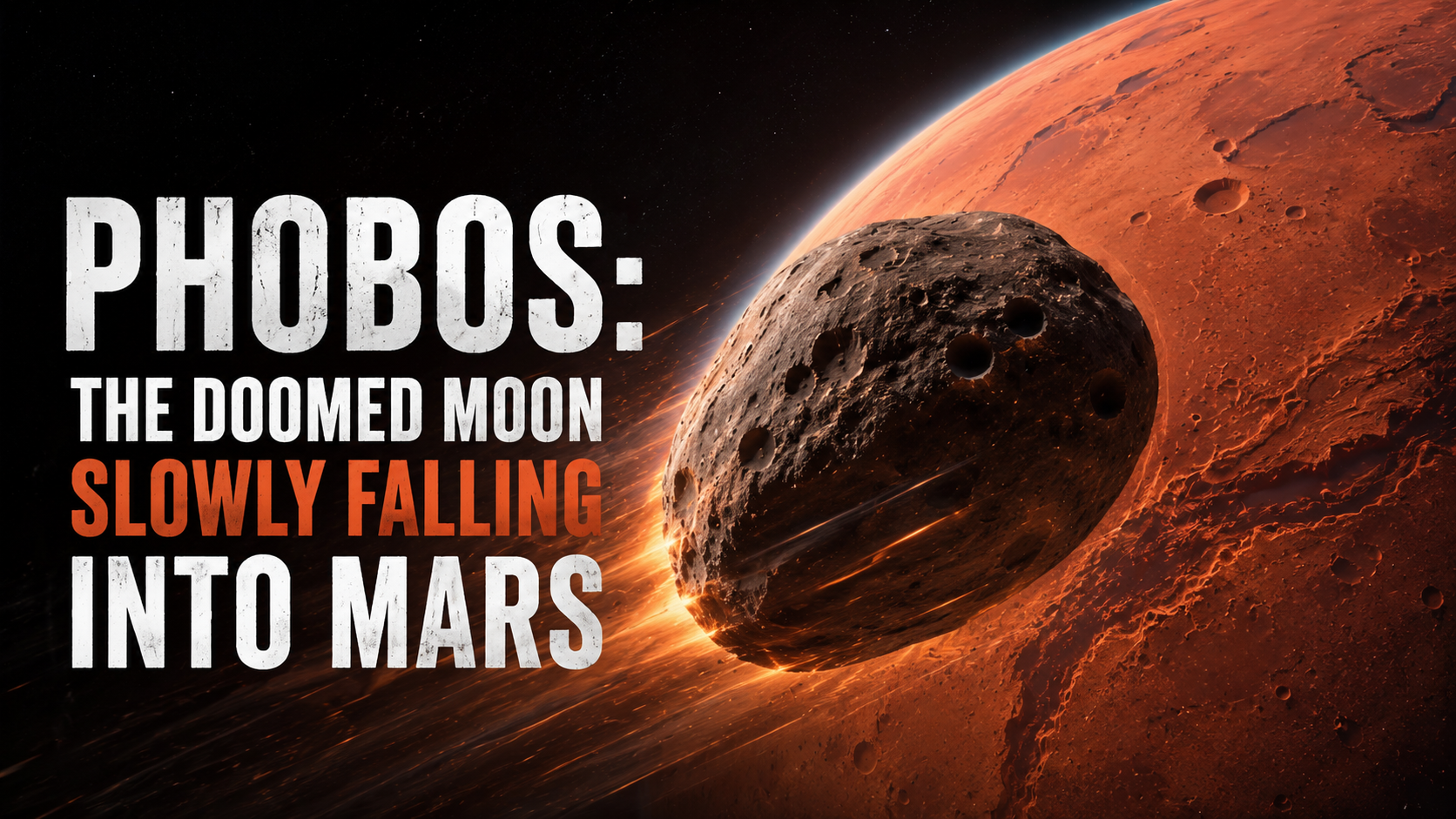
Phobos: In the vast and mysterious world of space, few objects are as strange and captivating as Phobos, the larger of the two moons orbiting Mars. Unlike the smooth, spherical moons we often imagine, Phobos is irregular, scarred, and fragile—a cosmic relic that tells a dramatic story of motion, gravity, and eventual destruction.
What makes Phobos even more fascinating is its inevitable fate. It is not just orbiting Mars—it is slowly spiraling toward it. And one day, millions of years from now, Mars will tear it apart.
Let’s explore everything about this unusual moon, from its appearance and orbit to the dramatic end that awaits it.
Contents
What Is Phobos?
Phobos is one of the two moons orbiting Mars, alongside its smaller companion Deimos. Discovered in “1877” by astronomer “Asaph Hall”, Phobos was named after the Greek god linked with fear and panic.

Unlike Earth’s Moon, Phobos is small and oddly shaped. It measures only about 22 kilometers across, making it more like a giant space rock than a typical moon.
Key Characteristics of Phobos:
- Mean radius: ~11 km
- Shape: Irregular and lumpy
- Surface: Heavily cratered with long grooves
- Gravity: Extremely weak
- Composition: Likely a mix of rock and porous material
Its rough, potato-like appearance suggests that it may not have formed like Earth’s Moon. Scientists believe it could be a captured asteroid or formed from debris after a collision.
A Moon Like No Other
Phobos stands out in the Solar System for several reasons. Its appearance alone is enough to set it apart—but its behavior is even more unusual.
1. Extremely Close Orbit

Phobos orbits Mars at a distance of just 6,000 kilometers above the planet’s surface. This is incredibly close compared to Earth’s Moon, which orbits at around 384,000 kilometers.

Because of this proximity:
- Phobos appears huge in the Martian sky
- It moves rapidly across the horizon
- From the surface of Mars, Phobos would appear huge as it races across the sky.
This makes Phobos the closest-orbiting moon of any planet in the Solar System.
2. A Rapid Orbit
Phobos circles Mars incredibly fast, completing one full orbit in only 7 hours and 39 minutes. That’s faster than Mars rotates on its axis.
This leads to a strange phenomenon:
👉 Phobos rises in the west and sets in the east, the opposite of what we see on Earth.
For a person standing on Mars, this would look incredibly unusual—watching a moon move backward across the sky.
3. A Scarred and Grooved Surface
The surface of Phobos is covered with:
- Massive craters
- Deep grooves stretching across its body
- Layers of dust and debris
The largest crater on Phobos is called Stickney crater, which alone is about 9 kilometers wide—nearly half the size of the moon itself.
Scientists believe the long grooves on Phobos may have formed because of:
- Past impacts
- Stress fractures from gravitational forces
- Internal structural weaknesses
All of this gives Phobos a fragile and fractured appearance.
Why Phobos Is Falling Toward Mars
Phobos is not in a stable orbit. Instead, it is slowly spiraling inward toward Mars due to tidal forces.
What Are Tidal Forces?
Tidal forces occur because of gravitational differences between two bodies. Mars pulls more strongly on the near side of Phobos than on its far side, creating stress within the moon.
Over time, this causes:
- Orbital decay
- Internal weakening
- Gradual movement toward Mars
Phobos is currently moving closer to Mars at a rate of about 1.8 centimeters per year.
The Inevitable Fate of Phobos


Phobos is on a slow but unstoppable path toward destruction.
What Will Happen?
Scientists predict that in about 30 to 50 million years, Phobos will reach a critical distance known as the Roche limit. At this point, Mars’ tidal forces will become too strong for the moon to hold itself together.
There are two possible outcomes:
1. It Breaks Apart
Phobos will likely be torn into pieces, forming a temporary ring system around Mars—similar to the rings of Saturn.
2. It Collides with Mars
Some fragments may eventually fall onto the Martian surface, creating massive impacts.
Most scientists believe the ring formation scenario is more likely.
How Phobos Compares to Earth’s Moon
| Feature | Phobos | Earth’s Moon |
|---|---|---|
| Distance from planet | ~6,000 km | ~384,000 km |
| Size | ~22 km | ~3,474 km |
| Shape | Irregular | Nearly spherical |
| Orbit time | 7h 39m | 27.3 days |
| Fate | Will be destroyed | Stable |
This comparison highlights just how unusual and fragile Phobos really is.
Exploration and Discoveries
Phobos has been studied by multiple space missions, including:
- Mars Express by the European Space Agency
- NASA orbiters observing Mars and its moons
A remarkable close-up image of Phobos was taken on March 26, 2010, by Mars Express, showing the moon’s rough surface, deep grooves, and giant craters in incredible detail.
Future missions aim to land on Phobos and collect samples, which could answer key questions about its origin.
Why Phobos Matters to Science
Phobos is more than just a small moon—it’s a scientific treasure.
It Helps Us Understand:
- The formation of planetary systems
- The behavior of tidal forces
- The evolution and destruction of moons
- Potential future ring formation around planets
Studying Phobos also helps scientists prepare for future human missions to Mars, as it could serve as a staging point for exploration.
A Glimpse Into the Future of Planets
Phobos gives us a rare opportunity to observe a moon in the process of orbital decay. While millions of years is a long time, in cosmic terms, this is relatively soon.
It reminds us that:
- Nothing in space is permanent
- Gravity shapes the destiny of celestial bodies
- Even moons can have dramatic endings
Conclusion
Phobos is one of the most fascinating objects in our Solar System—a small, battered moon locked in a slow dance with Mars that will ultimately lead to its destruction.
From its strange orbit and irregular shape to its inevitable breakup, Phobos tells a story of cosmic forces at work. It is a reminder that space is not static but constantly evolving.
One day, Mars may have rings formed from the remains of its own moon—a breathtaking transformation that future observers, millions of years from now, might witness.
FAQs About Phobos
1. What is Phobos made of?
Phobos is likely composed of rock mixed with porous material, possibly similar to carbon-rich asteroids.
2. Why does Phobos rise in the west?
Because it orbits Mars faster than the planet rotates, it appears to move backward across the sky.
3. How long will Phobos survive?
Scientists estimate it will be destroyed in about 30–50 million years.
4. Can humans land on Phobos?
Yes, its low gravity makes landing easier, and future missions may explore it.
5. Will Mars really have rings?
Most likely, yes. When Phobos breaks apart, it could form a temporary ring system around Mars.