
Contents
- 1 Introduction of Stephenson 2-18 vs the Sun
- 2 What Is Stephenson 2-18?
- 3 Understanding the Sun
- 4 Stephenson 2-18 vs The Sun: Size Comparison
- 5 Differences in Color and Temperature
- 6 Life Cycle: Stable vs Dying Star
- 7 Why Are Red Supergiants So Big?
- 8 What This Comparison Teaches Us
- 9 Could Stephenson 2-18 Affect Earth?
- 10 Final Thoughts
- 11 FAQs: Stephenson 2-18 vs The Sun
Introduction of Stephenson 2-18 vs the Sun
Stephenson 2-18 vs The Sun: When we look up at the sky, the Sun appears to be the most powerful and enormous object we can imagine. It lights up our world, controls our climate, and sustains life on Earth. But in the vast universe, our Sun is actually quite small compared to some of the giant stars out there. One of the most astonishing examples is Stephenson 2-18, one of the largest known stars ever discovered.
This comparison between Stephenson 2-18 vs the Sun reveals just how tiny our solar system really is. The difference in size, structure, and life cycle between these two stars is so extreme that it challenges our understanding of scale in the universe.
What Is Stephenson 2-18?
Stephenson 2-18 is a red supergiant star located thousands of light-years away from Earth. It belongs to a cluster of stars known as Stephenson 2, and it stands out due to its enormous size and brightness.
Here are some key facts about Stephenson 2-18 (Stephenson 2-18 vs the Sun):
- It is estimated to be over 2,000 times larger than the Sun in radius
- It is among the biggest stars ever discovered.
- It shines with a cool reddish glow, unlike the bright yellow-white light of our Sun.
Unlike stable stars, red supergiants like Stephenson 2-18 are nearing the end of their existence and may eventually explode as a supernova.
Understanding the Sun
The Sun is a yellow dwarf star located at the center of our solar system. While it may not be the biggest star in the universe, it is incredibly important to us.
Key characteristics of the Sun:
- Diameter: About 1.39 million kilometers
- Surface temperature: Around 5,500°C
- Age: Approximately 4.6 billion years
- Life stage: Stable main-sequence star
The Sun makes energy by joining hydrogen atoms to form helium. This process keeps it stable and shining steadily for billions of years.
Stephenson 2-18 vs The Sun: Size Comparison
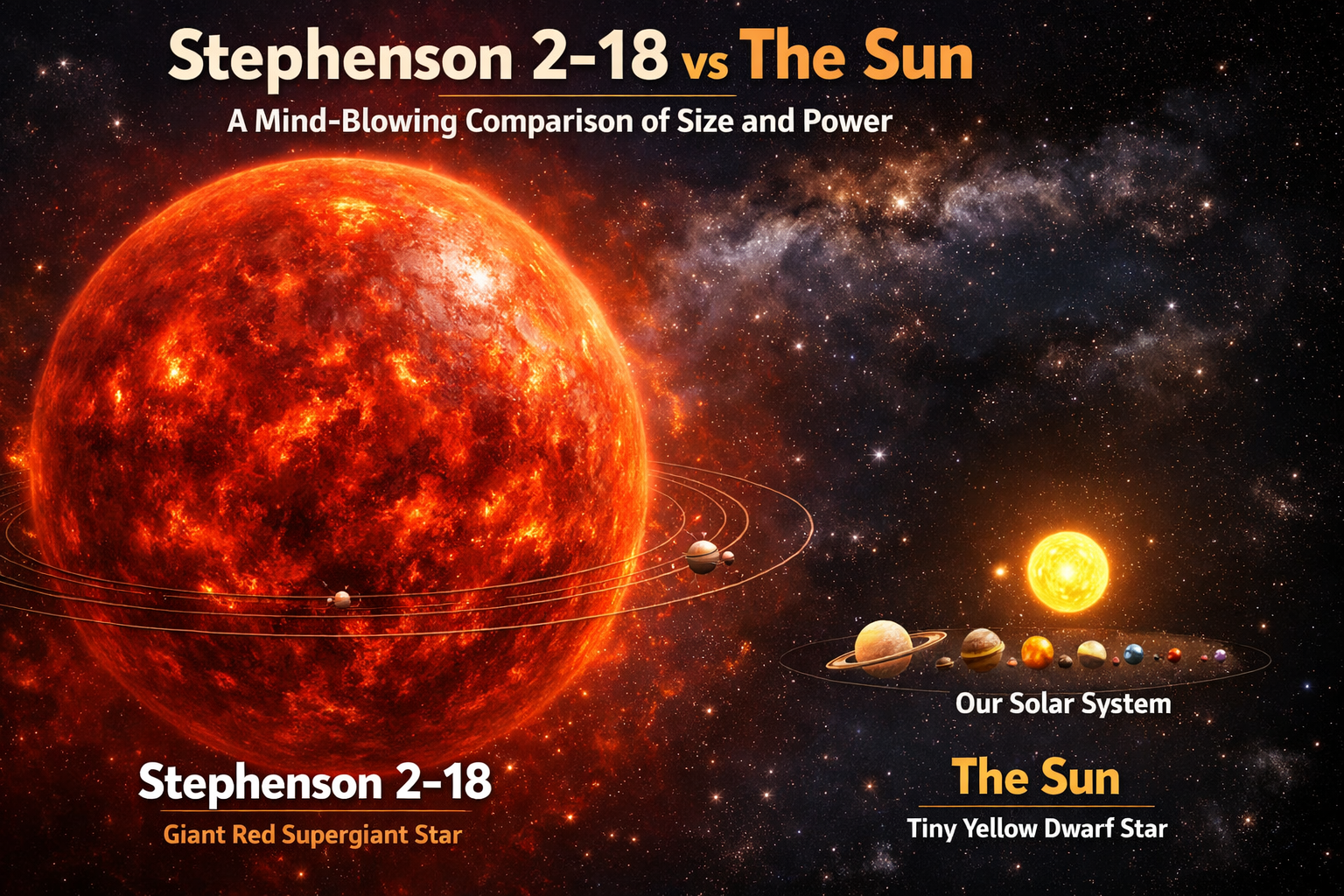
The most shocking difference between Stephenson 2-18 vs the Sun is their size.
If Stephenson 2-18 were placed at the center of our solar system instead of the Sun:
- It would be so massive that it would swallow Mercury, Venus, Earth, and Mars.
- It could extend beyond Jupiter’s orbit
- Some calculations show that it could extend nearly as far as Saturn’s orbit.
To put it simply, the Sun would appear as a tiny dot next to Stephenson 2-18.
Stephenson 2-18 vs the Sun Visualizing the Scale
Imagine placing the Sun next to Stephenson 2-18:
- The Sun would look like a grain of sand
- Stephenson 2-18 would be like a giant sphere filling most of the solar system
This comparison shows how incredibly vast and diverse stars in the universe can be.
Differences in Color and Temperature
Another major difference lies in their appearance and temperature.
The Sun:
- Color: Yellow-white
- Temperature: Extremely hot
- Emits strong visible and ultraviolet light
Stephenson 2-18:
- Color: Reddish
- Temperature: Much cooler than the Sun
- Emits more infrared radiation
Even though Stephenson 2-18 is cooler, it still appears very bright due to its massive size.
Life Cycle: Stable vs Dying Star
The Sun and Stephenson 2-18 are at very different stages of their life cycles.
The Sun’s Stage:
- Currently stable
- Has billions of years left
- In the far future, it will expand and turn into a red giant.
Stephenson 2-18’s Stage:
- Near the end of its life
- Already expanded into a red supergiant
- May explode as a supernova
This means Stephenson 2-18 is living its final chapter, while the Sun is still in its long, steady middle age.
Why Are Red Supergiants So Big?
Stars like Stephenson 2-18 grow extremely large due to changes happening in their core.
As a star runs out of hydrogen fuel:
- The core contracts
- The outer layers expand massively
- The star cools down and turns red
This expansion can make the star thousands of times larger than its original size, creating a red supergiant.
What This Comparison Teaches Us
The comparison between Stephenson 2-18 vs the Sun highlights some important truths about the universe:
1. The Universe Is Vast
Even our massive Sun is small compared to other stars.
2. Size Doesn’t Always Mean Hotter
Stephenson 2-18 is bigger but cooler than the Sun.
3. Stars Have Life Cycles
All stars are born, evolve, and eventually die.
4. Our Solar System Is Tiny
Compared to giant stars, our entire solar system is just a small region in space.
Could Stephenson 2-18 Affect Earth?
No, Stephenson 2-18 is located thousands of light-years away, so it has no direct impact on Earth.
Even if it explodes as a supernova:
- The distance is too great to harm us
- We might only see a bright light in the sky
So while it’s fascinating, it poses no danger to our planet.
Final Thoughts
The comparison of Stephenson 2-18 vs the Sun is truly mind-blowing. It reminds us that what seems enormous in our daily life is actually quite small on a cosmic scale.
Stephenson 2-18 vs the Sun: Stephenson 2-18, with its massive size and reddish glow, shows us the dramatic and powerful nature of stars nearing the end of their lives. Meanwhile, the Sun continues to shine steadily, supporting life on Earth.
This contrast not only deepens our understanding of stars but also inspires a sense of wonder about the universe we live in.
FAQs: Stephenson 2-18 vs The Sun
1. How big is Stephenson 2-18 compared to the Sun?
Stephenson 2-18 is estimated to be over 2,000 times larger in radius than the Sun, making it one of the largest known stars.
2. What would happen if Stephenson 2-18 replaced the Sun?
It would swallow the inner planets and extend beyond Jupiter, possibly reaching near Saturn, completely changing our solar system.
3. Is Stephenson 2-18 hotter than the Sun?
No, it is actually cooler than the Sun. Its reddish color comes from its lower surface temperature.
4. Will Stephenson 2-18 explode?
Yes, it is expected to end its life as a supernova, though this could happen thousands or millions of years from now.
5. Is Stephenson 2-18 dangerous to Earth?
No, it is extremely far away, so it poses no threat to Earth even if it explodes.