
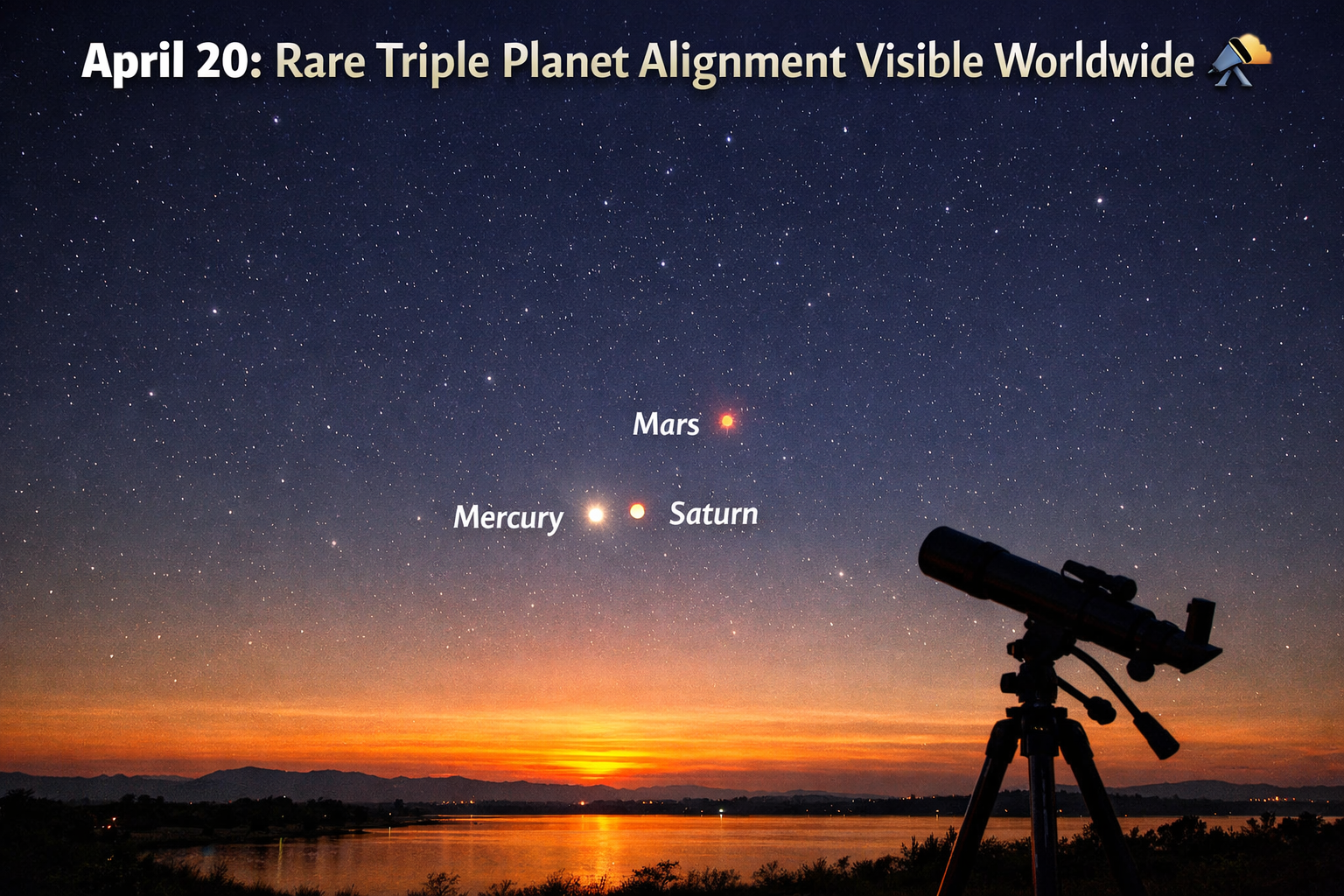
Set your alarm early—skywatchers are in for a special treat on April 20! A rare triple planetary alignment will bring Mercury, Mars, and Saturn close together in the predawn sky. This celestial event offers a stunning opportunity to witness three planets appearing side by side, even though they are separated by vast distances in space.
Whether you’re an astronomy enthusiast or just someone who loves beautiful sky views, this is a moment you won’t want to miss.
Contents
- 1 🌌 What Is a Triple Planet Alignment on April 20?
- 2 ✨ What You’ll See in the Sky on April 20
- 3 📍 Where to Look
- 4 ⏰ Best Viewing Times Around the World on April 20
- 5 🔭 Viewing Tips for the Best Experience
- 6 🌠 Why This Alignment Is Special
- 7 🌍 The Science Behind the Alignment
- 8 🌌 A Moment Worth Waking Up For
- 9 🌠 Final Thought:
- 10 ❓ FAQs About the April 20 Triple Planet Alignment
- 11 1. Can I see the triple planet alignment without a telescope?
- 12 2. What if I miss the exact time?
- 13 3. Why are the planets so close together?
- 14 4. Is this event visible worldwide?
- 15 5. When will a similar alignment happen again?
🌌 What Is a Triple Planet Alignment on April 20?
A triple planet alignment on April 20 occurs when three planets appear close to each other in the sky from Earth’s perspective. This doesn’t mean they are physically near one another in space—in fact, they remain millions or even billions of kilometers apart. Instead, it’s a line-of-sight effect, where their orbits align in such a way that they seem clustered together.
On April 20, this alignment becomes especially exciting because the planets will fit into a very small section of the sky, making the view both rare and visually striking.
✨ What You’ll See in the Sky on April 20
During this event, the three planets on April 20 will form a compact grouping that’s easy to spot under the right conditions:
- Mercury, with a brightness of -0.1 magnitude, will appear as the brightest among the three planets.
- Saturn (magnitude 0.9) will appear very close to Mercury—just 0°27′ apart, which is less than the width of a full Moon
- Mars (magnitude 1.2) will sit nearby, about 1°39′ away from Mercury
This creates a beautiful triangular arrangement of planets on April 20, all visible within a small patch of the sky.
📍 Where to Look
To spot the alignment, look toward the eastern horizon just before sunrise. The planets will be located in or near the constellation Cetus.
Because the planets will appear quite low in the sky, it’s important to find a location with:
- A clear and unobstructed horizon (no buildings, trees, or hills)
- Minimal light pollution for better visibility
⏰ Best Viewing Times Around the World on April 20
Timing is crucial for catching this event. The planets will only be visible for a short window before sunrise washes them out on April 20.
Here are the approximate viewing times:
- 🌏 India (IST): 4:45 AM – 5:30 AM
- 🌍 UTC: 23:15 – 00:00
- 🇬🇧 UK (BST): 12:15 AM – 1:00 AM
- 🇺🇸 Eastern Time (EDT): 1:15 AM – 2:00 AM
- 🇺🇸 Pacific Time (PDT): 10:15 PM – 11:00 PM (April 19)
- 🇦🇺 Australia (AEST): 9:15 AM – 10:00 AM (daylight may limit visibility)
For best results, start observing early within your local time window.
🔭 Viewing Tips for the Best Experience
To fully enjoy this rare sky event, keep the following tips in mind:
👀 1. Use Your Naked Eye First
All three planets are visible without any special equipment. Under clear skies, you should be able to spot them easily.
🔍 2. Bring Binoculars
While not required, binoculars can significantly enhance the experience—especially for spotting Saturn more clearly.
🌅 3. Start Early
The biggest challenge is the rising Sun. As dawn approaches, the sky brightens quickly, making the planets harder to see.
🌄 4. Choose the Right Location
Head to a place with a flat horizon—like an open field or rooftop—to avoid obstructions.
📸 5. Try Astrophotography
If you enjoy photography, this is a great chance to capture a rare alignment on April 20. For clearer photos, place your camera on a stable tripod and use longer exposure times.
🌠 Why This Alignment Is Special
Planetary alignments on April 20, 2026 happen from time to time, but tight groupings like this are relatively uncommon—especially involving bright planets visible to the naked eye.
What makes this event particularly fascinating is:
- The extremely close proximity between Mercury and Saturn
- Mars adds a beautiful touch to the scene with its distinct reddish color, creating a striking contrast.
- The fact that all three planets are visible in a single field of view
It’s a powerful reminder of how dynamic and interconnected our solar system is.
🌍 The Science Behind the Alignment
Every planet travels around the Sun at its own unique speed and distance:
- Mercury takes only about 88 days to complete one full orbit around the Sun.
- Mars takes about 687 days
- Saturn takes nearly 29.5 years
Since each planet moves at a different pace around the Sun, alignments like this happen only when they briefly appear lined up from Earth’s point of view.
This alignment is not a physical clustering but a visual coincidence—a cosmic illusion created by orbital geometry.
🌌 A Moment Worth Waking Up For
Imagine standing under the early morning sky, watching three distant worlds appear side by side. These planets, separated by unimaginable distances, come together for a brief moment in our sky.
It’s not just a visual spectacle—it’s a humbling reminder of the vastness and beauty of the universe.
So set your alarm, find a good viewing spot, and take a few quiet moments to look up. You might just witness one of the most beautiful celestial events of the year.
🌠 Final Thought:
Three planets on April 20, 2026, billions of kilometers apart, appearing together in a tiny patch of sky—this is the magic of astronomy. Don’t miss your chance to witness this rare and beautiful cosmic alignment!
❓ FAQs About the April 20 Triple Planet Alignment
1. Can I see the triple planet alignment without a telescope?
Yes, the alignment is visible to the naked eye. However, binoculars can improve the view, especially for Saturn.
2. What if I miss the exact time?
You may still catch the planets slightly before or after the peak window, but visibility drops quickly as the Sun rises.
3. Why are the planets so close together?
They only appear close due to Earth’s viewing angle. In reality, they remain far apart in space.
4. Is this event visible worldwide?
Yes, most parts of the world can see it, but exact timing and visibility depend on local weather and horizon conditions.
5. When will a similar alignment happen again?
While planetary alignments occur periodically, tight groupings like this are less frequent. It may take months or even years for a similar to appear again.