
Every Second, inside the Sun Converts 600 Million Tons of Hydrogen Into Energy
Inside the Sun: The Sun is far more than just a bright object in our sky—it is the ultimate source of energy that makes life possible on Earth. Every second, deep within its core, an extraordinary process unfolds: around 600 million tons of hydrogen are transformed into energy through nuclear fusion.
This incredible reaction powers everything we experience—from sunlight and warmth to weather patterns and the very existence of life itself. So, how exactly does this powerful process happen, and why does it matter so much for life on Earth? Let’s explore in detail.
Contents
- 1 What Happens Inside the Sun Every Second?
- 2 Understanding Nuclear Fusion in Simple Terms
- 3 Why This Energy Matters for Earth
- 4 Inside the Sun: The Powerhouse Driving Our Solar System
- 5 How Long Can the Sun Keep This Up?
- 6 The Journey of Energy: From Core to Earth
- 7 Why Scientists Study the Sun
- 8 Fun Facts About the Sun
- 9 Conclusion
- 10 FAQs
What Happens Inside the Sun Every Second?
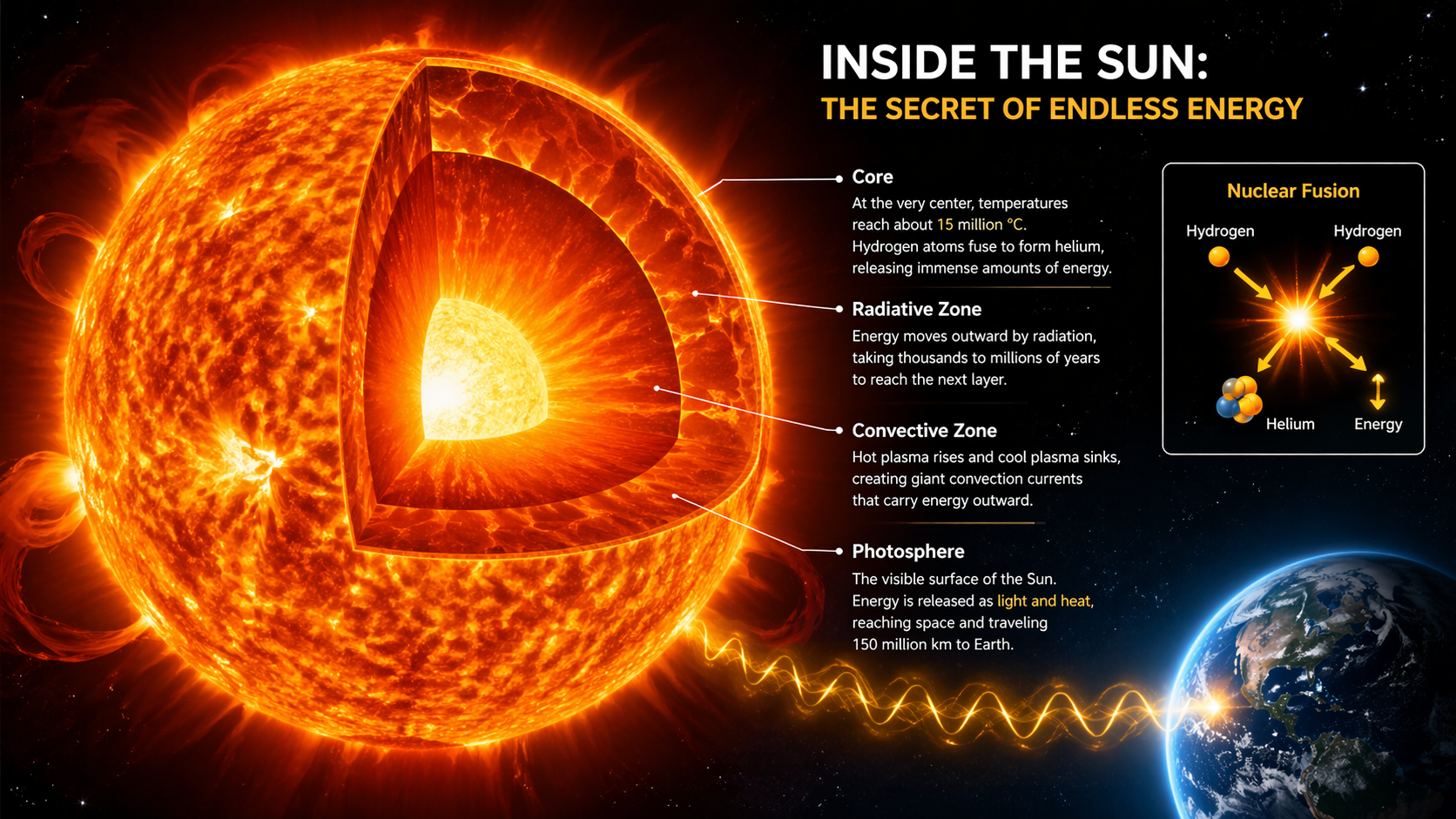
At the heart of inside the Sun lies its core, where temperatures reach about 15 million degrees Celsius and pressures are unimaginably high. Under these extreme conditions, hydrogen atoms are forced so close together that they fuse.
During this process:
- Hydrogen nuclei combine to form helium.
- A small amount of mass is lost.
- The small amount of mass that disappears during fusion is transformed into energy, following Einstein’s famous mass–energy principle (E = mc²).
Every second:
- 600 million tons of hydrogen are used.
- About 596 million tons become helium.
- The remaining 4 million tons are converted into pure energy.
This energy radiates outward from the core and eventually reaches the surface, where it is released as sunlight and heat.
Understanding Nuclear Fusion in Simple Terms
Nuclear fusion is the opposite of nuclear fission (used in nuclear power plants).
Here’s a simple way to understand it:
- Think of hydrogen atoms as tiny building blocks.
- Under intense heat and pressure, they merge.
- When they merge, they release energy—an enormous amount.
This process is incredibly efficient. Even a small amount of mass can produce a massive amount of energy, which is why inside the Sun can shine continuously for billions of years.
Why This Energy Matters for Earth
The energy produced by inside the Sun doesn’t stay in space—it travels about 150 million kilometers to reach Earth. This energy supports life in several essential ways:
1. Provides Light and Heat
Without sunlight, Earth would be a frozen, lifeless planet. The Sun maintains temperatures that allow water to remain liquid—a key requirement for life.
2. Drives Weather and Climate
Solar energy powers wind, ocean currents, and weather systems. It is the main force behind Earth’s climate.
3. Supports Photosynthesis
Plants rely on sunlight to create their own food through the process of photosynthesis, forming the foundation of life on Earth. This process forms the base of the entire food chain.
4. Enables Renewable Energy
Solar panels harness the Sun’s rays and transform them into electricity, offering a renewable and eco-friendly energy solution.
Inside the Sun: The Powerhouse Driving Our Solar System
The Sun is often described as the “engine” of the solar system, and for good reason.
- Its gravity holds planets in orbit.
- Its energy drives planetary environments.
- Its radiation shapes atmospheres and space weather.
Without the Sun, our solar system would not exist as we know it, as its gravity and energy are essential for maintaining balance and structure. It is the central force that keeps everything in balance.
How Long Can the Sun Keep This Up?
You might wonder—if the Sun is burning so much hydrogen every second, will it run out soon?
The answer is no, not anytime soon.
- The Sun is estimated to be around 4.6 billion years old, making it a mature and stable star in our galaxy.
- The Sun still holds a vast reserve of hydrogen, giving it enough fuel to continue shining for approximately another 5 billion years.
Eventually, it will expand into a red giant and undergo major changes, but for now, it remains stable and life-sustaining.
The Journey of Energy: From Core to Earth
The energy produced deep inside the Sun’s core does not travel to Earth immediately; it takes a long journey before finally reaching us as sunlight. It goes through a long journey:
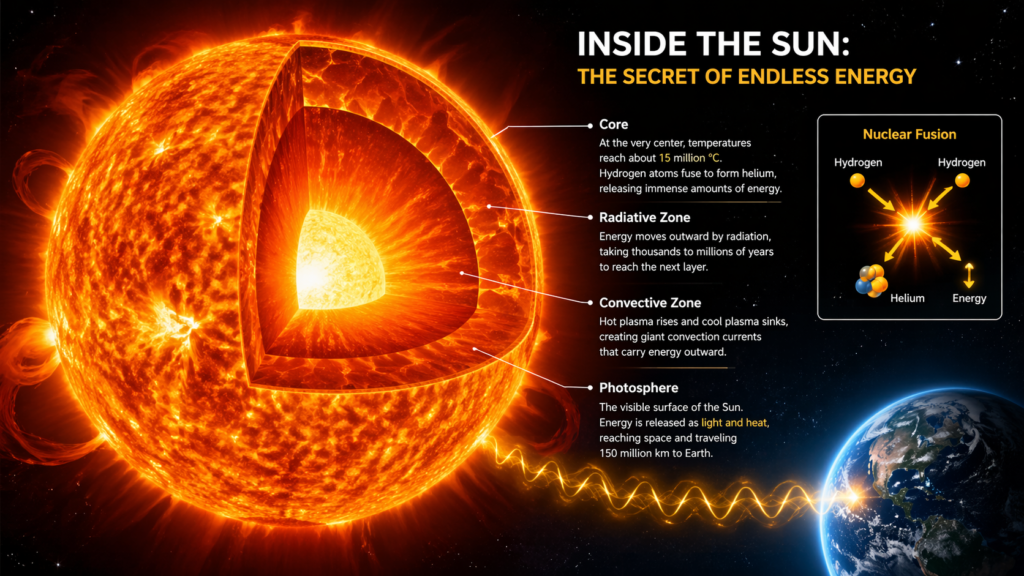
- Core – Fusion produces energy.
- Radiative Zone – Energy slowly moves outward, taking thousands to millions of years.
- Convective Zone – Hot plasma rises and falls, carrying energy to the surface.
- Photosphere – Energy is released as light.
- Space Travel – Sunlight reaches Earth in about 8 minutes and 20 seconds.
This journey highlights just how vast and complex the Sun truly is.
Why Scientists Study the Sun
Understanding how the Sun works is key for many important reasons:
- Studying the Sun helps scientists forecast solar storms, which can disrupt satellites, communication systems, and power grids on Earth.
- Improving renewable energy technologies.
- Learning about other stars in the universe.
- Exploring the origins of life and planetary systems.
Inside The Sun also acts as a natural testing ground for extreme physics, allowing researchers to explore how matter and energy behave under intense heat and pressure.
Fun Facts About the Sun
- In fact, the Sun dominates our solar system, containing an incredible 99.86% of its total mass.
- To put its size into perspective, the Sun is roughly 109 times larger in diameter than Earth, highlighting its scale and power.
- Sunlight reaches Earth in approximately 8 minutes and 20 seconds.
- The Sun’s surface temperature is about 5,500°C, while its core is much hotter.
Conclusion
Inside the Sun: Every second, inside the Sun performs a powerful transformation—turning 600 million tons of hydrogen into energy. This ongoing energy production supports nearly every aspect of life, from the oxygen we breathe to the food we consume each day.
The Sun is not just a distant star—it is the lifeline of our planet and the engine of our solar system. By understanding the Sun’s immense power, we gain a deeper appreciation for the fragile balance that allows life on Earth to thrive.
FAQs
1. What is nuclear fusion Inside the Sun?
Nuclear fusion is the process where hydrogen atoms combine to form helium under extreme heat and pressure, releasing vast amounts of energy.
2. How much hydrogen does inside the Sun use every second?
The Sun uses about 600 million tons of hydrogen every second, converting most of it into helium and energy.
3. How long will the Sun continue to shine?
The Sun has enough fuel to keep shining for about 5 billion more years.
4. How does the Sun’s energy reach Earth?
Energy travels from the Sun’s core to its surface and then through space, reaching Earth in about 8 minutes and 20 seconds.
5. Why is the Sun important for life on Earth?
The Sun provides light, heat, and energy necessary for photosynthesis, weather systems, and sustaining all forms of life.