
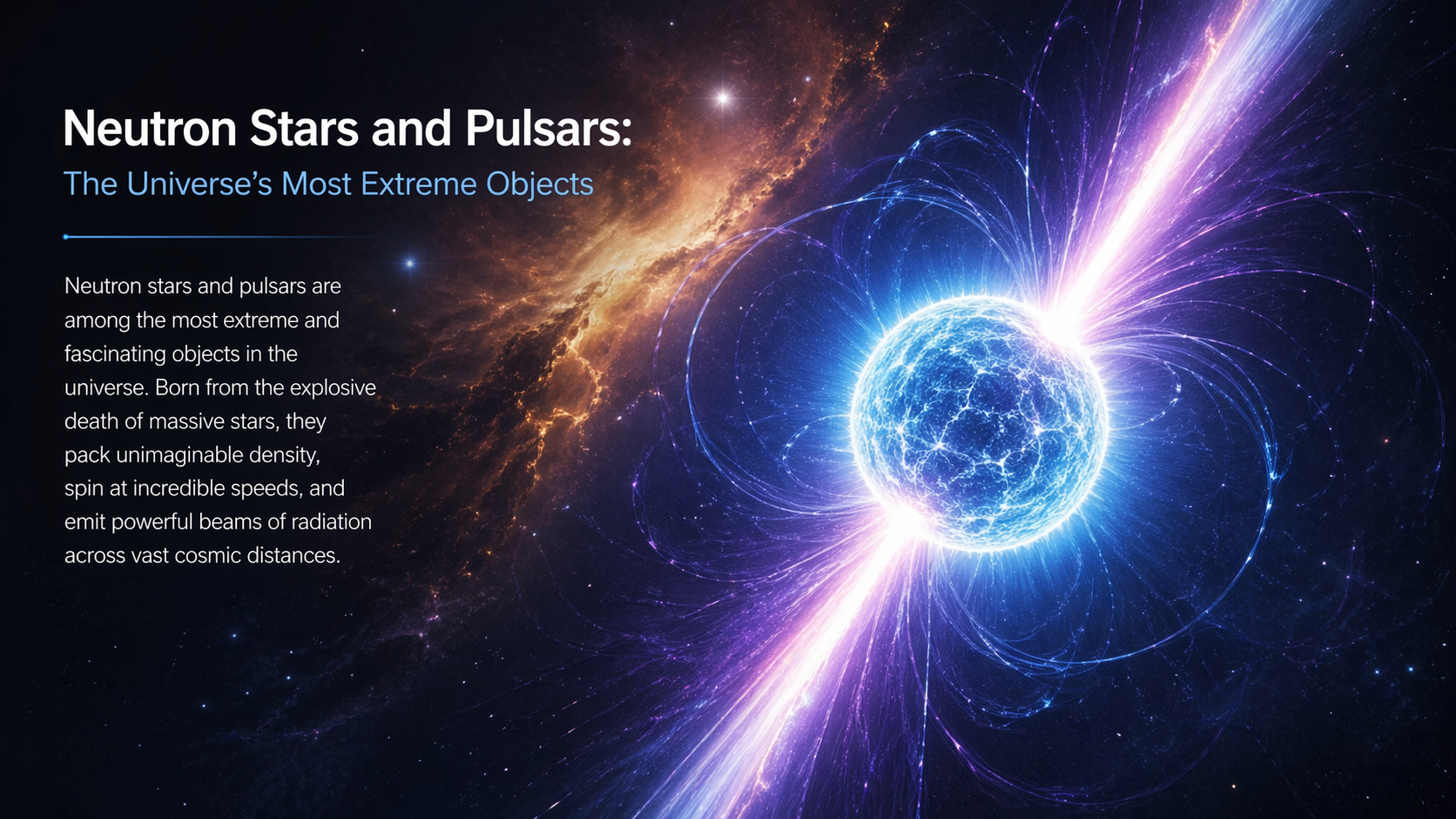
Neutron Stars and Pulsars: The universe is full of fascinating and mysterious objects, but few are as extraordinary as neutron stars and pulsars. These cosmic remnants are the result of massive stellar explosions and represent some of the densest, fastest-spinning, and most powerful objects known to science.
In this article, we’ll explore what neutron stars and pulsars are, how they form, their unique properties, and why they are so important in modern astronomy.
Contents
- 1 What Is a Neutron Star?
- 2 How Do Neutron Stars Form?
- 3 What Is a Pulsar?
- 4 Unique Features of Pulsars
- 5 Types of Pulsars
- 6 Neutron Stars and Pulsars: What’s the Difference?
- 7 Why Are Neutron Stars Important?
- 8 Pulsars and Modern Astronomy
- 9 Extreme Phenomena Associated with Neutron Stars
- 10 Can Humans Visit a Neutron Stars and Pulsars?
- 11 Fun Facts About Neutron Stars and Pulsars
- 12 Conclusion
- 13 FAQs About Neutron Stars and Pulsars
What Is a Neutron Star?
A neutron stars forms when the core of a massive star collapses after a powerful supernova explosion. Once a star significantly larger than our Sun exhausts its nuclear fuel, it can no longer resist its own gravity, leading to an intense inward collapse. As a result, its core collapses under immense pressure.
During this collapse, protons and electrons combine to form neutrons, creating an incredibly dense object composed almost entirely of neutrons.
Key Characteristics of Neutron Stars
- Incredible Density: A neutron star contains more mass than our Sun compressed into a sphere roughly 20 kilometers in diameter, making it one of the densest objects in the universe. The density of a neutron star is beyond imagination—just a single teaspoon of its material would weigh billions of tons on Earth.
- Small Size: Despite their massive weight, neutron stars are incredibly compact.
- Strong Gravity: Their gravitational pull is so intense that it significantly bends space and time around them.
- Rapid Rotation: Newly formed neutron stars can spin several times per second.
How Do Neutron Stars Form?
Neutron stars are born from massive stars, typically those with at least 8 times the mass of the Sun.
Formation Process
- Stellar Evolution
The star burns nuclear fuel in its core, producing energy that balances gravity. - Fuel Depletion
Once the fuel runs out, the outward pressure drops. - Core Collapse
Gravity causes the core to collapse rapidly. - Supernova Explosion
The outer layers of the star explode outward in a powerful supernova. - Neutron Star Creation
The remaining core compresses into a neutron star.
This entire process happens in a matter of seconds but releases enormous energy, often outshining entire galaxies for a brief period.
What Is a Pulsar?
A pulsar is a highly magnetized, rapidly spinning neutron star that releases focused beams of electromagnetic radiation from its magnetic poles, creating detectable pulses as it rotates. As these compact stars spin rapidly, they emit narrow beams of radiation that sweep across space like a cosmic lighthouse. If one of these beams crosses Earth, it appears as a regular pulse of radiation—hence the name “pulsar.”
Pulsars are often compared to cosmic lighthouses because of this sweeping beam effect.
Unique Features of Pulsars
1. Precise Pulses
Pulsars rotate with incredible stability, making their pulses extremely regular. Some pulsars are so accurate that they rival atomic clocks.
2. Strong Magnetic Fields
Pulsars have magnetic fields trillions of times stronger than Earth’s. These fields accelerate particles and produce intense radiation.
3. High-Speed Rotation
Some pulsars, called millisecond pulsars, can spin hundreds of times per second.
4. Energy Emission
They emit radiation across multiple wavelengths, including radio waves, X-rays, and gamma rays.
Types of Pulsars
1. Radio Pulsars
These are the most common and are detected using radio telescopes.
2. X-ray Pulsars
Found in binary systems, these pulsars emit strong X-rays as they pull matter from a companion star.
3. Millisecond Pulsars
Old neutron stars that have been “spun up” by accreting matter from a nearby star, resulting in extremely rapid rotation.
Neutron Stars and Pulsars: What’s the Difference?
Neutron Stars and Pulsars: It’s important to note that although every pulsar is a neutron star, not every neutron star produces pulsar-like signals.
Neutron Stars and Pulsars – Difference
| Feature | Neutron Star | Pulsar |
|---|---|---|
| Definition | Dense stellar remnant | Rotating neutron star emitting beams |
| Visibility | May be hard to detect | Easily detected via pulses |
| Rotation | Fast | Very fast and stable |
| Radiation | May emit weak radiation | Emits strong, regular signals |
Why Are Neutron Stars Important?
Neutron stars help scientists understand physics under extreme conditions that cannot be replicated on Earth.
1. Testing Theories of Gravity
Their strong gravitational fields allow researchers to test Einstein’s theory of relativity.
2. Understanding Matter
They provide insight into how matter behaves at nuclear densities.
3. Cosmic Laboratories
Neutron stars act as natural laboratories for studying fundamental physics.
Pulsars and Modern Astronomy
Pulsars have become essential tools in astronomy and astrophysics.
Their predictable signals can be used for spacecraft navigation.
2. Detecting Gravitational Waves
Arrays of pulsars help scientists detect ripples in spacetime caused by massive cosmic events.
3. Mapping the Galaxy
Pulsars help measure distances and map the structure of the Milky Way.
Extreme Phenomena Associated with Neutron Stars
Neutron stars are involved in some of the most violent events in the universe.
1. Magnetars
A type of neutron star with extremely powerful magnetic fields, capable of releasing massive bursts of energy.
2. Starquakes
Crustal shifts on neutron stars can release huge amounts of energy, similar to earthquakes but far more powerful.
3. Binary Mergers
When two neutron stars collide, they produce gravitational waves and heavy elements like gold and platinum.
Can Humans Visit a Neutron Stars and Pulsars?
The idea of visiting a neutron stars and Pulsars is purely theoretical and currently impossible.
The conditions near a neutron stars and Pulsars are extremely hostile:
- Intense radiation
- Crushing gravity
- Extreme temperatures
Even getting close would be fatal due to tidal forces that would stretch and tear objects apart.
Fun Facts About Neutron Stars and Pulsars
- A neutron star can spin up to 700 times per second.
- Pulsars were first discovered in 1967.
- Many neutron stars exist in binary systems, orbiting closely with another star and often interacting with it.
- They can have “mountains” only a few millimeters high due to strong gravity.
- Neutron stars are among the final stages of stellar evolution.
Conclusion
Neutron stars and pulsars rank among the most intriguing and extreme objects in the universe, capturing the interest of astronomers worldwide. Born from the explosive deaths of massive stars, they push the limits of physics with their extreme density, rapid rotation, and powerful magnetic fields.
While neutron stars and Pulsars represent the dense remnants of stellar cores, pulsars add an extra layer of intrigue with their rhythmic signals that can be detected across vast cosmic distances.
Researching neutron stars and Pulsars extraordinary objects not only deepens our understanding of how stars evolve and die but also provides valuable insights into the fundamental laws that govern the universe. As technology advances, scientists will continue to uncover more secrets about neutron stars and Pulsars incredible cosmic phenomena.
FAQs About Neutron Stars and Pulsars
1. What is the main difference between a neutron stars and pulsar?
A neutron star is a dense stellar remnant, while a pulsar is a rotating neutron star that emits beams of radiation detected as pulses.
2. How fast can a pulsar spin?
Some pulsars, known as millisecond pulsars, can spin over 700 times per second.
3. Are neutron stars dangerous?
Yes, their intense gravity and radiation make them extremely dangerous and uninhabitable.
4. How are pulsars detected?
Pulsars are detected using radio telescopes that pick up their regular pulses of radiation.
5. Can neutron stars collide?
Yes, when two neutron stars merge, they create powerful explosions and gravitational waves, contributing to the formation of heavy elements.