
Planetary systems are among the most fascinating structures in the universe. They include stars, planets, moons, asteroids, comets, and other celestial objects bound together by gravity. Our own Solar System is just one example, but astronomers have discovered thousands of planetary systems across the galaxy—each with unique characteristics and surprising features.
In this SEO-friendly and easy-to-read guide, we’ll explore what planetary systems are, how they form, their different types, and why they are so important in understanding the universe.
Contents
- 1 What Is a Planetary System?
- 2 How Do Planetary Systems Form?
- 3 Components of a Planetary System
- 4 Types of Planetary Systems
- 5 Exoplanets: Worlds Beyond Our Solar System
- 6 The Role of Gravity in Planetary Systems
- 7 Why Are Planetary Systems Important?
- 8 Habitable Zones: Where Life Might Exist
- 9 Challenges in Studying Planetary Systems
- 10 Future of Planetary System Research
- 11 Fun Facts About Planetary Systems
- 12 Conclusion
- 13 FAQs About Planetary Systems
What Is a Planetary System?
A planetary system is a group of celestial bodies that orbit a central star. These systems typically include planets, natural satellites (moons), dwarf planets, asteroids, and comets, all held together by the gravitational pull of the star.
The most well-known example is our Solar System, which consists of the Sun and everything that orbits it, including Earth and seven other major planets.
How Do Planetary Systems Form?
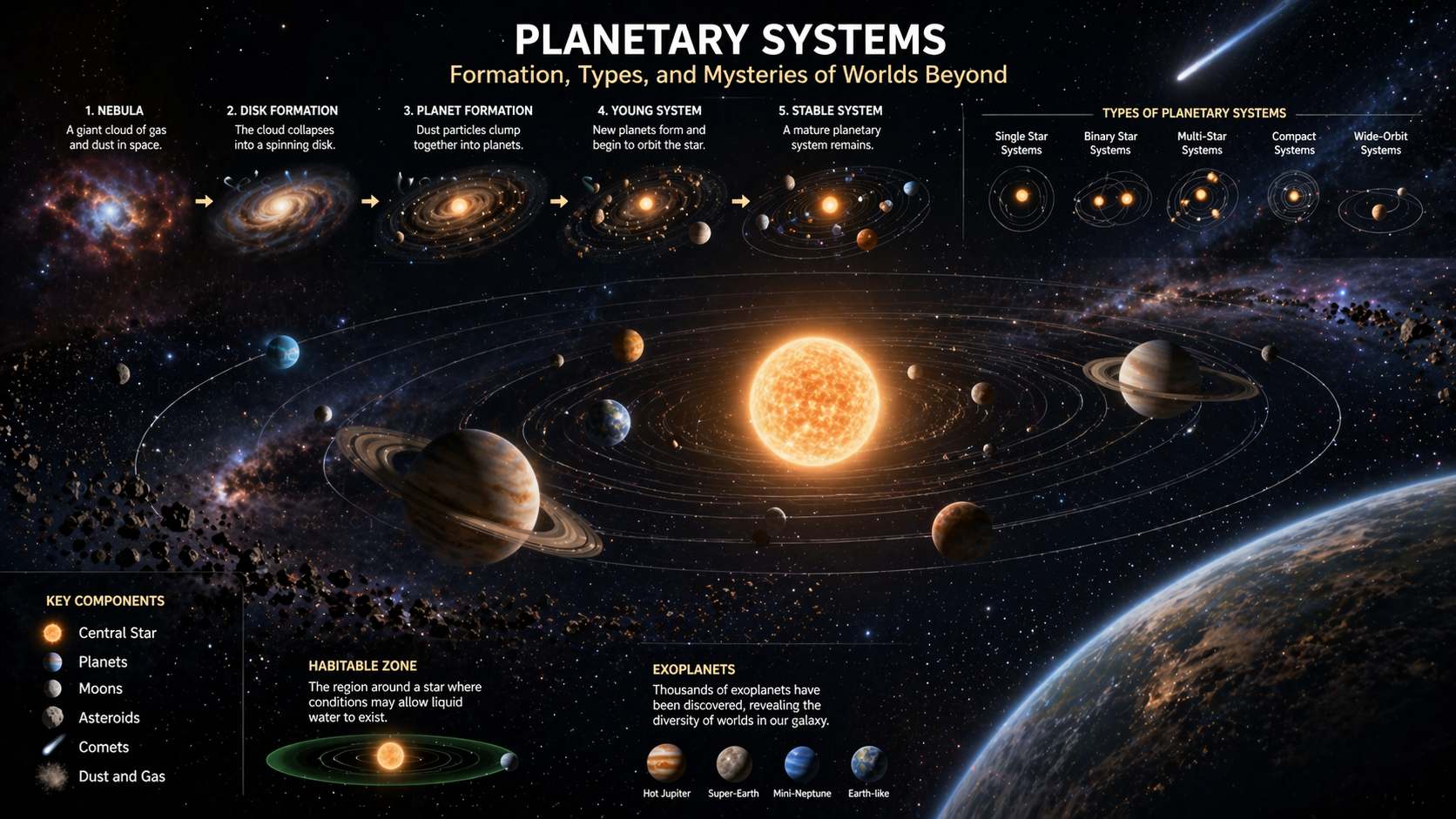
Planetary systems begin their life inside vast clouds of gas and dust called nebulae. The formation process is complex but follows a general pattern.
1. Nebula Collapse
A nebula starts to collapse under its own gravity, often triggered by nearby cosmic events like supernova explosions.
2. Star Formation
As the cloud collapses, most of the material gathers at the center, forming a new star.
3. Protoplanetary Disk
The remaining gas and dust flatten into a spinning disk around the young star, known as a protoplanetary disk.
4. Planet Formation
Tiny particles within the disk collide and stick together, gradually forming larger bodies called planetesimals. Over time, these grow into full-sized planets.
5. System Stabilization
After millions of years, the system stabilizes, leaving behind planets, moons, and smaller objects in stable orbits.
Components of a Planetary System
A planetary system is made up of several key elements:
1. Central Star
The star is the dominant object, providing light, heat, and gravitational stability.
2. Planets
Planets orbit the star and can be rocky (like Earth) or gaseous (like Jupiter).
3. Moons
Many planets are accompanied by natural satellites, commonly known as moons, which revolve around them in stable orbits.
4. Asteroids
These are small rocky bodies, often found in belts between planets.
5. Comets
Comets are icy objects that develop glowing tails when they approach the star.
6. Dust and Gas
Even after formation, leftover material may remain in the system.
Types of Planetary Systems
Planetary systems throughout the universe come in diverse forms, and many of them are very different from the structure of our own Solar System. Scientists have discovered a wide variety of system types.
1. Single-Star Systems
These systems have one central star, like our own Solar System.
2. Binary Star Systems
In these systems, two stars orbit each other, and planets may orbit one or both stars.
3. Multi-Star Systems
Some systems contain three or more stars, creating complex gravitational environments.
4. Compact Systems
These systems have planets orbiting very close to their star, often completing an orbit in just a few days.
5. Wide-Orbit Systems
Planets in these systems orbit far from their star, sometimes at extreme distances.
Exoplanets: Worlds Beyond Our Solar System
Planets that exist beyond our Solar System are known as exoplanets, and thousands have already been discovered by astronomers. Since the 1990s, astronomers have discovered thousands of them, revealing that planetary systems are common in the universe.
Common Types of Exoplanets
- Hot Jupiters: These are massive gas planets that orbit extremely close to their host star, often completing a full orbit in just a few days due to their tight proximity.
- Super-Earths: These are solid, Earth-like planets that are bigger than our planet but smaller than Neptune, often featuring diverse compositions and environments.
- Mini-Neptunes: Smaller gas-rich planets
- Earth-like planets are those that may have conditions suitable for life, such as the presence of water, a stable atmosphere, and moderate temperatures.
The Role of Gravity in Planetary Systems
Gravity is the fundamental force that binds planetary systems, keeping planets, moons, and other celestial bodies in stable orbits around their central star. It controls how planets orbit stars and how moons orbit planets.
Without gravity:
- Planets would drift into space
- Systems would not remain stable
- Stars could not form planetary systems
Gravity also influences orbital shapes, speeds, and long-term stability.
Why Are Planetary Systems Important?
Studying planetary systems helps scientists answer some of the biggest questions in science.
1. Understanding Our Origins
By studying how planetary systems form, we learn how our own Solar System came into existence.
2. Search for Life
Scientists look for Earth-like planets in habitable zones where life could exist.
3. Testing Physics
Planetary systems help test theories of gravity, motion, and cosmic evolution.
4. Exploring Diversity
Each system is different, showing how varied the universe can be.
Habitable Zones: Where Life Might Exist
The habitable zone, often called the “Goldilocks zone,” is the region around a star where environmental conditions are just right for liquid water to exist, making it a key factor in the search for life.
Planets in this zone are considered the best candidates for supporting life.
Factors affecting habitability include:
- Distance from the star
- Atmosphere composition
- Planet size and gravity
- Presence of water
Challenges in Studying Planetary Systems
Despite advances in technology, studying planetary systems is not easy.
1. Distance
Most systems are light-years away from Earth.
2. Detection Limits
Planets are small and often hidden by the brightness of their stars.
3. Limited Data
Scientists often rely on indirect methods like light dimming or gravitational effects.
Future of Planetary System Research
The future of planetary science is exciting. New telescopes and missions are helping scientists discover more systems and study them in detail.
Advancements include:
- More powerful space telescopes
- Improved imaging techniques
- Better data analysis tools
These developments will help us understand planetary systems more deeply and may even lead to the discovery of life beyond Earth.
Fun Facts About Planetary Systems
- In some unique planetary systems, planets orbit around two stars instead of one, creating fascinating and complex orbital patterns.
- There are planets made mostly of gas, ice, or rock
- Some exoplanets are hotter than stars’ surfaces
- Planetary systems can be billions of years old
- Our galaxy may contain billions of planetary systems
Conclusion
Planetary systems are the building blocks of the universe, offering a glimpse into how stars and planets form and evolve. From our familiar Solar System to distant exoplanetary systems, each one tells a unique story.
As scientists continue to explore the cosmos, planetary systems remain at the center of discovery—helping us understand our place in the universe and the possibility of life beyond Earth.
FAQs About Planetary Systems
1. What is a planetary system?
A planetary system is a collection of planets, moons, and other objects that orbit a central star.
2. How many planetary systems are there?
There are thousands of known planetary systems, and scientists believe billions exist in our galaxy alone.
3. What is an exoplanet?
An exoplanet is a planet that exists outside our Solar System.
4. Can planetary systems have more than one star?
Yes, many systems have two or more stars, known as binary or multi-star systems.
5. What is the habitable zone?
The habitable zone is the region around a star where conditions may allow liquid water to exist, making it suitable for life.