
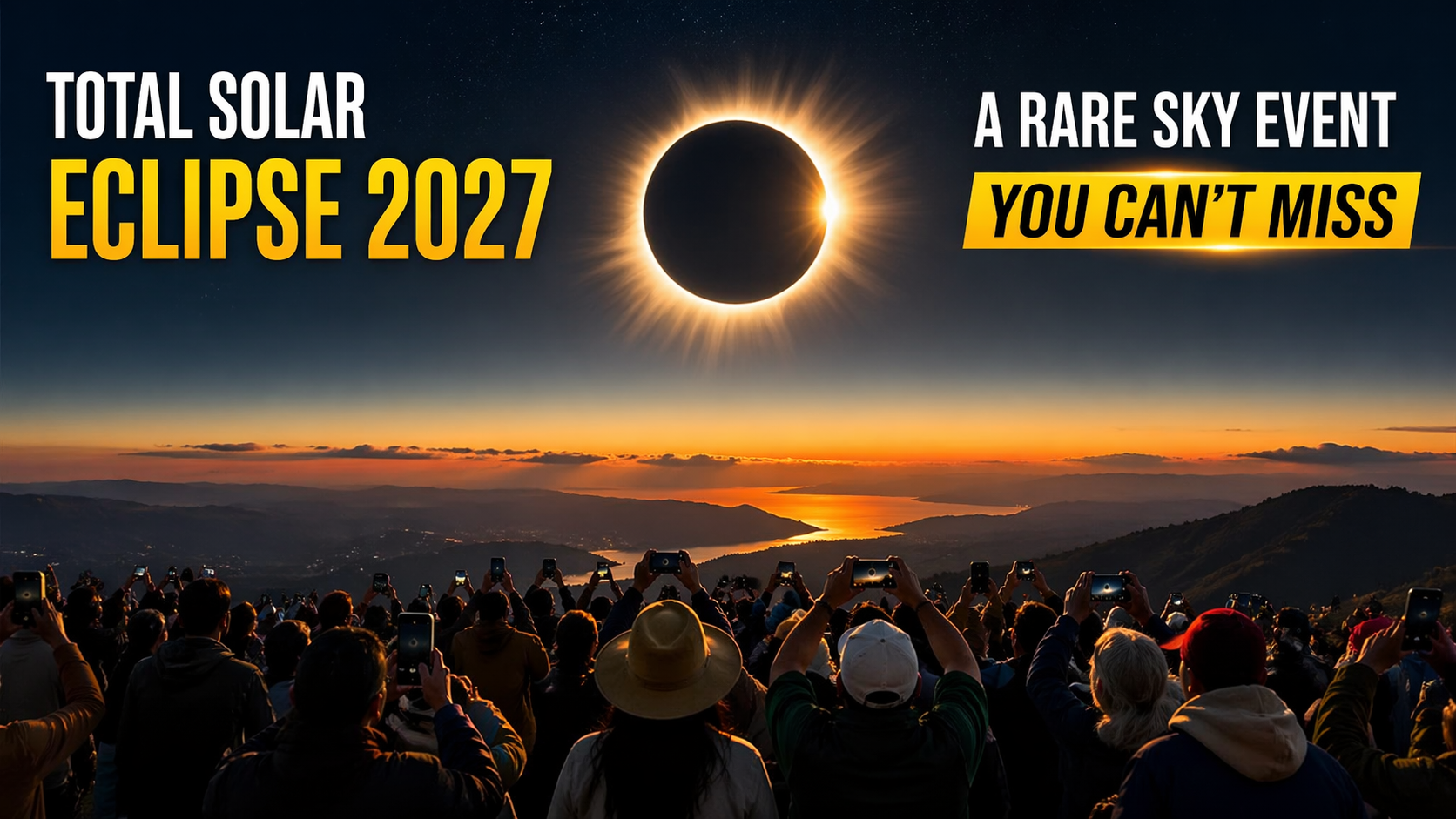
Total Solar Eclipse: On August 2, 2027, the world will witness one of nature’s most breathtaking celestial events — a total solar eclipse. For a few magical minutes, daylight will fade, the temperature may drop, and the sky will transform into an eerie twilight. This rare astronomical event is already generating excitement among skywatchers, photographers, and travelers across the globe.
If you’ve ever dreamed of seeing the Sun disappear in the middle of the day, this is your chance. Let’s explore everything you need to know about this incredible phenomenon.
Contents
- 1 🌌 What Is a Total Solar Eclipse?
- 2 🌟 Why the August 2, 2027 Eclipse Is Special
- 3 🌍 Where Will It Be Visible?
- 4 ⏳ Date and Duration
- 5 🌑 What Will You Experience?
- 6 🔥 “Ring of Fire” vs Total Eclipse – Know the Difference
- 7 🛡️ How to Watch Safely
- 8 📸 Tips for Capturing the Eclipse
- 9 ✈️ Should You Travel for It?
- 10 🌠 Why You Shouldn’t Miss This Event
- 11 🌍 Final Thoughts
- 12 ❓ Frequently Asked Questions (FAQs)
🌌 What Is a Total Solar Eclipse?
A total solar eclipse happens when the Moon moves precisely between the Earth and the Sun, temporarily blocking the Sun’s light and casting a shadow on our planet. This perfect alignment creates a dramatic visual effect where the bright solar disk is replaced by a dark circle, surrounded by the glowing outer atmosphere of the Sun, known as the corona.
Unlike partial eclipses, a total solar eclipse offers a full transformation of the sky. Day turns into night, stars may become visible, and the environment takes on a surreal, almost otherworldly appearance.
🌟 Why the August 2, 2027 Eclipse Is Special
The August 2, 2027 solar eclipse is not just another eclipse — it is considered one of the most significant sky events of the 21st century. Here’s why:
- Long Duration: In some locations, totality will last over 6 minutes, making it one of the longest eclipses in decades.
- Wide Visibility Path: The eclipse will be visible across parts of Europe, North Africa, and the Middle East.
- Perfect Alignment: The Moon will cover the Sun almost perfectly, offering a stunning view of the solar corona.
Because of these factors, millions of people are expected to travel to prime viewing locations to experience this once-in-a-lifetime event.
🌍 Where Will It Be Visible?
The path of totality — the region where the eclipse will be fully visible — will pass through several regions, including:
- Southern Europe (Spain)
- North Africa (Morocco, Algeria, Egypt)
- Parts of the Middle East (Saudi Arabia, Yemen)
Outside these areas, people will still be able to see a partial solar eclipse, though the full “day-to-night” experience will only occur within the path of totality.
⏳ Date and Duration
- Date: August 2, 2027
- Duration: A few minutes (varies depending on your location)
In some prime spots, totality could last over 6 minutes, which is exceptionally long compared to most solar eclipses.
🌑 What Will You Experience?
Experiencing a total solar eclipse is truly one of the most extraordinary sights in nature. Here’s what you can expect:
🌒 Sudden Darkness
As the Moon slowly covers the Sun, daylight begins to fade. Within minutes, the sky darkens dramatically, creating a twilight effect.
🌡️ Drop in Temperature
You may feel a noticeable drop in temperature as sunlight is temporarily blocked.
🌠 Stars in Daylight
In some cases, bright stars and planets may become visible in the darkened sky.
🐦 Nature’s Reaction
Animals and birds often behave as if night has arrived — some may go quiet, while others return to their nests.
✨ The Solar Corona
The highlight of the event is the Sun’s corona — a glowing halo that is usually invisible due to the Sun’s brightness.
🔥 “Ring of Fire” vs Total Eclipse – Know the Difference
Many people confuse a total solar eclipse with an annular eclipse, often called the “ring of fire.”
- During a total solar eclipse, the Moon fully blocks the Sun, allowing the Sun’s outer atmosphere, known as the corona, to shine brilliantly.
- Annular Eclipse (“Ring of Fire”): The Moon does not fully cover the Sun, leaving a bright ring around it.
The August 2, 2027 event is a total solar eclipse, which means you will experience complete darkness — something far more dramatic than the ring effect.
🛡️ How to Watch Safely
Watching a solar eclipse is exciting, but safety is crucial:
- Always use certified solar eclipse glasses
- Always protect your eyes when viewing the Sun—never look at it directly without proper safety equipment like certified solar eclipse glasses.
- Use proper filters for cameras or telescopes
- You can also use a pinhole projector for indirect viewing
⚠️ Important: Only during the brief phase of totality (when the Sun is completely covered) is it safe to look without protection — but only if you are within the path of totality.
📸 Tips for Capturing the Eclipse
If you’re planning to photograph the event, preparation is key:
- Use a tripod for stability
- For safe and high-quality photography, using a proper solar filter on your camera lens is highly recommended.
- Practice settings in advance
- Capture different phases — partial, totality, and post-eclipse
This rare event offers a once-in-a-lifetime opportunity for stunning photography.
✈️ Should You Travel for It?
Because this eclipse is both long and visually spectacular, many people are planning travel around it. Popular destinations like Spain and Egypt are expected to attract large crowds.
If you’re serious about witnessing it:
- Book accommodations early
- Choose a location with clear weather forecasts
- Consider less crowded viewing spots for a better experience
🌠 Why You Shouldn’t Miss This Event
Total solar eclipses are uncommon at any single location, making each occurrence a rare opportunity. For most people, witnessing a total solar eclipse is a rare experience that may only happen once or a few times in an entire lifetime.
The August 2, 2027 eclipse stands out because of its:
- Exceptional duration
- Wide visibility
- Stunning visual effects
This event goes beyond science — it creates a powerful and unforgettable moment that leaves a lasting impression.
🌍 Final Thoughts
The total solar eclipse of August 2, 2027 is set to be one of the most awe-inspiring celestial events of our time. From the sudden darkness to the glowing corona, every moment will feel surreal.
Whether you plan to travel to the path of totality or watch a partial eclipse from your location, this is a rare opportunity to connect with the wonders of the universe.
Mark your calendar, prepare your viewing gear, and get ready to witness the sky like never before. 🌑✨
❓ Frequently Asked Questions (FAQs)
1. What makes the August 2, 2027 solar eclipse special?
This eclipse is unique due to its long duration (over 6 minutes in some areas) and wide visibility across multiple continents, making it one of the most significant eclipses of the century.
2. Where is the best place to watch the eclipse?
The best locations are within the path of totality, including parts of Spain, North Africa, and the Middle East. Clear skies will provide the best viewing experience.
3. Is it safe to watch a solar eclipse with the naked eye?
No, it is not safe to look directly at the Sun without proper protection. Always use certified eclipse glasses, except during the brief totality phase.
4. How long will the eclipse last?
The total phase will last a few minutes, depending on your location. In some regions, it may exceed 6 minutes.
5. Can I see the eclipse from India?
India will mostly experience a partial solar eclipse, not totality. However, it will still be visible with proper safety precautions.