
Planets have fascinated humans for thousands of years. From ancient skywatchers to modern scientists, these celestial bodies continue to inspire curiosity and exploration. But what exactly is a planet, and how do planets form, move, and support life?
In this detailed, easy guide, you’ll learn everything about planet in a simple and easy-to-understand way.
Contents
🌌 What Is a Planet?


A planet is a large celestial object that orbits a star, such as the Sun, and does not produce its own light. Instead, planet shine by reflecting the light of their star.
According to the International Astronomical Union (IAU), a planet must meet three important conditions:
- It must orbit a star (like the Sun).
- It must be large enough for gravity to shape it into a nearly round form.
- It must have cleared its orbit of other debris.
These criteria help scientists distinguish planet from smaller objects like asteroids and dwarf planet.
🪐 Types of Planet


Planets are generally divided into different categories based on their composition and size:
🌍 Terrestrial Planet (Rocky Planet)
These planet have solid surfaces made of rock and metal.
Examples include:
- Mercury
- Venus
- Earth
- Mars
They are smaller in size and have fewer moons.
🌪️ Gas Giants
Gas giants are massive planets mostly made of hydrogen and helium gases.
Examples include:
- Jupiter
- Saturn
These planet do not have a solid surface and are known for their thick atmospheres.
❄️ Ice Giants
Ice giants are similar to gas giants but contain more “icy” materials like water, ammonia, and methane.
Examples include:
- Uranus
- Neptune
They appear blue due to methane in their atmospheres.
🌞 Planets in Our Solar System


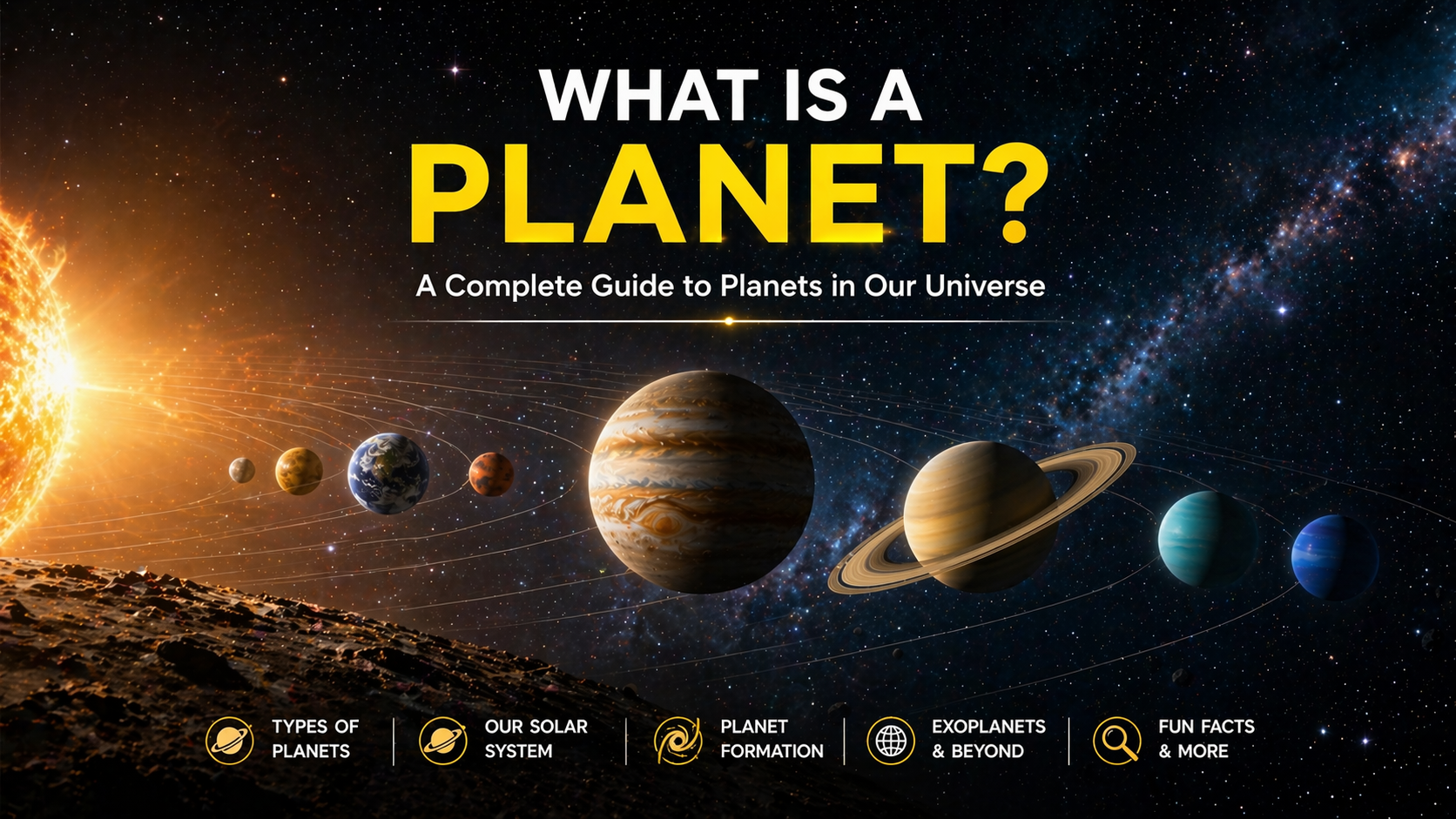
Our solar system contains eight official planets, all orbiting the Sun in a fixed path:
- Mercury
- Venus
- Earth
- Mars
- Jupiter
- Saturn
- Uranus
- Neptune
Each planet has unique characteristics, from extreme temperatures to massive storms and beautiful ring systems.
🌠 How Do Planet Form?


Planets form from clouds of gas and dust called nebulae. When a star forms, leftover material spins around it, creating a protoplanetary disk.
Over millions of years:
- Tiny particles collide and stick together
- They grow into larger bodies called planetesimals
- Eventually, gravity pulls them into full-sized planets
This process is known as accretion.
🌍 Why Is Earth Unique?


Among all known planets, Earth is special because it supports life. Here’s why:
- Liquid Water: Essential for all known life forms
- Oxygen-Rich Atmosphere: Supports breathing organisms
- Right Temperature: Located in the “habitable zone”
- Magnetic Field: Protects from harmful solar radiation
So far, Earth is the only planet known to host life.
🔭 What Are Exoplanets?


Planet that orbit stars outside our solar system are called exoplanets. Scientists have discovered thousands of them in recent years.
Some exoplanets are:
- Larger than Jupiter
- Rocky like Earth
- Located in habitable zones
The search for exoplanets helps scientists understand whether life might exist elsewhere in the universe.
🌌 Fun Facts About Planets
- Jupiter is so large that all other planet could fit inside it.
- Saturn has stunning rings made of ice and rock.
- Venus is widely recognized as the hottest planet in our solar system due to its extreme surface temperatures. Its thick carbon dioxide atmosphere traps heat very effectively, creating an intense greenhouse effect that keeps its surface extremely hot.
- Neptune is famous for having the fastest winds ever recorded in the solar system. These powerful storms can reach speeds of over 2,000 kilometers per hour, making Neptune one of the most extreme and dynamic worlds.
🚀 Why Studying Planet Is Important
Understanding planet helps us:
- Learn about the origin of our solar system
- Predict space weather and cosmic events
- Search for life beyond Earth
- Advance space exploration technologies
Planetary science is a key part of modern astronomy and space missions.
🌠 Conclusion
Planets are more than just objects in the sky — they are worlds with unique environments, histories, and mysteries. From rocky planet like Earth to massive gas giants like Jupiter, each planet tells a story about the universe.
As technology improves, we continue to discover new planet and unlock secrets about their formation and potential for life. Whether you’re a student, a space enthusiast, or simply curious, learning about planet opens a window to the vast and fascinating cosmos.
❓ Frequently Asked Questions (FAQs)
1. 🪐 What Is a Planet?
A planet is a celestial body that orbits a star, is nearly round in shape due to gravity, and has cleared its orbital path of debris.
2. How many planet are in our solar system?
There are eight recognized planets in our solar system, orbiting the Sun.
3. ⭐ Planet vs Star – What’s the Difference?
A planet reflects light from a nearby star and does not create its own energy. In contrast, a star produces its own light and heat through a process called nuclear fusion, where atoms combine under intense pressure to release massive amounts of energy.
4. Are there planet outside our solar system?
Yes, these are called exoplanets, and thousands have been discovered orbiting distant stars.
5. Why is Earth the only known planet with life?
Earth has the right conditions for life, including water, oxygen, and a suitable temperature range.