
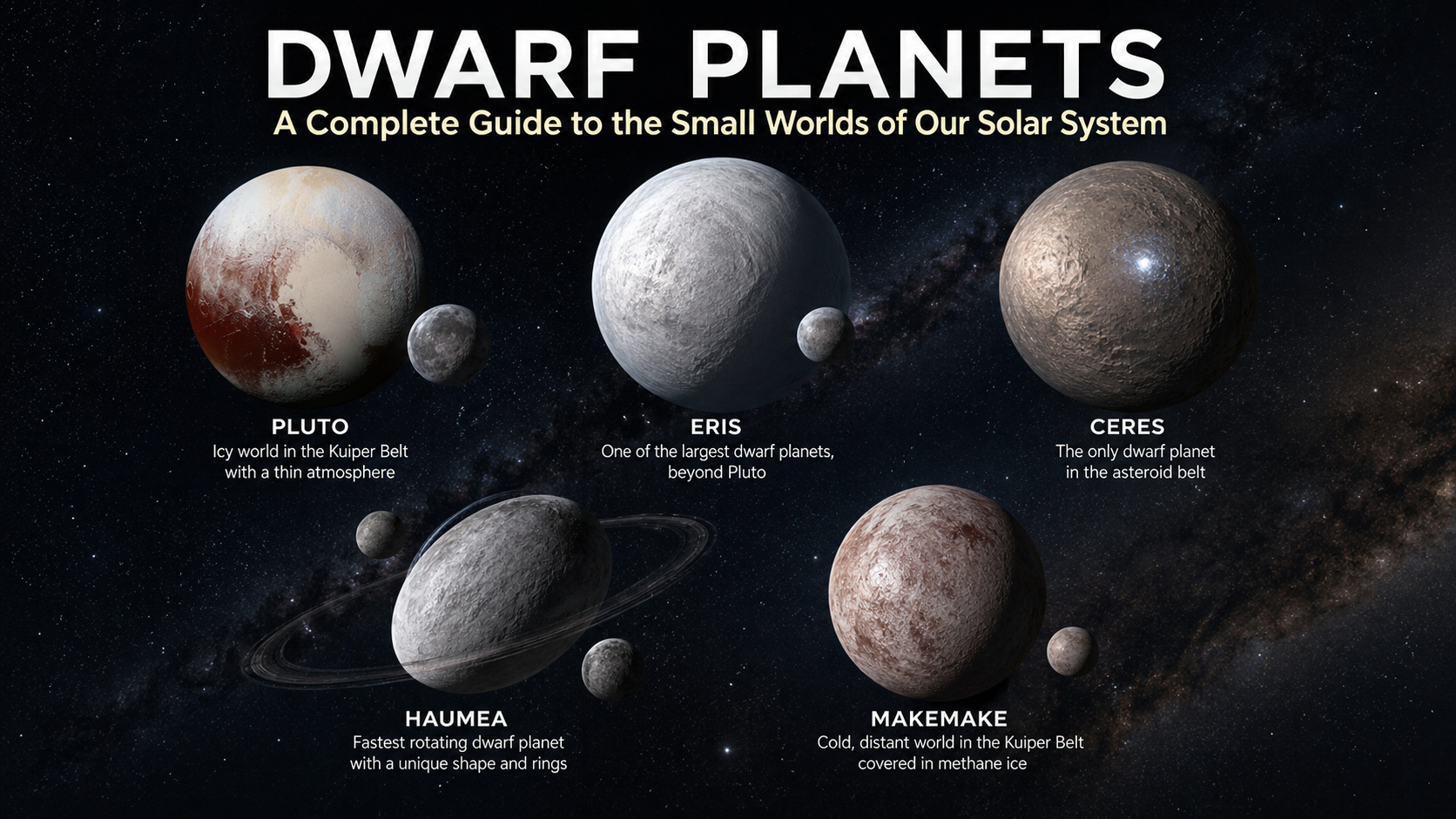
Dwarf Planets: The universe is full of fascinating objects, and among them, dwarf planets hold a special place. These celestial bodies may be smaller than traditional planets, but they are just as intriguing. From icy surfaces to mysterious atmospheres, dwarf planets offer valuable insights into how our solar system formed and evolved.
In this article, easy-to-read guide, you’ll learn everything about dwarf planet—their definition, characteristics, types, and some of the most well-known examples.
Contents
- 1 🪐 What Are Dwarf Planet?
- 2 🌠 Why Are Dwarf Planets Important?
- 3 🌍 Key Characteristics of Dwarf Planet
- 4 🚀 Famous Dwarf Planet in Our Solar System
- 5 🌌 Where Are Dwarf Planets Found?
- 6 🔭 Difference Between Planets and Dwarf Planets
- 7 🧠 Fun Facts About Dwarf Planets
- 8 🌠 The Future of Dwarf Planet Exploration
- 9 🌍 Conclusion
- 10 ❓ FAQs About Dwarf Planets
🪐 What Are Dwarf Planet?
A dwarf planet is a type of celestial body that orbits the Sun and shares some features with full-sized planets but does not meet all the criteria required to be classified as a planet.
According to the International Astronomical Union (IAU), a dwarf planet must:
- Orbit the Sun
- Have enough mass to form a nearly round shape
- Not be a satellite (moon)
- Not have cleared its orbital path of other debris
This last point is what mainly separates dwarf planet from the eight major planets.
🌠 Why Are Dwarf Planets Important?
Dwarf planet are like cosmic time capsules. They preserve ancient materials from the early solar system, helping scientists understand how planets formed billions of years ago.
Studying these objects also helps astronomers:
- Learn about planetary formation
- Understand the outer regions of the solar system
- Explore the possibility of hidden or undiscovered objects
🌍 Key Characteristics of Dwarf Planet
Dwarf planets share some common features that make them unique:
- Small Size: They are smaller than regular planets
- Spherical Shape: Gravity pulls them into a round form
- Orbital Zone Sharing: They share their orbit with other objects
- Varied Composition: Some are rocky, while others are icy
Despite their size, many dwarf planet have complex surfaces, thin atmospheres, and even moons.
🚀 Famous Dwarf Planet in Our Solar System
1. Pluto – The Most Popular Dwarf Planet
Pluto was once considered the ninth planet but was reclassified in 2006. It is located in the Kuiper Belt and has five known moons, including Charon.


Key Facts:
- Extremely cold surface
- Icy mountains and glaciers
- Thin atmosphere that expands and contracts
2. Eris – The Massive Challenger
Eris is one of the largest known dwarf planet and even slightly more massive than Pluto. Its discovery played a major role in redefining what a planet is.


Key Facts:
- Located far beyond Pluto
- Has a moon named Dysnomia
- Extremely reflective surface
3. Ceres – The Closest Dwarf Planet
Ceres is the only dwarf planet found in the asteroid belt between Mars and Jupiter.


Key Facts:
- Contains water ice
- Features bright spots caused by salt deposits
- May have underground liquid water
4. Haumea – The Fast Spinner
Haumea has a unique elongated shape due to its rapid rotation.


Key Facts:
- Spins very quickly (about 4 hours)
- Has a ring system
- Possesses two moons
5. Makemake – The Icy World
Makemake is another distant dwarf planet found in the Kuiper Belt.


Key Facts:
- Surface covered with methane ice
- Very cold environment
- Has at least one moon
🌌 Where Are Dwarf Planets Found?
Most dwarf planets are located in two main regions:
- Kuiper Belt: A region beyond Neptune filled with icy objects
- Asteroid Belt: Located between Mars and Jupiter (home to Ceres)
Scientists believe there may be hundreds of undiscovered dwarf planet in the outer solar system.
🔭 Difference Between Planets and Dwarf Planets
Understanding the difference is simple:
- Planets clear their orbital path and dominate their region
- Dwarf planets share their orbit with other objects
This distinction may seem small, but it is crucial in modern astronomy.
🧠 Fun Facts About Dwarf Planets
- Pluto has mountains as tall as the Himalayas
- Ceres may contain more water than Earth’s freshwater reserves
- Haumea is one of the fastest-rotating large bodies in our solar system.
- Eris helped change the definition of a planet
🌠 The Future of Dwarf Planet Exploration
With advanced telescopes and space missions, scientists continue to discover new dwarf planet. Future missions may explore these distant worlds more closely, unlocking secrets about the early solar system.
Exploration of dwarf planet could also help answer big questions like:
- How did planets form?
- Is there life beyond Earth?
- What exists at the edge of our solar system?
🌍 Conclusion
Dwarf planets may be small, but they are incredibly important for understanding our solar system. From the icy plains of Pluto to the mysterious bright spots on Ceres, these worlds continue to amaze scientists and space enthusiasts alike.
As technology advances, we can expect even more discoveries that will reshape our knowledge of the cosmos. So, the next time you look up at the night sky, remember—there’s much more out there than meets the eye. 🚀✨
❓ FAQs About Dwarf Planets
1. What is the simplest definition of a dwarf planet?
A dwarf planet is a small, round object that orbits the Sun but has not cleared its orbital path.
2. How many dwarf planets are there?
There are currently five officially recognized dwarf planets, but many more are likely waiting to be discovered.
3. Why is Pluto no longer a planet?
Pluto was reclassified because it does not clear its orbit of other objects, which is a requirement for full planet status.
4. Can dwarf planets have moons?
Yes, some dwarf planets like Pluto and Haumea have moons.
5. Are dwarf planets habitable?
Most dwarf planets are extremely cold and lack the conditions needed to support life as we know it.