
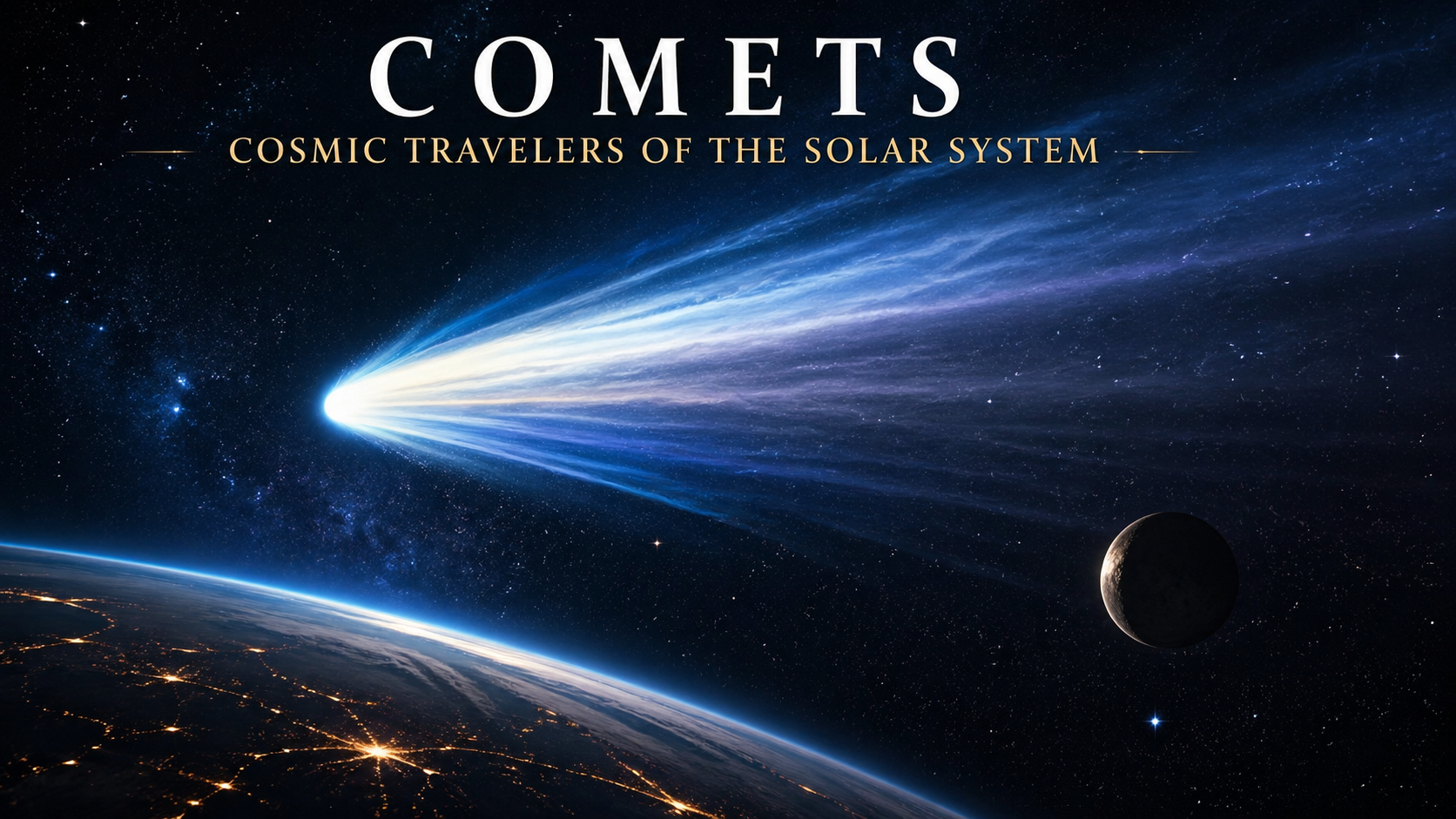
Comets are fascinating space objects made of ice, dust, and rocky material that travel across our solar system.
Often called “cosmic snowballs,” they light up the sky when they come close to the Sun, forming a glowing tail.
These ancient travelers carry valuable clues about how our solar system formed billions of years ago, making them important for both scientists and skywatchers.
Contents
- 1 🌌 What Are Comet?
- 2 🧊 Structure of a Comet
- 3 🌍 Where Do Comet’s Come From?
- 4 ⏳ Types of Comet’s
- 5 ☀️ How Do Comet Form Tails?
- 6 🌠 Famous Comet’s in History
- 7 🔬 Scientific Importance of Comet
- 8 🪨 Comets vs Asteroids
- 9 ☄️ Can Comets Hit Earth?
- 10 🔭 How to Observe Comet
- 11 🌟 Why Comet Matter
- 12 🧾 Conclusion
- 13 ❓ FAQs About Comet
🌌 What Are Comet?
Comets are icy space objects that move through the solar system. They are often called “dirty snowballs” because they are made of ice, dust, and small rocky pieces.

When they move closer to the Sun, they heat up and release gas and dust, creating a glowing head and a long, beautiful tail that can sometimes be seen from Earth.

These fascinating objects have captured human curiosity for thousands of years. Ancient civilizations often saw comet as signs or omens, but today, scientists study them to understand the origins of our solar system.
🧊 Structure of a Comet

A comet has several key parts:
1. Nucleus
The nucleus is the dense, solid core that forms the center of a comet. It is made up of frozen gases, dust, and rocky materials. Most nuclei are relatively small, ranging from a few kilometers to tens of kilometers in diameter.

2. Coma
As a comet gets closer to the Sun, the heat turns its icy surface into gas, creating a glowing effect. This process forms a bright, glowing cloud around the core, known as the coma.
3. Tail
Comet often have two types of tails:
- Dust Tail: Made of small particles pushed away by sunlight
- Ion Tail: Made of charged gases affected by the solar wind
Interestingly, a comet’s tail always points away from the Sun, regardless of its direction of travel.
🌍 Where Do Comet’s Come From?
Most comet begin their journey in two distant regions of our solar system.
1. Kuiper Belt
This region lies beyond Neptune and contains many icy bodies. This area is known for producing short-period comet.
2. Oort Cloud
Far beyond the planets lies a vast, spherical cloud that is believed to be the birthplace of long-period comet’s. Some comets from this region take thousands or even millions of years to orbit the Sun.
⏳ Types of Comet’s
Comets are grouped by the time they take to complete one orbit around the Sun:
🔹 Short-Period Comet
- Orbit time: Less than 200 years
- Example: Halley’s Comet
- Origin: Kuiper Belt
🔹 Long-Period Comet
- Orbit time: More than 200 years
- Some take thousands of years
- Origin: Oort Cloud
🔹 Non-Periodic Comet
These comets pass through the solar system only once and may never return.
☀️ How Do Comet Form Tails?
When a comet moves closer to the Sun, its surface starts heating up due to solar energy. This causes sublimation—where ice turns directly into gas. Gas and dust released from the comet are pushed outward by solar wind and sunlight, creating its glowing tail.
The closer the comet gets to the Sun, the brighter and longer its tail becomes.
🌠 Famous Comet’s in History

Halley’s Comet
One of the most famous comet, visible from Earth every 76 years. It has been observed for centuries and was the first comet whose orbit was accurately predicted.
Hale-Bopp
A spectacular comet visible to the naked eye for 18 months in the 1990s. It had a very bright nucleus and long-lasting visibility.
Comet NEOWISE
Seen in 2020, it became one of the brightest comet in recent years and was easily visible without telescopes.
🔬 Scientific Importance of Comet
Comets act like time capsules, carrying ancient material from the early days of the solar system. Scientists study them to learn about:
- The formation of planets
- The composition of early solar material
- The origin of water on Earth
- Organic molecules that may have contributed to life
Some missions have even landed spacecraft on comet to study them up close.
🪨 Comets vs Asteroids
| Feature | Comets | Asteroids |
|---|---|---|
| Composition | Ice, dust, gas | Rock and metal |
| Appearance | Bright with tail | Usually no tail |
| Location | Outer solar system | Mostly asteroid belt |
| Behavior | Develop coma and tail near Sun | Remain solid and inactive |
☄️ Can Comets Hit Earth?
While rare, comets can potentially collide with Earth. However, scientists continuously monitor near-Earth objects to detect any threats early.
Most comets pass safely by, offering spectacular views instead of danger.
🔭 How to Observe Comet

You don’t need advanced equipment to enjoy a comet. Here are some tips:
- Choose a dark place far from city lights for the best sky view.
- Check sky visibility forecasts
- Use binoculars for a better view
- Allow your eyes to adjust to darkness
- Look toward the horizon during early evening or morning

Sometimes, comets are visible with the naked eye, making them a magical experience for skywatchers.
🌟 Why Comet Matter
Comets are more than just beautiful objects in the sky. They help us understand:
- The early history of our solar system
- The building blocks of planets
- The possibility of life beyond Earth
Their unpredictable nature and stunning appearance make them one of the most exciting astronomical phenomena.
🧾 Conclusion
Comets are ancient travelers that carry secrets from billions of years ago. From their icy origins in distant regions of the solar system to their glowing appearance near the Sun, they continue to inspire scientists and skywatchers alike.
Whether you’re observing a bright comet streaking across the sky or learning about their composition, these celestial wonders remind us of the vast and dynamic universe we live in.
❓ FAQs About Comet
1. What is a comet made of?
Comets are made of ice, dust, and rocky materials, often described as frozen leftovers from the early solar system.
2. Why do comet have tails?
Comet develop tails when heat from the Sun causes their ice to vaporize, releasing gas and dust.
3. How often can we see comet?
Some comets appear regularly, while others may be visible only once in thousands of years.
4. Are comets dangerous to Earth?
Most comets are harmless and pass far from Earth. Scientists monitor them to ensure safety.
5. Can we see these comets without a telescope?
Yes, some bright comets can be seen with the naked eye under clear, dark skies.