
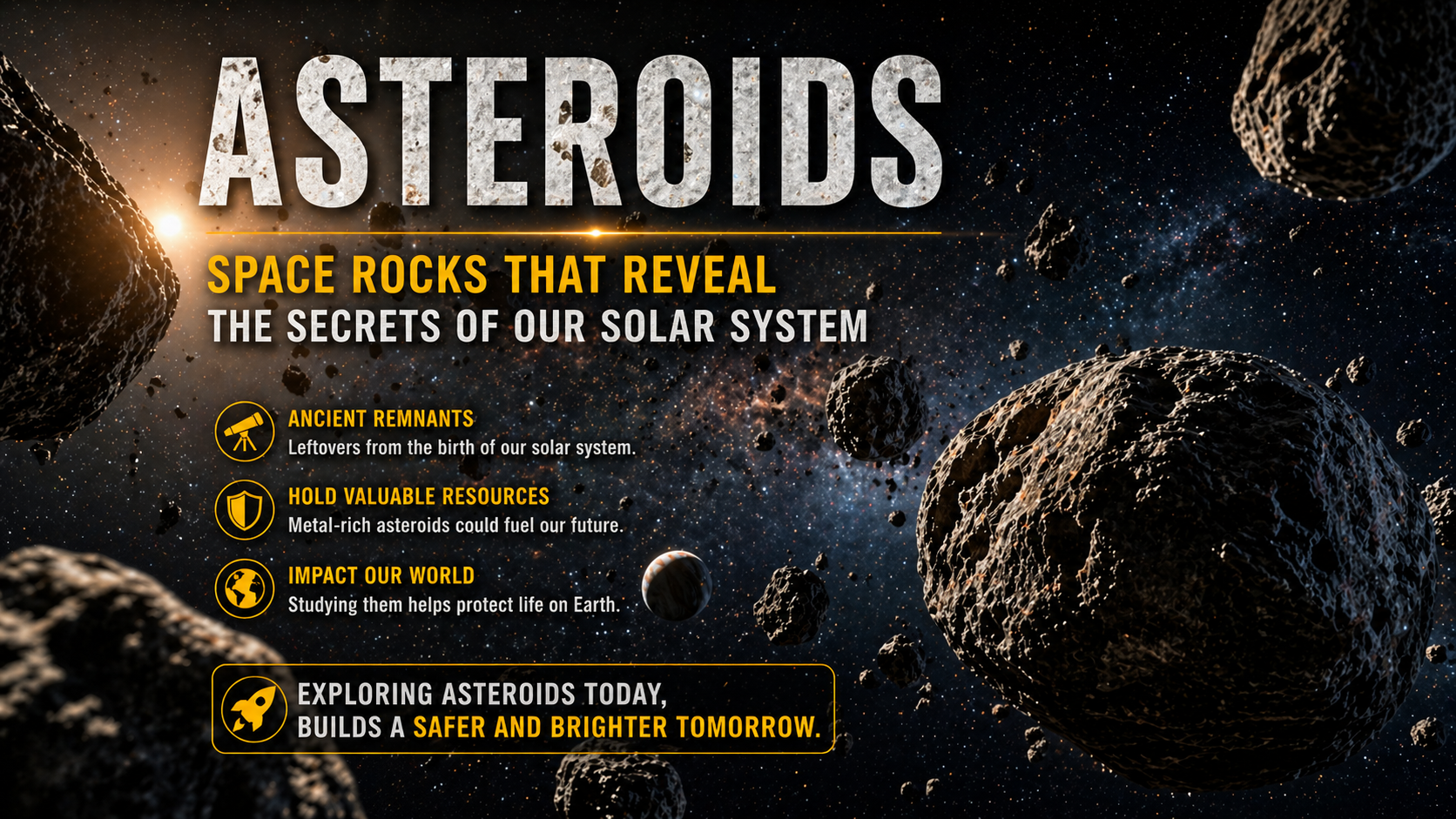
Asteroids may look like simple chunks of rock drifting through space, but they are far more fascinating than they appear. These ancient objects are like time capsules, preserving clues about how our solar system formed billions of years ago.
From tiny pebble-sized fragments to massive bodies hundreds of kilometers wide, asteroid play a crucial role in shaping planets, influencing space missions, and even impacting life on Earth. Studying asteroid goes beyond space science—it helps us explore our origins and plan for future discoveries.
Contents
- 1 What Are Asteroids?
- 2 Where Are Asteroids Found?
- 3 Types of Asteroid
- 4 How Asteroid Formed
- 5 Why Asteroids Are Important
- 6 Famous Asteroids You Should Know
- 7 Asteroid and Earth: A Powerful Connection
- 8 Can Asteroids Hit Earth?
- 9 Asteroid Exploration Missions
- 10 Asteroid Mining: The Future Opportunity
- 11 Asteroids vs Comets: What’s the Difference?
- 12 Fun Facts About Asteroid
- 13 Why You Should Care About Asteroids
- 14 Conclusion
- 15 FAQs
What Are Asteroids?
Asteroid are rocky objects that orbit the Sun, primarily found between Mars and Jupiter in a region known as the asteroid belt. Unlike planets, they are too small to have a spherical shape and lack atmospheres.
These space rocks are made up of different materials, including:
- Metals like iron and nickel
- Silicate rocks
- Carbon-rich compounds
Some asteroid are solid, while others are loosely held together piles of debris, often called “rubble piles.”
Where Are Asteroids Found?
1. The Asteroid Belt
The majority of asteroid exist in the main asteroid belt, located between Mars and Jupiter. This region contains millions of objects, ranging in size from dust particles to dwarf planet-sized bodies like Ceres.
2. Near-Earth Asteroids (NEAs)
Some asteroid follow paths that take them very close to Earth, making them important to track and study. While most pass by safely, scientists monitor them closely for potential impact risks.
3. Trojan Asteroid
These asteroid share an orbit with a larger planet, usually Jupiter, and stay in stable positions ahead of or behind the planet.
4. Kuiper Belt and Beyond
Some asteroid-like objects exist in distant regions beyond Neptune, blending into what we often call icy bodies or dwarf planets.
Types of Asteroid
Asteroids are classified based on their composition:
C-type (Carbonaceous)
- Most common type
- Dark in appearance
- Rich in carbon and organic materials
S-type (Silicaceous)
- Made of rock and metals
- Brighter than C-type
- Common in the inner asteroid belt
M-type (Metallic)
- Composed mainly of iron and nickel
- Believed to be leftover fragments from the cores of early-formed planets
Each type provides unique insights into the early solar system.
How Asteroid Formed
Asteroids formed about 4.6 billion years ago during the early stages of the solar system. When the Sun and planets were forming, leftover material didn’t come together to form a planet due to the strong gravitational influence of Jupiter.
Instead, these fragments remained scattered, eventually becoming the asteroid we see today.
Why Asteroids Are Important
1. Clues to the Past
Asteroid contain untouched material from the early solar system, helping scientists understand how planets formed.
2. Potential Resources
Some asteroids are rich in valuable metals like platinum and gold, making them potential targets for future space mining.
3. Planetary Defense
Studying asteroid helps scientists detect and track objects that could pose a threat to Earth.
4. Scientific Exploration
Space missions to asteroid provide valuable data about their structure, composition, and history.
Famous Asteroids You Should Know
1. Ceres
The biggest body in the asteroid belt is so large that it’s officially recognized as a dwarf planet.
2. Vesta
One of the brightest asteroid visible from Earth, with a differentiated structure similar to planets.
3. Eros
A near-Earth asteroid that has been studied by spacecraft.
4. Bennu
A carbon-rich asteroid explored for clues about organic materials in space.
Asteroid and Earth: A Powerful Connection
Asteroid have played a significant role in Earth’s history. One of the most famous examples is the asteroid impact that led to the extinction of the dinosaurs about 66 million years ago.
This event shows that asteroids are not just distant objects—they can directly influence life on Earth.
Can Asteroids Hit Earth?
Yes, but large impacts are extremely rare. Scientists use advanced tracking systems to monitor near-Earth objects and predict their paths.
Organizations like NASA and other space agencies work continuously to identify potential threats and develop strategies to prevent collisions.
Asteroid Exploration Missions
Space agencies have launched several missions to study asteroid:
- OSIRIS-REx: Collected samples from asteroid Bennu
- Hayabusa Missions: Returned samples from asteroids
- Dawn Mission: Studied Ceres and Vesta
These missions help scientists better understand asteroid composition and behavior.
Asteroid Mining: The Future Opportunity
Asteroid may become valuable resources in the future. They contain:
- Precious metals
- Water (which can be converted into fuel)
- Rare minerals
While asteroid mining is still in its early stages, it has the potential to revolutionize space exploration and the global economy.
Asteroids vs Comets: What’s the Difference?
Although they may seem similar, asteroids and comets are quite different:
| Feature | Asteroids | Comets |
|---|---|---|
| Composition | Rock and metal | Ice and dust |
| Appearance | No tail | Glowing tail near Sun |
| Location | Asteroid belt | Outer solar system |
Comets are more visually dramatic, but asteroids are equally important scientifically.
Fun Facts About Asteroid
- Some asteroid have moons orbiting them
- A few asteroid are hollow or loosely packed
- The total mass of all asteroid is less than Earth’s Moon
- Some asteroid pass closer to Earth than the Moon
Why You Should Care About Asteroids
Asteroids are not just scientific curiosities—they are part of our cosmic story. They help us understand:
- How Earth formed
- Where life’s building blocks may have come from
- How to protect our planet from future impacts
They also inspire curiosity and exploration, pushing humanity to look beyond Earth.
Conclusion
Asteroids are much more than floating rocks in space. They are ancient remnants of the solar system, holding secrets about our origins and future.
From their role in shaping planets to their potential as resources and threats, asteroid remain one of the most intriguing subjects in astronomy.
As technology advances, our ability to study and interact with these celestial bodies will only grow, opening new doors for discovery and exploration.
FAQs
1. What is an asteroid?
An asteroid is a small rocky body that travels around the Sun, mainly located between Mars and Jupiter in the asteroid belt.
2. Are asteroids dangerous?
Most are harmless, but some near-Earth asteroids are monitored for potential impact risks.
3. How big can asteroids get?
Asteroid vary greatly in size, from small rocks just a few meters wide to massive bodies stretching hundreds of kilometers across.
4. What is the difference between asteroids and meteors?
Asteroids are in space, while meteors are fragments that burn up in Earth’s atmosphere.
5. Can we mine asteroid?
Yes, scientists are exploring asteroid mining as a future possibility for resources like metals and water.