
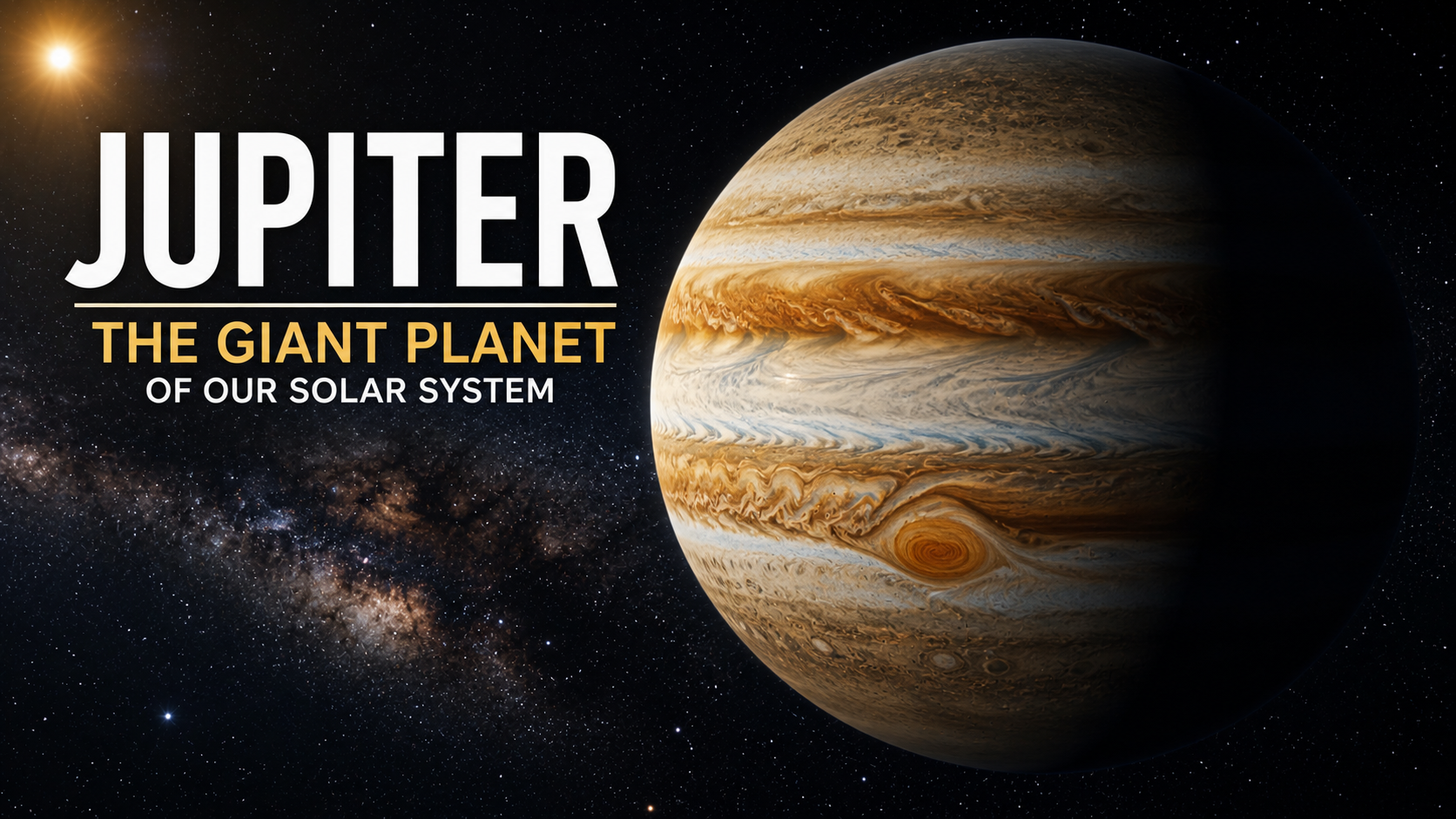
Jupiter is the largest planet in our solar system and one of the most fascinating objects in space. Known for its enormous size, powerful storms, and dozens of moons, Jupiter has captured human curiosity for centuries. Its bright appearance in the night sky makes it easy to spot, even without a telescope.
Scientists consider Jupiter a key planet for understanding how the solar system formed. With its swirling clouds, giant storms, and mysterious interior, Jupiter continues to amaze astronomers and space enthusiasts around the world.
In this detailed guide, we will explore everything about Jupiter, including its size, atmosphere, moons, rings, exploration missions, and why it is so important in space science.
Contents
- 1 What is Jupiter?
- 2 Key Facts About Jupiter
- 3 Why is Jupiter So Big?
- 4 Structure and Composition of Jupiter
- 5 Jupiter’s Atmosphere
- 6 The Great Red Spot
- 7 Does Jupiter Have Rings?
- 8 Moons of Jupiter
- 9 The Four Largest Moons
- 10 How Long is a Day on Jupiter?
- 11 How Long is a Year on Jupiter?
- 12 Can Humans Live on Jupiter?
- 13 Space Missions to Jupiter
- 14 Jupiter’s Magnetic Field
- 15 Why Jupiter is Important
- 16 Future Exploration of Jupiter
- 17 Jupiter vs Earth
- 18 Conclusion
- 19 FAQs About Jupiter
What is Jupiter?
Jupiter is the largest fifth-planet from the Sun in our solar system. Jupiter is famous for its massive size and powerful storms, making it one of the most exciting and mysterious planets in space. It is classified as a gas giant because it is made mostly of hydrogen and helium rather than solid rock.
The planet is so massive that more than 1,300 Earths could fit inside it. Jupiter’s strong gravity also influences many objects in the solar system, including asteroids and comets.
Key Facts About Jupiter
| Feature | Details |
|---|---|
| Distance from Sun | About 778 million km |
| Diameter | About 139,820 km |
| Planet Type | Gas Giant |
| Length of Day | About 10 hours |
| Length of Year | About 12 Earth years |
| Number of Moons | More than 90 |
| Surface Temperature | Around -145°C |
These numbers show just how enormous and unique Jupiter truly is.
Why is Jupiter So Big?
Jupiter formed early in the history of the solar system when huge amounts of gas and dust surrounded the young Sun. Its powerful gravity pulled in massive amounts of hydrogen and helium, allowing it to grow into the largest planet.
Because of its size, Jupiter acts like a giant protector for Earth. Its gravity can attract or redirect dangerous asteroids and comets that might otherwise move toward the inner solar system.
Structure and Composition of Jupiter
Unlike Earth, Jupiter does not have a solid surface that humans can stand on.
1. Outer Atmosphere
The outer layer is made of thick clouds of hydrogen and helium mixed with ammonia and water vapor.
2. Liquid Metallic Hydrogen
Deep inside the planet, intense pressure turns hydrogen into a metallic liquid that can conduct electricity.
3. Core
Scientists believe Jupiter may contain a rocky or icy core at its center, although this is still being studied.
Jupiter’s Atmosphere
Jupiter’s atmosphere is famous for its colorful cloud bands and violent storms.
Cloud Bands
The planet has alternating dark and light bands caused by fast-moving winds in different directions.
Strong Winds
Winds on Jupiter can reach speeds of over 600 km/h, making them much stronger than hurricanes on Earth.
Massive Storms
Jupiter experiences constant storms due to heat rising from deep inside the planet.
The Great Red Spot
One of the most well-known features of Jupiter is the massive Great Red Spot, a giant storm that has lasted for centuries.
The Great Red Spot is a gigantic storm larger than Earth itself. Scientists have observed this storm for more than 300 years, making it one of the longest-lasting storms ever discovered.
Interesting Facts About the Great Red Spot
- It rotates in a counterclockwise direction
- Winds can exceed 400 km/h
- The storm has slowly been shrinking over time
Despite shrinking, it remains one of the most iconic sights in our solar system.
Does Jupiter Have Rings?
Many people know Saturn for its rings, but Jupiter also has a ring system.
Jupiter’s rings are:
- Thin and faint
- Made mostly of dust particles
- Difficult to see from Earth
These rings were discovered by NASA’s Voyager 1 spacecraft in 1979.
Moons of Jupiter
Jupiter is well known for having the largest number of discovered moons in the solar system. Scientists continue to discover new moons orbiting this giant planet. Scientists have discovered over 90 moons orbiting the giant planet.
The Four Largest Moons
These moons are called the Galilean moons because astronomer Galileo Galilei discovered them in 1610.
1. Io
Io is one of Jupiter’s most incredible moons and is famous for having the strongest volcanic activity ever seen in space.
2. Europa
Europa is covered with ice and may contain a huge ocean beneath its frozen surface. Scientists think some of Jupiter’s moons may have conditions that could support tiny microbial life forms.
3. Ganymede
Ganymede is the biggest moon in the solar system and is even larger than some planets. It is so huge that it is even bigger than the planet Mercury.
4. Callisto
Callisto has an ancient surface filled with craters and may also contain underground oceans.
These moons are major targets for future space exploration missions.
How Long is a Day on Jupiter?
Jupiter spins extremely fast.
Jupiter rotates extremely fast, and one full day on the planet lasts only around 10 hours.
Because of this rapid rotation:
- Jupiter bulges at the equator
- The planet appears slightly flattened
- Strong winds and storms form easily
How Long is a Year on Jupiter?
Although Jupiter rotates quickly, it moves slowly around the Sun.
One year on Jupiter equals nearly 12 Earth years because the planet is so far from the Sun.
Can Humans Live on Jupiter?
Humans cannot live on Jupiter because the planet has no solid surface and extremely harsh conditions.
Major Challenges
- Crushing atmospheric pressure
- Extremely cold temperatures
- Powerful radiation
- Violent storms
Even spacecraft must be specially designed to survive near Jupiter.
Space Missions to Jupiter
Scientists have explored Jupiter using several robotic missions.
Pioneer Missions
The Pioneer spacecraft provided some of the first close-up images of Jupiter.
Voyager Missions
Voyager 1 and Voyager 2 revealed Jupiter’s rings and detailed cloud structures.
Galileo Mission
The Galileo spacecraft studied Jupiter and its moons for many years.
Juno Mission
NASA’s Juno spacecraft is currently studying Jupiter’s atmosphere, magnetic field, and internal structure.
These missions have greatly improved our understanding of the giant planet.
Jupiter’s Magnetic Field
Another incredible fact about Jupiter is its extremely strong magnetic field. It is the most powerful magnetic field of any planet in our solar system and is much stronger than Earth’s magnetic field.
This magnetic field:
- Traps charged particles
- Creates intense radiation belts
- Produces beautiful auroras near the poles
The magnetic field is generated by liquid metallic hydrogen deep inside the planet.
Why Jupiter is Important
Jupiter plays an important role in keeping the solar system stable with its powerful gravity and massive size.
1. Protecting Inner Planets
Its gravity can deflect asteroids and comets away from Earth.
2. Understanding Planet Formation
Studying Jupiter helps scientists learn how planets form around stars.
3. Searching for Life
Moons like Europa may contain conditions suitable for life.
Future Exploration of Jupiter
Scientists are planning more missions to study Jupiter and its moons.
Europa Clipper
NASA’s Europa Clipper mission will explore Europa’s icy surface and underground ocean.
JUICE Mission
The European Space Agency launched the JUICE mission to study Jupiter and several of its moons.
These future missions may help answer one of humanity’s biggest questions: Is there life beyond Earth?
Jupiter vs Earth
| Feature | Jupiter | Earth |
|---|---|---|
| Planet Type | Gas Giant | Rocky Planet |
| Diameter | 139,820 km | 12,742 km |
| Number of Moons | 90+ | 1 |
| Length of Day | 10 hours | 24 hours |
| Length of Year | 12 Earth years | 365 days |
The difference between Jupiter and Earth shows just how unique and enormous this giant planet truly is.
Conclusion
Jupiter is truly one of the most extraordinary planets in our solar system. Its massive size, powerful storms, fascinating moons, and mysterious interior continue to inspire scientific discovery.
Although humans cannot live on Jupiter, studying this giant planet helps scientists understand the origins of planets, the formation of solar systems, and the possibility of life elsewhere in the universe.
As space technology advances, future missions to Jupiter and its moons may uncover even more secrets hidden within this incredible world.
FAQs About Jupiter
1. Why is Jupiter called a gas giant?
Jupiter is called a gas giant because it is made mostly of hydrogen and helium instead of solid rock.
2. How many moons does Jupiter have?
Jupiter has more than 90 known moons.
3. Can humans land on Jupiter?
No, Jupiter does not have a solid surface for humans or spacecraft to land on.
4. What is the Great Red Spot?
The Great Red Spot is a giant storm on Jupiter that has existed for hundreds of years.
5. Which is the largest moon of Jupiter?
Ganymede is Jupiter’s largest moon and also the biggest moon in the entire solar system.