
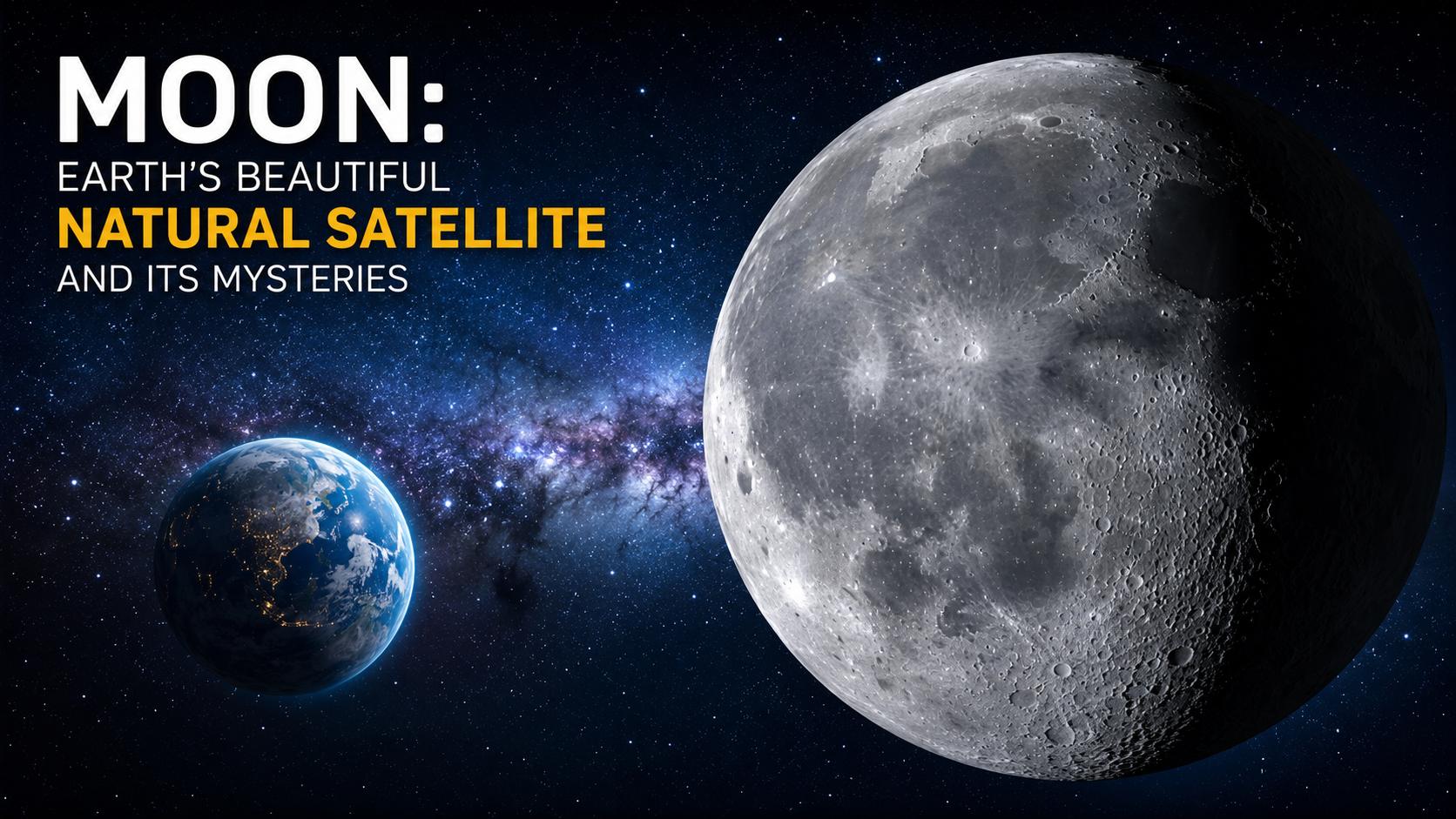
For thousands of years, the Moon has inspired people with its beauty and mystery. From ancient myths and calendars to modern space missions, the Moon has always held a special place in human history. It lights up the night sky, controls ocean tides, influences cultures around the world, and continues to inspire scientists and skywatchers alike.
Although it may seem calm and silent from Earth, the Moon is a remarkable world filled with craters, mountains, valleys, and secrets waiting to be explored. It is also the only celestial body beyond Earth where humans have walked.
In this article, we will explore everything about the Moon—its formation, structure, phases, importance, exploration, and fascinating facts.
Contents
- 1 What Is the Moon?
- 2 How Did the Moon Form?
- 3 The Surface of the Moon
- 4 Why Does the Moon Change Shape?
- 5 The Moon and Earth’s Tides
- 6 Can Humans Live on the Moon?
- 7 Moon Exploration History
- 8 Modern Moon Missions
- 9 Interesting Facts About the Moon
- 10 Why the Moon Is Important
- 11 The Moon in Culture and Mythology
- 12 Future of Lunar Exploration
- 13 Conclusion
- 14 FAQs About the Moon
What Is the Moon?

The Moon is Earth’s only natural satellite. It orbits our planet at an average distance of around 384,400 kilometers and is the fifth-largest moon in the Solar System.

The Moon doesn’t have any own light. It shines because it reflects sunlight. Its changing appearance in the sky creates the lunar phases we see throughout the month.
Quick Facts About the Moon
| Feature | Information |
|---|---|
| Diameter | 3,474 km |
| Distance from Earth | ~384,400 km |
| Gravity | About 1/6 of Earth’s gravity |
| Orbit Time | 27.3 days |
| Surface Temperature | -173°C to 127°C |
| Atmosphere | Extremely thin |
How Did the Moon Form?
Scientists believe the Moon formed about 4.5 billion years ago after a massive collision between early Earth and a Mars-sized object called Theia.
This theory is known as the Giant Impact Hypothesis.


According to the theory:
- A giant object struck young Earth
- The Moon does not create its own light — it shines by reflecting sunlight from the Sun.
- The debris slowly came together
- The Moon formed from this material
This explanation matches many observations about the Moon’s composition and orbit.
The Surface of the Moon
The Moon’s surface is rocky, dusty, and heavily cratered. Because it lacks weather, wind, and flowing water, ancient impact marks remain visible for millions of years.
Major Features of the Moon
1. Craters

Craters are the most recognizable features on the Moon. They formed when asteroids and meteoroids crashed into its surface.

Some famous lunar craters include:
- Tycho crater
- Copernicus crater
2. Lunar Maria
The dark patches visible from Earth are called maria, meaning “seas” in Latin.
Ancient people believed these areas were oceans, but they are actually vast plains formed by ancient volcanic lava flows.
3. Mountains and Valleys
The Moon also has:
- Tall mountain ranges
- Deep valleys
- Rocky cliffs
Some lunar mountains rise higher than Earth’s tallest peaks.
Why Does the Moon Change Shape?
The Moon itself does not change shape. What changes is how much sunlight reflects toward Earth as the Moon orbits our planet.
These changing appearances are called Moon phases.


Main Phases of the Moon
New Moon
During the New Moon phase, the Moon moves between Earth and the Sun, making it difficult to see in the night sky.
Crescent Moon
A thin curved portion becomes visible.
First Quarter
Half the Moon appears lit.
Gibbous Moon
More than half becomes illuminated.
Full Moon
The entire visible side shines brightly.
Waning Phases
The illuminated portion slowly decreases again.
A full lunar cycle, from one New Moon to the next, lasts about 29.5 days.
The Moon and Earth’s Tides
One of the Moon’s most important effects on Earth is its control over ocean tides.
The Moon’s gravity pulls on Earth’s oceans, causing water levels to rise and fall.
Types of Tides
High Tide
Water rises higher along coastlines.
Low Tide
Water levels decrease.
The Sun also affects tides, but the Moon has the stronger influence because it is much closer to Earth.
Can Humans Live on the Moon?
Living on the Moon would be extremely difficult because it has:
- No breathable atmosphere
- Extreme temperatures
- Harmful radiation
- Very low gravity
However, scientists are studying ways to create future lunar bases.
Possible Future Technologies
- Underground habitats
- Solar-powered stations
- Water extraction from lunar ice
Space agencies hope the Moon could become a stepping stone for missions to Mars.
Moon Exploration History

The Moon has been explored by many robotic and human missions.

The Space Race
During the 1960s, the United States and Soviet Union competed to reach the Moon.
The biggest success came with:
- Apollo 11
On July 20, 1969:
- Neil Armstrong
Neil Armstrong made history as the first person to walk on the Moon during the famous Apollo 11 mission.
Modern Moon Missions
Today, many countries continue exploring the Moon.
Important Missions Include:
- NASA’s Artemis Program
- China’s Chang’e missions
- India’s Chandrayaan-3
These missions aim to:
- Study lunar ice
- Search for resources
- Prepare for future human settlements
Interesting Facts About the Moon
1. The Moon Is Slowly Moving Away
The Moon drifts away from Earth by about 3.8 cm each year.
2. Moonquakes Exist
The Moon experiences seismic activity called moonquakes.
3. The Moon Has Water Ice
Scientists discovered frozen water in permanently shadowed craters near the poles.
4. Footprints Can Last Millions of Years
Because there is no wind or rain, astronaut footprints remain unchanged.
5. The Same Side Always Faces Earth
The Moon rotates at the same speed it orbits Earth, causing one side to always face us.
This is called tidal locking.
Why the Moon Is Important
The Moon is far more than a beautiful object in the night sky.
It plays a major role in:
- Stabilizing Earth’s rotation
- Controlling tides
- Influencing animal behavior
- Inspiring science and culture
Without the Moon, Earth’s tides, climate stability, and natural balance could be very different.
The Moon in Culture and Mythology
For thousands of years, civilizations around the world created stories about the Moon.
Ancient Beliefs Included:
- Moon gods and goddesses
- Lunar calendars
- Myths about eclipses
- Festivals based on Moon phases
Even today, the Moon remains a powerful symbol in:
- Poetry
- Music
- Art
- Religion
Future of Lunar Exploration

The future of Moon exploration looks exciting.

Scientists hope to:
- Build permanent Moon bases
- Mine lunar resources
- Use the Moon for deep-space missions
NASA’s Artemis missions plan to return humans to the Moon in the coming years.
This could begin a new era of space exploration.
Conclusion
The Moon is one of the most amazing and mysterious objects visible in the night sky. From controlling ocean tides to guiding future space missions, it continues to shape both Earth and human imagination.
Its glowing presence has inspired people for thousands of years, and scientists still have much to learn about it. As technology advances, the Moon may soon become humanity’s next home beyond Earth.
Whether you watch a bright full Moon rise over the horizon or follow future lunar missions, one thing is certain—the Moon will always remain a symbol of mystery, beauty, and discovery.
FAQs About the Moon
1. How far is the Moon from Earth?
The Moon is about 384,400 kilometers away from Earth on average.
2. Why does the Moon shine?
The Moon shines because it reflects sunlight.
3. Has anyone walked on the Moon?
Yes, astronauts first walked on the Moon during the Apollo 11 mission in 1969.
4. Does the Moon have water?
Yes, scientists discovered water ice in some lunar craters.
5. Can humans live on the Moon?
Scientists are working on future technologies that may allow humans to live on the Moon someday.