
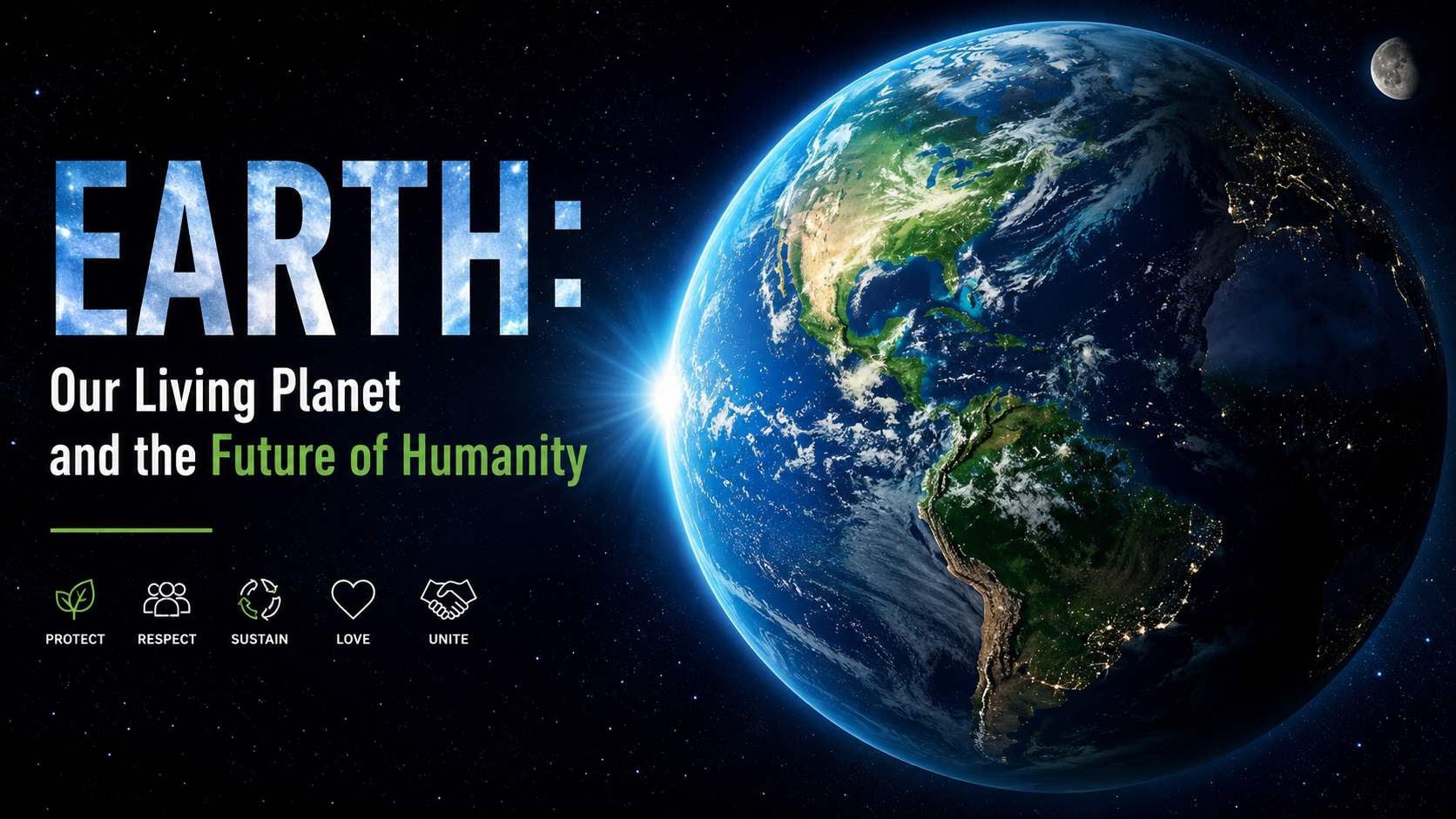
Earth: The only known planet in the universe where life exists is Earth. It is our home, a beautiful blue world filled with oceans, mountains, forests, deserts, rivers, and countless living organisms. Located in the Solar System as the third planet from the Sun, Earth provides the perfect conditions for life to survive and grow.
Often called the “Blue Planet,” Earth appears blue from space because nearly 71% of its surface is covered by water. The planet has a balanced atmosphere, suitable temperatures, and essential natural resources that make life possible. From tiny microorganisms to massive whales, millions of species depend on Earth’s ecosystems for survival.
Earth is not just a planet made of rocks and water. It is a dynamic and living system where land, air, water, and life continuously interact with each other. Understanding Earth helps humanity appreciate the importance of protecting nature and preserving the environment for future generations.
Contents
- 1 The Formation of Earth
- 2 Structure of the Earth
- 3 Earth’s Atmosphere and Climate
- 4 Water: The Lifeline of Earth
- 5 Life on Earth and Biodiversity
- 6 Earth’s Natural Resources
- 7 Environmental Challenges Facing Earth
- 8 The Importance of Protecting Earth
- 9 Future of Earth and Human Civilization
- 10 Conclusion
- 11 FAQs
The Formation of Earth
Scientists believe Earth formed around 4.5 billion years ago from a giant cloud of dust and gas surrounding the young Sun. This process began after the birth of the Solar System. Small particles collided and joined together over millions of years, eventually creating larger bodies called planetesimals.
The early Earth was formed by gravity pulling more material together as these objects continued to collide. During its early stages, Earth was extremely hot due to volcanic activity and frequent impacts from space rocks. Over time, the planet cooled, allowing a solid crust to form.
In Earth’s early history, volcanoes released gases like water vapor, carbon dioxide, and nitrogen into the sky. The formation of Earth marked the beginning of a long and complex journey that eventually led to the appearance of plants, animals, and human civilization.
Structure of the Earth
The Earth is made up of several layers, each of which has its own functions and properties. These layers play a major role in shaping the planet’s surface and supporting life.
1. Crust
The crust is Earth’s outer layer where we live, build cities, and see mountains and oceans. It is relatively thin compared to the planet’s overall size. The crust includes continents, mountains, valleys, and the ocean floor. Humans live on this layer.
Earth’s crust is broken into huge tectonic plates that slowly move over time. These movements cause earthquakes, volcanic eruptions, and the formation of mountain ranges.
2. Mantle
Beneath the crust is the mantle, the thickest and hottest layer inside Earth. It is made of hot, semi-solid rock that slowly flows over long periods.
Heat rising from the mantle pushes the tectonic plates and causes earthquakes and volcanoes. This process continuously changes Earth’s surface and creates geological activity.
3. Outer Core
Earth’s outer core is mainly made of hot liquid iron and nickel deep inside the planet. The movement of these molten metals creates Earth’s magnetic field.
This magnetic field protects the planet from harmful solar radiation and helps maintain conditions necessary for life.
4. Inner Core
At the center of Earth lies the inner core, a solid sphere made mainly of iron and nickel. Despite extremely high temperatures, intense pressure keeps the inner core solid.
The inner core plays an important role in maintaining Earth’s magnetic field and internal heat.
Earth’s Atmosphere and Climate
Earth’s atmosphere is a protective blanket of gases surrounding the planet. It contains nitrogen, oxygen, carbon dioxide, and other gases essential for life.
Importance of the Atmosphere
The atmosphere protects Earth in several ways:
- It provides oxygen for breathing.
- It traps heat to keep the planet warm.
- It shields life from harmful ultraviolet radiation.
- It burns up many meteors before they reach the surface.
Without the atmosphere, Earth would be freezing cold and unsafe for living things.
Earth’s Climate
Climate describes the usual weather conditions of a place over many years. Earth has different climate zones, including tropical, desert, temperate, and polar climates.
Climate is influenced by several factors such as:
- Distance from the Sun
- Ocean currents
- Wind patterns
- Greenhouse gases
- Earth’s rotation and tilt
Over the years, human activities such as burning fossil fuels and deforestation have increased greenhouse gases in the atmosphere. This has contributed to global warming and climate change.
Water: The Lifeline of Earth
Water is one of the most important natural resources that supports all life on Earth. It covers most of the planet’s surface and is essential for all forms of life.
Earth is unique because it contains water in three states:
- Liquid water in oceans, lakes, and rivers
- Ice in glaciers and polar regions
- Water vapor in the atmosphere
The Water Cycle
The water cycle is a natural process that continuously moves water around Earth. It includes:
- Evaporation
- Condensation
- Precipitation
- Collection
This cycle helps maintain weather systems and supports agriculture, ecosystems, and human life.
Importance of Oceans
Oceans play a major role in balancing Earth’s climate by absorbing heat and carbon dioxide. They also produce a large portion of the oxygen we breathe through marine plants and algae.
Marine ecosystems support countless species and provide food and livelihoods for millions of people worldwide.
Life on Earth and Biodiversity
Earth is home to countless species of plants, animals, and microscopic life forms. Scientists estimate that millions of species exist on the planet, including animals, plants, fungi, and microorganisms.
Biodiversity
Biodiversity refers to the variety of living organisms in different ecosystems. Healthy biodiversity is important because it:
- Maintains ecological balance
- Supports food chains
- Provides medicine and resources
- Helps ecosystems recover from disasters
Forests, oceans, grasslands, and wetlands all contain unique ecosystems that support life.
Human Life on Earth
Humans depend heavily on Earth’s natural systems. Agriculture, clean water, forests, minerals, and energy resources are all essential for civilization.
Throughout history, humans have developed societies, technologies, and cultures while relying on Earth’s resources.
However, rapid industrialization and population growth have placed increasing pressure on the environment.
Earth’s Natural Resources
Earth provides a wide range of natural resources that support modern life.
Renewable Resources
Renewable resources can naturally replenish over time. Examples include:
- Solar energy
- Wind energy
- Water
- Forests
- Biomass
These resources are important for sustainable development.
Non-Renewable Resources
Non-renewable resources need millions of years to develop and cannot be replaced quickly once used. Examples include:
- Coal
- Oil
- Natural gas
- Minerals
Overuse of non-renewable resources can lead to environmental damage and shortages.
Importance of Sustainable Use
Using resources responsibly is essential for protecting Earth’s ecosystems. Sustainable practices include:
- Recycling
- Conserving water
- Using renewable energy
- Reducing pollution
- Protecting forests and wildlife
Simple eco-friendly actions can help save natural resources for future generations.
Environmental Challenges Facing Earth
Earth faces several major environmental challenges that threaten ecosystems and human life.
1. Climate Change
Climate change is a major global issue caused by increasing greenhouse gas emissions and rising temperatures.
Effects of climate change include:
- Melting glaciers
- Rising sea levels
- Extreme weather events
- Droughts and floods
- Loss of biodiversity
2. Pollution
Pollution affects air, water, and land. Industrial waste, plastic pollution, and vehicle emissions harm ecosystems and human health.
Ocean pollution is especially dangerous for marine life. Every year, millions of tons of plastic waste pollute the world’s oceans and harm marine life.
3. Deforestation
Forests are being cut down to create farmland, cities, and wood products. Deforestation destroys habitats and increases carbon dioxide levels in the atmosphere.
Rainforests are particularly important because they absorb large amounts of carbon dioxide and support rich biodiversity.
4. Loss of Biodiversity
Many species are becoming endangered due to habitat destruction, pollution, and climate change.
The loss of biodiversity weakens ecosystems and reduces Earth’s natural resilience.
The Importance of Protecting Earth
Protecting “Earth” is important to ensure a safe and healthy future for coming generations. Every individual, community, and nation has a role to play in preserving the environment.
Simple Ways to Protect Earth
People can help protect the planet by:
- Reducing waste
- Recycling materials
- Conserving water and electricity
- Planting trees
- Using eco-friendly transportation
- Avoiding single-use plastics
Global Efforts
Countries around the world are working together to address environmental issues through international agreements and sustainability programs.
Renewable energy technologies such as solar and wind power are helping reduce dependence on fossil fuels.
Environmental education is also important because it encourages people to make responsible decisions.
Future of Earth and Human Civilization
The future of Earth depends largely on human actions. Scientific advancements and sustainable practices can help create a healthier and more balanced planet.
Technology and Sustainability
Modern technologies are improving environmental protection through:
- Clean energy systems
- Electric vehicles
- Sustainable agriculture
- Water purification
- Recycling innovations
These developments can reduce pollution and conserve resources.
Space Exploration and Earth
Exploring other planets helps scientists learn more about Earth and its environment. Space missions provide valuable information about climate systems, geology, and planetary evolution.
Despite advancements in space exploration, Earth remains humanity’s only true home. No other known planet currently offers the same conditions for life.
Building a Better Future
Creating a sustainable future requires cooperation between governments, scientists, businesses, and individuals.
By protecting ecosystems, reducing pollution, and conserving resources, humanity can ensure that Earth remains habitable for generations to come.
Conclusion
Earth is an extraordinary planet filled with life, beauty, and natural wonders. From vast oceans and forests to mountains and deserts, every part of Earth contributes to the balance that supports life.
The planet provides essential resources, a stable atmosphere, and the conditions necessary for human civilization to thrive. However, environmental challenges such as climate change, pollution, and deforestation threaten Earth’s future.
Protecting Earth is not only a responsibility but also a necessity. Sustainable living, environmental awareness, and global cooperation are key to preserving the planet.
As humanity continues to advance technologically and scientifically, it is important to remember that Earth is our shared home. By caring for the planet today, we can create a healthier, safer, and more sustainable future for all life on Earth.
FAQs
1. Why is Earth called the “Blue-Planet”?
Earth is called the Blue Planet because most of its surface is covered by water, making it appear blue from space.
2. How old is Earth?
Scientists estimate that Earth is around 4.5 billion years old.
3. What makes Earth suitable for life?
Earth has liquid water, a breathable atmosphere, suitable temperatures, and essential nutrients that support life.
4. What are the major environmental problems on Earth?
Major environmental issues include climate change, pollution, deforestation, and loss of biodiversity.
5. How can people help protect Earth?
People can protect Earth by recycling, conserving energy and water, reducing pollution, and supporting sustainable practices.