
Contents
- 1 Introduction: A Journey Beyond Imagination
- 2 What Does “One Light-Day Away” Really Mean?
- 3 Crossing the Boundary: Entering Interstellar Space
- 4 The Scale of the Universe: Comparing Distances
- 5 Voyager 1: Humanity’s Silent Ambassador
- 6 The Technology Behind the Mission
- 7 Why This Milestone Matters
- 8 The Challenges of Interstellar Travel
- 9 A humble view of our place in the universe
- 10 The Future of Space Exploration
- 11 Conclusion: Just the Beginning
- 12 FAQs
- 13 1. What is Voyager 1 and why is it important?
- 14 2. How far is Voyager 1 from Earth right now?
- 15 3. What is Proxima Centauri and how far is it?
- 16 4. Is Voyager 1 still sending data?
- 17 5. Will Voyager 1 ever reach another star?
Introduction: A Journey Beyond Imagination
Voyager 1: Humanity has always looked up at the night sky with curiosity and wonder. From ancient stargazers to modern astronomers, the desire to explore the universe has driven innovation and discovery. Among all our achievements in space exploration, one mission stands out as a symbol of human ambition—the journey of Voyager 1.
Voyager 1 has journeyed farther than any human-made object since its launch in 1977. Today, it is nearly one light-day away from Earth—an extraordinary milestone that highlights both our progress and our limitations. While this achievement is remarkable, it also reveals just how vast the universe truly is.
What Does “One Light-Day Away” Really Mean?
To understand the significance of Voyager 1’s distance, we need to grasp the concept of a “light-day.” Light travels at about 300,000 kilometers per second. In one day, it covers roughly 26 billion kilometers.
So when we say Voyager 1 is nearly one light-day away, it means:
- Signals from the spacecraft take about 24 hours to reach Earth
- It has traveled billions of kilometers beyond our planet
- It is far beyond the influence of most of the Sun’s particles
This distance places Voyager 1 in interstellar space, a region beyond our solar system where the Sun’s influence begins to fade.
Crossing the Boundary: Entering Interstellar Space
In 2012, Voyager 1 achieved another historic milestone—it crossed the heliopause, the boundary where the Sun’s solar wind meets the interstellar medium.
This moment marked humanity’s first direct entry into interstellar space. It was no longer just exploring planets; it had stepped into the vast region between stars.
Even now, Voyager 1 continues to send valuable scientific data back to Earth, helping scientists understand:
- Cosmic radiation levels
- Magnetic fields in interstellar space
Despite its age, the spacecraft remains operational—a testament to the engineering brilliance of its creators.
The Scale of the Universe: Comparing Distances
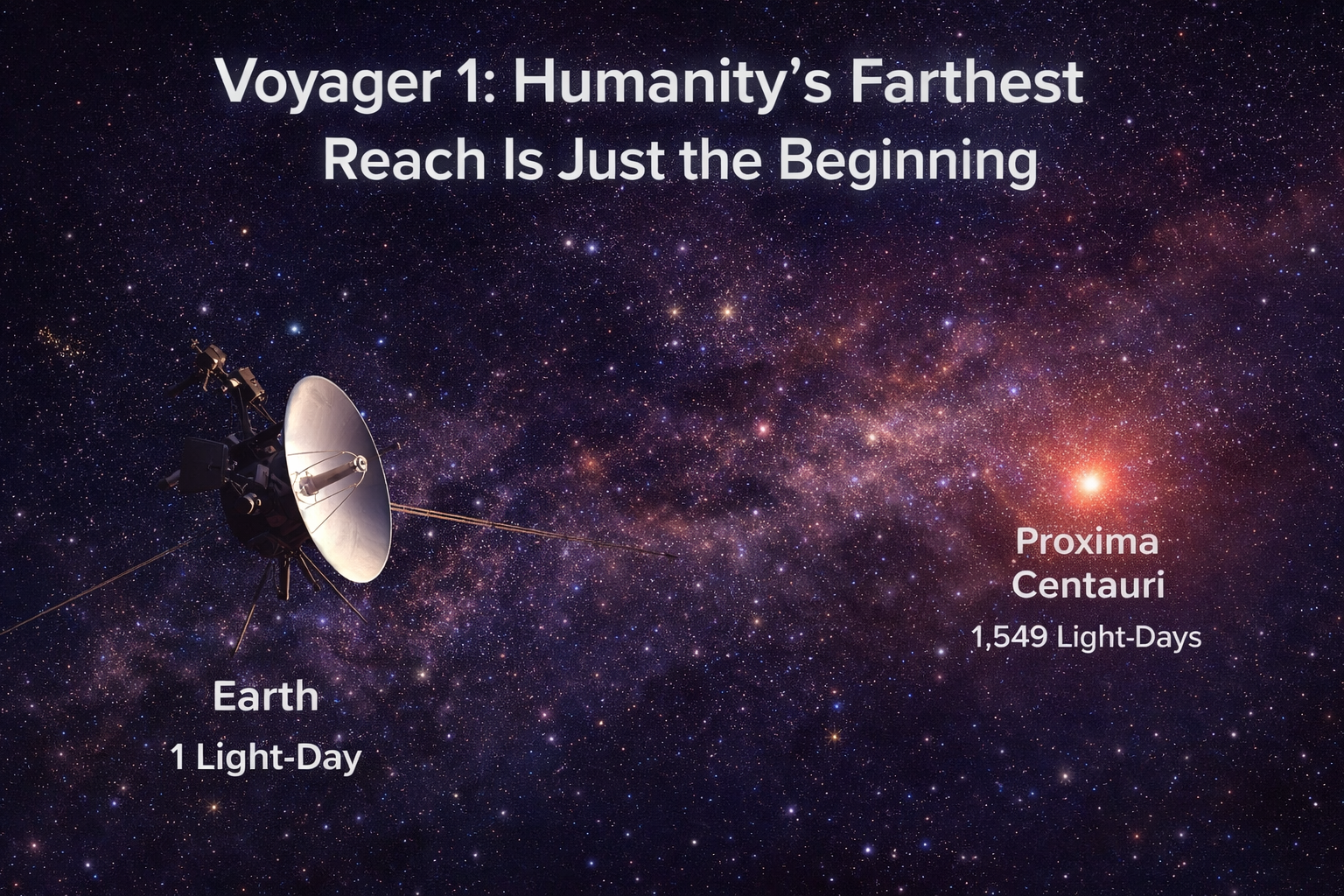
While Voyager 1’s journey is impressive, it becomes humbling when compared to cosmic distances. Our nearest stellar neighbor, Proxima Centauri, lies about 1,549 light-days away.
Let’s break that down:
- Voyager 1 distance: ~1 light-day
- Proxima Centauri distance: ~1,549 light-days
- Percentage traveled: Less than 0.1% of the distance
After nearly five decades of travel, Voyager 1 has only covered a tiny fraction of the distance to the nearest star.
This comparison highlights a powerful truth:
In the context of the universe, even our fastest space missions progress at a very slow pace.
Voyager 1: Humanity’s Silent Ambassador
Voyager 1 is more than a space probe—it’s a symbol of Earth. It holds the Golden Record, which includes sounds, music, and pictures showing life on our world.
This record was designed in case the spacecraft is ever discovered by intelligent extraterrestrial life. It includes:
- Greetings in multiple languages
- Music from different cultures
- Natural sounds from Earth
- Images of humanity and our world
Even though the chances of it being found are extremely small, the idea itself is powerful. Voyager 1 represents humanity’s desire to connect, explore, and be remembered.
The Technology Behind the Mission
Considering it was launched in 1977, Voyager 1’s technology is surprisingly simple by today’s standards. Yet, it has proven to be incredibly durable and reliable.
Some key features include:
- A radioisotope thermoelectric generator (RTG) for power
- A large dish antenna for communication
- Scientific instruments to study particles and fields
However, Voyager 1 won’t last forever. Its power supply is slowly decreasing, and scientists expect it to stop sending data sometime in the coming years.
Even after it goes silent, it will continue drifting through space for millions of years—a relic of human curiosity.
Why This Milestone Matters
Reaching nearly one light-day away is not just a technical achievement—it’s a philosophical one.
It reminds us that:
- We are capable of incredible innovation
- Exploration is part of human nature
At the same time, it puts our progress into perspective. Despite decades of effort, we are still at the very beginning of interstellar exploration.
The Challenges of Interstellar Travel
Traveling to another star system is one of the greatest challenges humanity faces. The distances are so vast that current technology would take tens of thousands of years to reach even the nearest star.
Some of the main challenges include:
- Distance: Even light takes years to travel between stars
- Energy requirements: Enormous power is needed for faster travel
- Human survival: Long-duration missions pose serious risks
- Communication delays: Signals can take years to travel
Scientists are exploring advanced concepts like:
- Nuclear propulsion
- Light sails
- Artificial intelligence-driven probes
These ideas could one day make interstellar travel more feasible.
A humble view of our place in the universe
Voyager 1’s journey teaches us an important lesson about our place in the universe. Despite our achievements, we are still a small part of a vast and largely unexplored cosmos.
The Milky Way is home to hundreds of billions of stars, and it exists among billions of galaxies, each containing countless stars and planets.
In this context, Voyager 1’s journey—while extraordinary—is just a tiny step.
The Future of Space Exploration
The story of Voyager 1 is far from the end—it’s just the beginning.
Future missions aim to go even farther and faster. Scientists and engineers are working on new technologies that could one day allow us to:
- Send probes to nearby star systems
- Explore exoplanets
- Search for signs of life beyond Earth
Projects like interstellar probes and advanced propulsion systems are already being studied.
As technology evolves, what seems impossible today may become reality tomorrow.
Conclusion: Just the Beginning
Voyager 1 stands as a powerful symbol of human curiosity and determination. Nearly one light-day away from Earth, it represents the farthest reach of our species.
Yet, when compared to the distance to Proxima Centauri, its journey is only a tiny fraction of what lies ahead.
This contrast is both humbling and inspiring. It reminds us that while we have achieved incredible things, we are only at the beginning of our journey into the cosmos.
The universe is vast, mysterious, and full of possibilities—and Voyager 1 is our first step into that infinite frontier.
FAQs
1. What is Voyager 1 and why is it important?
Voyager 1 is a NASA spacecraft launched in 1977 to study the outer planets. It is now the farthest human-made object from Earth and the first to enter interstellar space, making it a historic milestone in space exploration.
2. How far is Voyager 1 from Earth right now?
Voyager 1 is nearly one light-day away from Earth, meaning it takes about 24 hours for its signals to reach us.
3. What is Proxima Centauri and how far is it?
Proxima Centauri is the closest known star to Earth after the Sun. It is about 1,549 light-days away, which shows how vast interstellar distances are.
4. Is Voyager 1 still sending data?
Yes, Voyager 1 is still transmitting data back to Earth, although its power is gradually decreasing. Scientists expect it to stop functioning in the near future.
5. Will Voyager 1 ever reach another star?
No, Voyager 1 is not heading toward any specific star and would take tens of thousands of years to reach even the nearest one. It will continue drifting through space indefinitely.