
From Cosmic Birth to Stellar Death — A Journey Through the Universe
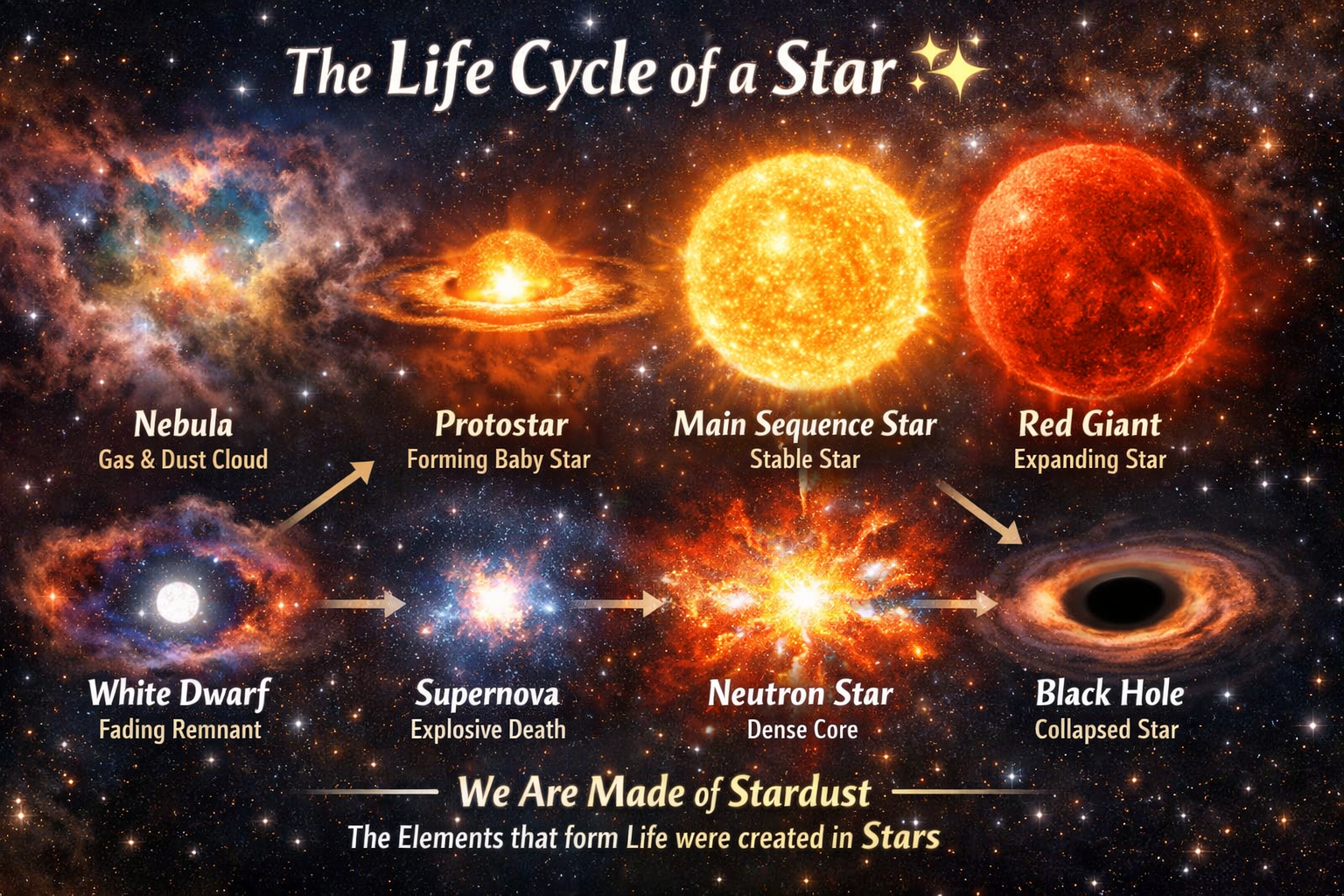
The Life Cycle of a Star: Have you ever looked up at the night sky and wondered how those twinkling stars came into existence—and what happens to them over time? The journey of a star is one of the most incredible processes in the universe. From their birth in vast cosmic clouds to their dramatic endings, stars (The Life Cycle of a Star) go through incredible transformations that shape galaxies and even create the elements that make up life on Earth.
Let’s explore this journey in a simple and clear way—understanding how stars are formed, how they live, and how they eventually reach their end.
Contents
- 1 🌌 Birth of a Star: Stellar Nurseries (Nebulae)
- 2 🔥 Protostar to Main Sequence Star (The Life Cycle of a Star)
- 3 🔴 Red Giant Phase: When Stars Expand
- 4 💫 The Fate of Smaller Stars: White Dwarfs
- 5 💥 The Fate of Massive Stars: Supernova Explosions
- 6 🌠 Stardust: The Cosmic Connection to Life
- 7 🌌 Why the Life Cycle of Stars Matters
- 8 ✨ Final Thoughts of The Life Cycle of a Star
- 9 ❓ FAQs About the Life Cycle of a Star
- 10 1. How long does a star live?
- 11 2. What is a protostar?
- 12 3. Will our Sun become a supernova?
- 13 4. What is a black hole?
- 14 5. Why are stars important for life?
🌌 Birth of a Star: Stellar Nurseries (Nebulae)
Every star begins its life inside a nebula, which is a massive cloud of gas and dust floating in space. These nebulae are often called “stellar nurseries” because they are the birthplaces of stars.
Over time, gravity starts pulling the gas and dust together. As more material gathers, the center becomes denser and hotter. This process continues until a compact object called a protostar forms.
At this stage, the star is not yet shining like we see in the night sky—but it’s getting there.
🔥 Protostar to Main Sequence Star (The Life Cycle of a Star)
As the protostar continues to collapse under its own gravity, its core temperature rises dramatically. Eventually, it becomes hot enough for nuclear fusion to begin.
This is the point when a star is officially born.
During nuclear fusion, hydrogen atoms combine to form helium, releasing a huge amount of energy. The energy produced makes the star shine, giving off light and heat.
At this stage, the star enters the main sequence, its longest and most stable phase. Our own Sun is currently in this phase and has been shining for about 4.6 billion years.
Depending on its size, a star can remain in this stage for millions, billions, or even trillions of years.
🔴 Red Giant Phase: When Stars Expand
But nothing lasts forever—even stars.
As a star uses up its hydrogen fuel, the balance between gravity and energy begins to shift. The core contracts while the outer layers expand, causing the star to grow enormously in size.
This stage is known as the red giant phase.
During this time (The Life Cycle of a Star):
- The star becomes cooler on the surface, giving it a reddish color
- It can grow to many times its original size, sometimes becoming hundreds of times larger.
- It begins fusing heavier elements like helium
For example, in the distant future, our Sun will expand so much that it may engulf nearby planets, possibly including Earth.
💫 The Fate of Smaller Stars: White Dwarfs
Stars that are about the same size as our Sun usually end their lives in a gentle and less dramatic way compared to bigger stars.
After the red giant phase (The Life Cycle of a Star):
- The outer layers slowly move away into space, creating a stunning planetary nebula.
- The core that remains becomes a white dwarf
A white dwarf is extremely dense and hot at first, but it no longer produces energy through fusion. Over billions of years, it slowly cools and fades into darkness, eventually becoming a black dwarf (a theoretical stage that may take longer than the current age of the universe).
💥 The Fate of Massive Stars: Supernova Explosions
Massive stars live fast and die dramatically.
When a very large star runs out of fuel, it cannot support its own weight anymore. The core collapses suddenly, leading to a massive explosion known as a supernova.
This explosion is incredibly powerful—it can outshine entire galaxies for a short time.
After a supernova, what remains depends on the original mass of the star:
- Neutron Star: A super-dense object made mostly of neutrons
- Black Hole: A strange area in space where gravity is so powerful that even light cannot escape.
These remains of stars are among the most powerful and unusual objects in the universe.
🌠 Stardust: The Cosmic Connection to Life
One of the most incredible things about stars is that they produce the elements that form everything around us—including the matter in our own bodies.
Inside stars, nuclear fusion produces elements like carbon, oxygen, and iron. During supernova explosions, even heavier elements are formed and scattered across space.
These elements eventually become part of new stars, planets, and even living beings.
In a real way, the material that makes us comes from the stars.
🌌 Why the Life Cycle of Stars Matters
Understanding the life cycle of stars helps scientists:
- Learn how galaxies evolve
- Discover how elements are formed
- Understand the origins of planets and life
- Study extreme physics like black holes and neutron stars
Every star tells a story—and by studying them, we learn more about the universe and our place within it.
✨ Final Thoughts of The Life Cycle of a Star
The life cycle of a star is a powerful reminder of how dynamic and interconnected the universe truly is. From humble beginnings in a cloud of dust to explosive endings that shape the cosmos, stars play a crucial role in everything we see around us.
Next time you look up at the night sky, remember: those distant lights are not just stars—they are stories of creation, transformation, and cosmic wonder.
🌟 And perhaps most beautifully of all… you are a part of that story.
❓ FAQs About the Life Cycle of a Star
1. How long does a star live?
A star’s lifespan depends on its size. Small stars can live for trillions of years, while massive stars may only last a few million years.
2. What is a protostar?
A protostar is an early stage in star formation when gas and dust are collapsing but nuclear fusion has not yet begun.
3. Will our Sun become a supernova?
No, the Sun is not massive enough. It will become a red giant and eventually form a white dwarf.
4. What is a black hole?
A black hole is a region in space with extremely strong gravity, formed when a massive star collapses after a supernova.
5. Why are stars important for life?
Stars create essential elements like carbon and oxygen, which are necessary for life. Without stars, life as we know it wouldn’t exist.
📸 Tag someone who loves space and share the wonder of the universe!