
Contents
- 1 ✨ A Universe Largely Invisible to Us
- 2 🌠 What We Can See: Just a Tiny Fraction
- 3 🧲 Dark Matter: The Invisible Glue of the Universe
- 4 🌌 Dark Energy: The Force Driving the Universe Apart
- 5 ⚖️ The Balance of the Universe
- 6 🧠 Why Don’t We Fully Understand Them Yet?
- 7 🌌 A New Perspective on the Night Sky
- 8 🌠 Final Thoughts
- 9 ❓ Frequently Asked Questions (FAQs)
- 10 1. Why can’t we see most of the universe?
- 11 2. What is dark matter made of?
- 12 3. How does dark energy affect the universe?
- 13 4. Can dark matter be detected directly?
- 14 5. Is research on dark matter and dark energy still ongoing?
✨ A Universe Largely Invisible to Us
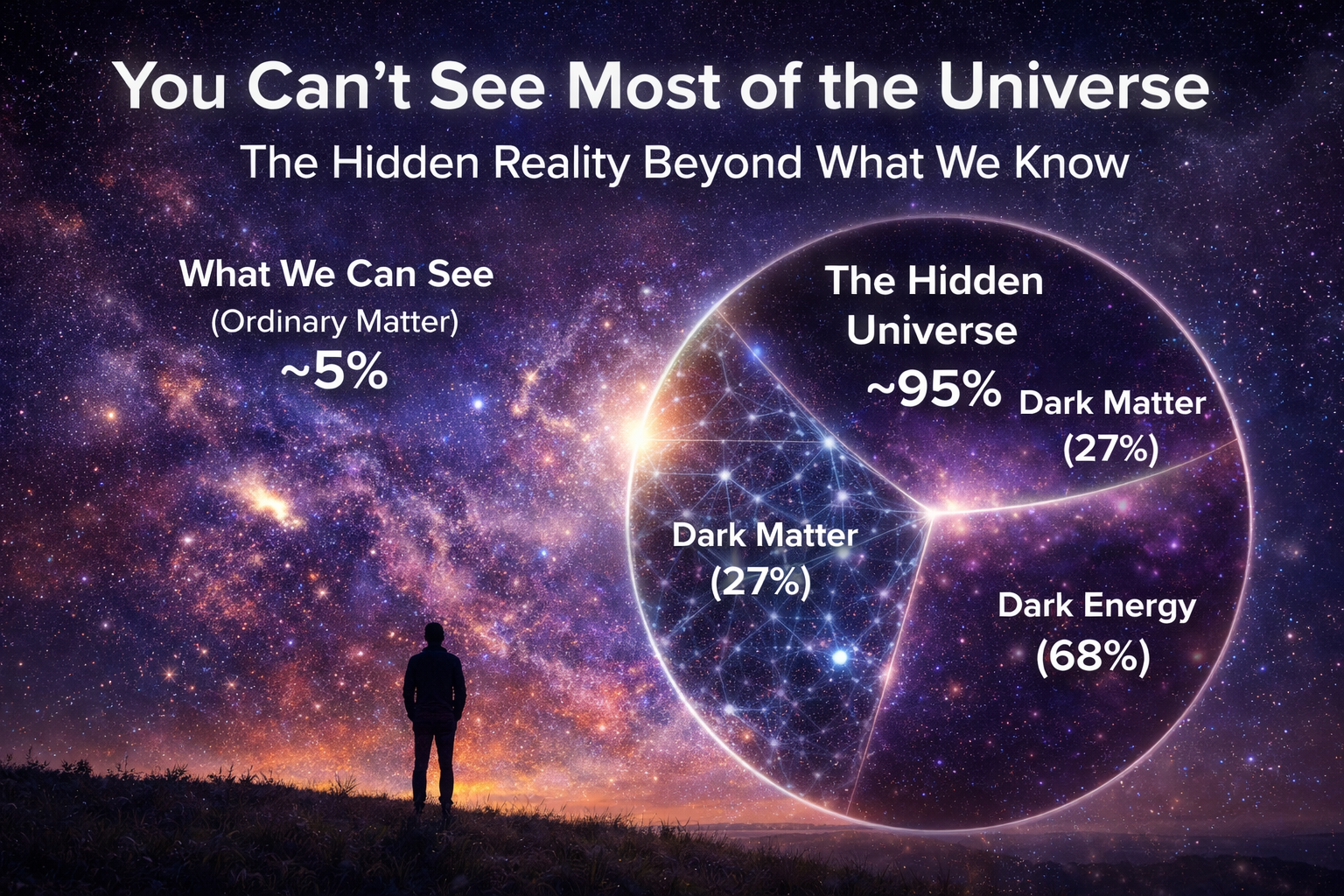
When you look up at the night sky, it feels like you’re seeing the vastness of the universe — countless stars, glowing planets, and distant galaxies. But here’s something truly astonishing: what you see makes up less than 5% of the entire universe.
The remaining 95% is completely invisible, not because it’s too far away, but because it doesn’t interact with light the way normal matter does. This hidden portion is made up of two mysterious components: Dark matter and Dark energy.
Despite decades of research, scientists still don’t fully understand these invisible forces. Yet, they shape the space in powerful ways.
🌠 What We Can See: Just a Tiny Fraction
Everything we can observe — stars, planets, galaxies, nebulae — belongs to what scientists call ordinary matter. This includes all atoms, everything made of protons, neutrons, and electrons.
Even with powerful telescopes, including those used by organizations like NASA, we can only study this small visible slice of reality.
In fact:
- Stars and galaxies: Make up only a small part of visible matter
- Planets and life: Even smaller fraction
- Total visible universe: Less than 5%
This means that almost everything that exists is beyond direct observation.
🧲 Dark Matter: The Invisible Glue of the Universe
One of the biggest mysteries in modern science is Dark matter.
🔍 What is Dark Matter?
Dark matter is a type of matter that:
- Does not emit, absorb, or reflect light
- Cannot be seen with any telescope
- Interacts through gravity
Even though it’s invisible, its presence is strongly felt across the universe.
🌌 How Do Scientists Know It Exists?
Scientists detect dark matter indirectly by observing how visible matter behaves. For example:
- Galaxy rotation: Galaxies spin so fast that they should break apart — but they don’t
- Gravitational lensing: Light bends more than expected, suggesting extra unseen mass
- Cosmic structure: Large-scale formations in the universe require more matter than we can see
These clues indicate that something invisible is holding galaxies together — like a cosmic glue.
The current state of galaxies would not be possible without dark matter.
🌌 Dark Energy: The Force Driving the Universe Apart
If dark matter holds things together, Dark energy does the opposite — it pushes everything apart.
🚀 What is Dark Energy?
The mysterious force that drives the space rapid expansion is dark energy.
Instead of slowing down due to gravity, the universe is expanding faster and faster — something scientists did not expect.
🔭 How Was It Discovered?
Dark energy was discovered through observations of distant exploding stars called supernovae. Scientists noticed that:
- These stars were farther away than expected
- The universe’s expansion was speeding up, not slowing down
This groundbreaking discovery changed our understanding of cosmology forever.
⚖️ The Balance of the Universe
The universe is shaped by a delicate balance between these components:
- ~5% Ordinary Matter (everything we can see)
- ~27% Dark Matter (invisible structure and gravity)
- ~68% Dark Energy (driving expansion)
This balance determines how galaxies form, evolve, and move.
🧠 Why Don’t We Fully Understand Them Yet?
Despite incredible advances in technology and physics, dark matter and dark energy remain unsolved mysteries.
🔬 Challenges Scientists Face:
- They don’t interact with light, making them hard to detect
- They don’t fit neatly into existing physics theories
- Experiments on Earth have yet to directly confirm their nature
Even with advanced research from organizations like CERN, we are still searching for answers.
🌌 A New Perspective on the Night Sky
The next time you gaze at the stars, remember this:
- You are seeing only a tiny fraction of reality
- Most of the universe is “invisible and unknown“
- The cosmos is far more complex than it appears
This realization doesn’t make the space feel smaller — it makes it infinitely more fascinating.
🌠 Final Thoughts
The idea that 95% of the universe is invisible challenges everything we think we know about reality. Dark matter and Dark energy are not just scientific concepts — they are clues to a much deeper understanding of existence.
Scientists continue to explore these mysteries, using advanced telescopes, experiments, and theories to uncover what lies beyond our perception.
Until then, the universe remains a place of wonder, mystery, and endless discovery.
Everything you see is just the beginning. The rest is still waiting to be understood. 🌌✨
❓ Frequently Asked Questions (FAQs)
1. Why can’t we see most of the universe?
Because most of it is made of dark matter and dark energy, which do not interact with light like normal matter does.
2. What is dark matter made of?
Scientists don’t yet know. It could be made of unknown particles that haven’t been detected directly.
3. How does dark energy affect the universe?
Dark energy causes the universe to expand faster over time, pushing galaxies away from each other.
4. Can dark matter be detected directly?
So far, no. Scientists detect it indirectly through its gravitational effects on visible matter.
5. Is research on dark matter and dark energy still ongoing?
Yes, scientists around the world continue to study them using advanced technology and experiments to understand their true nature.