
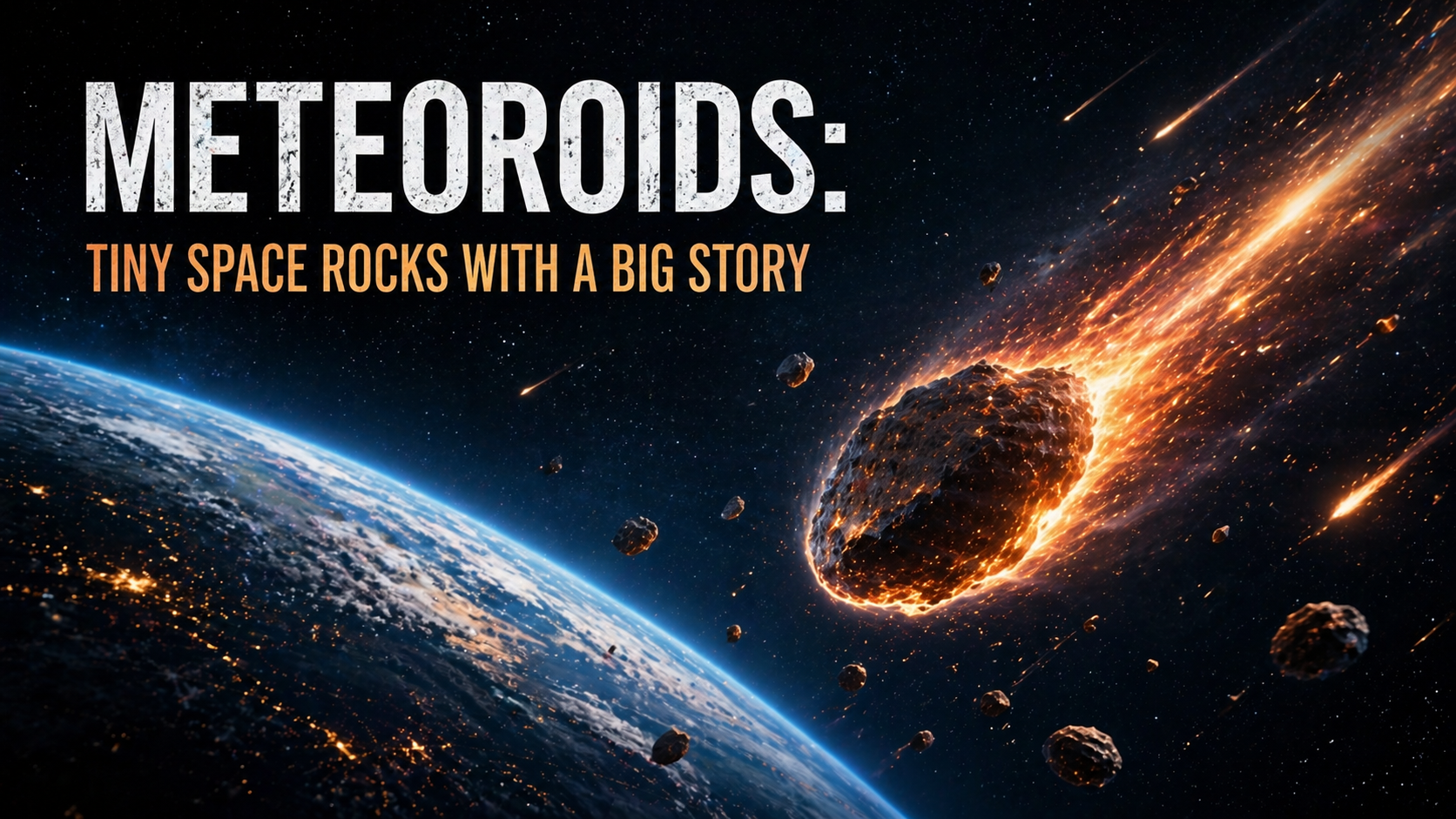
Meteoroids are tiny pieces of rock or metal that move through space. They are much smaller than asteroids, ranging from tiny grains to objects about a meter wide.
When these objects enter Earth’s atmosphere, they create bright streaks of light in the sky.
This is when we call them meteors, often known as “shooting stars.”

If any part of the object survives the journey and lands on Earth, it becomes a meteorite.
Contents
- 1 ☄️ Meteoroid vs Meteor vs Meteorite
- 2 🌍 Where Do Meteoroid Come From?
- 3 🪨 Types of Meteoroids
- 4 🔥 What Happens When Meteoroid Enter Earth’s Atmosphere?
- 5 🌠 Meteor Showers Explained
- 6 🌍 Famous Meteor Events
- 7 🔬 Scientific Importance of Meteoroids
- 8 ⚠️ Can Meteoroid Be Dangerous?
- 9 🔭 How to Observe Meteors
- 10 🌟 Why Meteoroid Matter
- 11 🧾 Conclusion
- 12 ❓ FAQs About Meteoroids
☄️ Meteoroid vs Meteor vs Meteorite
Many people confuse these three terms, but they describe different stages of the same object:
- Meteoroid: A small rock traveling in space
- Meteor: The bright light seen when it enters the atmosphere
- Meteorite: The part that reaches Earth’s surface
Understanding this difference helps you better appreciate what you see in the night sky.
🌍 Where Do Meteoroid Come From?
Meteoroid originate from several sources in our solar system:
1. Asteroids
Most meteoroids come from collisions between asteroids in the asteroid belt. These impacts break larger rocks into smaller fragments.
2. Comets
Comets leave behind trails of dust and debris as they travel around the Sun. When Earth crosses these dust trails, we see beautiful meteor showers in the sky.
3. Planetary Debris
Some meteoroids are pieces of planets or moons that were ejected into space after massive impacts.
🪨 Types of Meteoroids

Meteoroid vary in composition and structure. Meteoroids are usually grouped into three main types based on their composition:
🔹 Stony Meteoroids
- Made mostly of silicate minerals
- Most common type
- Often resemble Earth rocks

🔹 Iron Meteoroid
- Composed mainly of iron and nickel
- Very dense and heavy
- Often survive atmospheric entry
🔹 Stony-Iron Meteoroid
- A mix of metal and rock
- Rare but scientifically valuable
🔥 What Happens When Meteoroid Enter Earth’s Atmosphere?
When a meteoroid enters Earth’s atmosphere, it travels at extremely high speeds—often tens of kilometers per second.
Step-by-Step Process:
- Friction and Heat: Air resistance causes intense heating
- Glow Formation: The object begins to glow brightly
- Disintegration: Most meteoroids burn up completely
- Impact (if any): Larger pieces may reach the ground
This glowing streak is what we call a meteor.
🌠 Meteor Showers Explained

Meteor showers happen when our planet passes through leftover debris from a comet.
During these events, multiple meteors appear to radiate from a single point in the sky.
Popular Meteor Showers:
- Perseids (August) – Bright and frequent
- Geminids (December) – Colorful meteors
- Eta Aquarids (May) – Fast-moving streaks
Meteor showers are one of the easiest and most exciting sky events to observe.
🌍 Famous Meteor Events
🌟 Chelyabinsk Event (2013)
A large meteor exploded over Russia, creating a powerful shockwave that damaged buildings and injured people.
🌟 Tunguska Event (1908)
A massive explosion in Siberia flattened thousands of square kilometers of forest. It is believed to have been caused by a meteoroid airburst.
🌟 Meteor Crater (Arizona)
A well-preserved impact site in the United States formed by a large meteorite.
🔬 Scientific Importance of Meteoroids
Meteoroids are valuable to scientists because they:
- Provide clues about the early solar system
- Contain primitive materials older than Earth
- Help us understand planetary formation
- Offer insights into space chemistry
Some meteorites even contain organic molecules, raising questions about the origins of life.
⚠️ Can Meteoroid Be Dangerous?
Most meteoroids are very small and burn up before reaching the ground.
However, larger ones can pose risks:
- Airbursts can create shockwaves
- Impact events can cause local damage
- Extremely large impacts are rare but significant
Scientists track near-Earth objects to reduce potential risks.
🔭 How to Observe Meteors

Watching meteors is simple and doesn’t require expensive equipment.
Tips for Best Viewing:
- Pick a dark spot away from city lights to enjoy a clearer night sky view.
- Lie down and look up at the sky
- Allow your eyes 15–20 minutes to adjust
- Avoid using your phone
- Check peak dates of meteor showers
The best time to watch is usually after midnight or before dawn.
🌟 Why Meteoroid Matter
Meteoroid may be small, but they play a big role in space science.
They help us understand:
- The building blocks of planets
- The history of our solar system
- The dynamic nature of space
Every shooting star you see is a reminder of how active and fascinating our universe truly is.
🧾 Conclusion
Meteoroids are tiny travelers that connect space and Earth in a spectacular way. From glowing meteors in the sky to meteorites on the ground, they tell a story that spans billions of years.
Whether you are watching a meteor shower or learning about their origins, meteoroids offer a unique glimpse into the universe’s past and present.
❓ FAQs About Meteoroids
1. What is a meteoroid?
A meteoroid is a small space rock made of metal or stone traveling in orbit.
2. What’s difference between meteor and meteoroid?
A meteoroid is in space, while a meteor is the light seen when it enters Earth’s atmosphere.
3. Can meteoroids reach Earth?
Yes, if they survive the atmosphere, they become meteorites.
4. Are meteoroids dangerous?
Most are harmless, but larger ones can cause damage if they reach Earth.
5. When is the best time to see meteors?
During meteor showers, especially after midnight in dark, clear skies.