
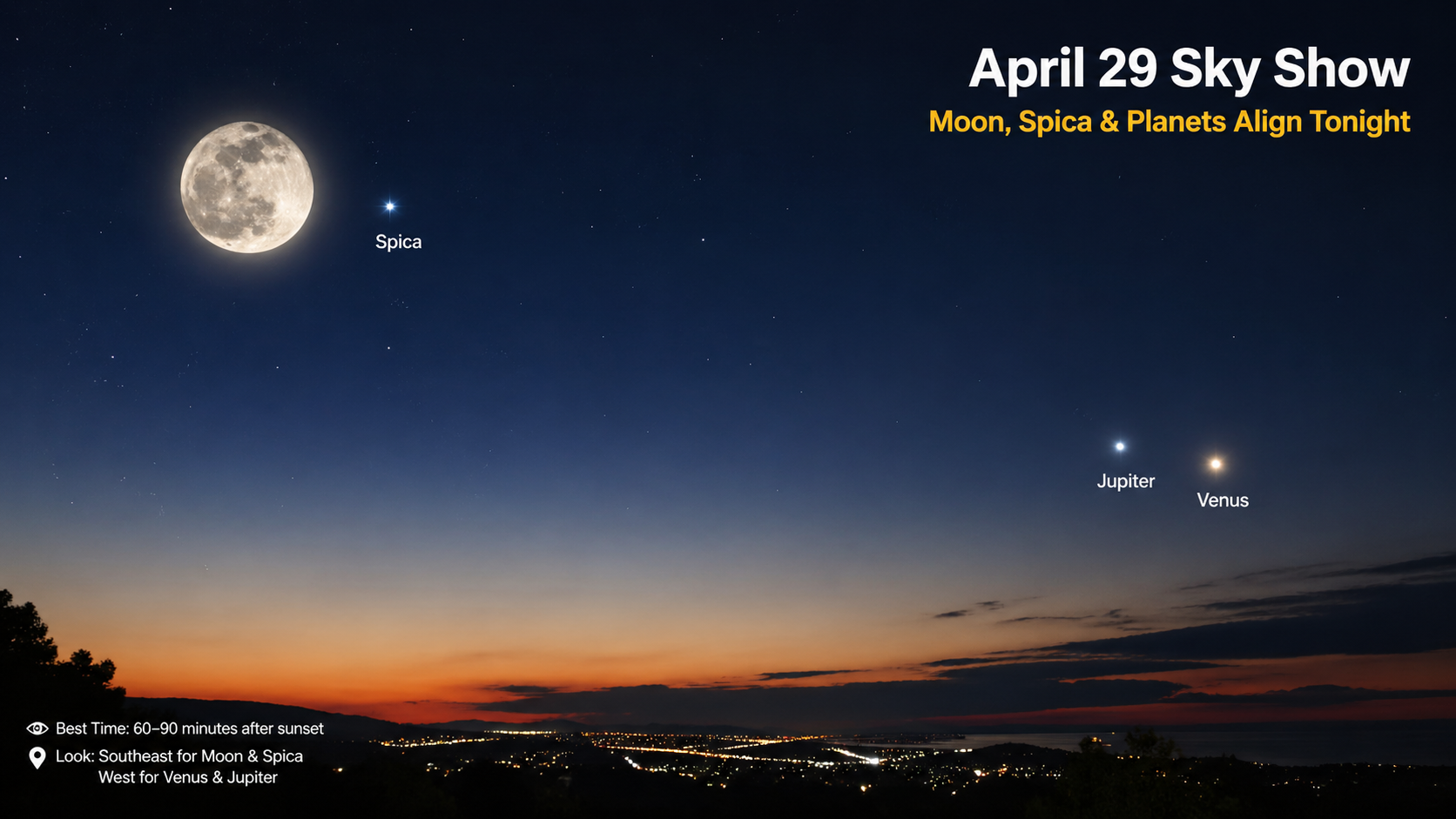
April 29 Sky Show: On the evening of April 29, the night sky offers a rare and beautiful alignment that many people might overlook. A bright 98% waxing gibbous Moon will glow near Spica. At the same time, Venus and Jupiter will shine together in the western sky.
This celestial combination is simple to observe, requires no equipment, and can be enjoyed from almost anywhere with clear skies. Yet, because it’s not widely talked about, many people may miss out. This guide will walk you through everything you need to know—from when and where to look to why this event is special.
Contents
- 1 What Makes April 29 Special?
- 2 The Waxing Gibbous Moon: Almost Full, Fully Stunning
- 3 Meet Spica: The Bright Jewel of Virgo
- 4 Venus and Jupiter: A Bright Planetary Duo
- 5 Where to Look in the Sky
- 6 Best Time to Watch
- 7 Do You Need a Telescope?
- 8 Tips for the Best Viewing Experience
- 9 Why Events Like This Matter
- 10 Astrophotography Opportunity
- 11 Common Mistakes to Avoid
- 12 How Often Do Alignments Like This Happen?
- 13 A Night Worth Stepping Outside
- 14 Conclusion
- 15 FAQs
What Makes April 29 Special?
Astronomy often rewards patience, but some nights deliver instant beauty. April 29 is one of those nights.
Instead of a single event, the sky presents a multi-object display:
- A bright Moon nearing fullness
- A prominent star shining beside it
- Two brilliant planets visible together
This kind of alignment doesn’t happen every day. While each object appears regularly on its own, seeing them all clearly visible in one evening creates a memorable skywatching experience.
The Waxing Gibbous Moon: Almost Full, Fully Stunning

The Moon on April 29 will be in its waxing gibbous phase, meaning it is more than 98% illuminated and just one step away from being full.
Why This Phase Matters
- The Moon is extremely bright, making it easy to locate
- Its light can dominate the sky, reducing visibility of faint stars
- It creates a dramatic contrast when paired with bright stars like Spica
Even without binoculars or a telescope, the Moon’s glow will be the first thing you notice after sunset.
Meet Spica: The Bright Jewel of Virgo

Right beside the Moon on April 29, you’ll spot Spica, the brightest star in the constellation Virgo constellation.

Quick Facts About Spica
- Located about 250 light-years away from Earth
- Spica is one of the brightest stars you can easily spot at night.
- Appears as a steady bluish-white point of light
Why It Stands Out Tonight
Spica is usually easy to see, but when placed next to the Moon, it becomes even more noticeable. The contrast between the Moon’s soft glow and Spica’s sharp brilliance creates a visually striking pairing.
Venus and Jupiter: A Bright Planetary Duo

While the Moon on April 29 and Spica shine in the southeast, the western sky features another highlight: Venus and Jupiter appearing together.
Why This Pair Is Special
- Venus stands out as the brightest planet in the sky.
- Jupiter is the second brightest after Venus
- Seeing them close together makes them hard to miss
Unlike stars, these planets don’t twinkle much. Instead, they shine with a steady, powerful light.
Where to Look in the Sky
Knowing where to look is key to enjoying the full experience.
Southeast Sky
- Look for the Moon and Spica on April 29
- They will appear relatively high compared to the horizon
West / West-Northwest
- Look for Venus and Jupiter
- They will be lower in the sky, close to the horizon
If you have buildings or trees nearby, try to find an open view toward the west.
Best Time to Watch
Timing makes all the difference in skywatching.
- Start Time: Around 8 PM (local time) on April 29
- Ideal Window: 60 to 90 minutes after sunset
During this period:
- As the evening deepens, the sky becomes dark enough to reveal more stars.
- The planets are still visible before setting
- The Moon is bright but not overwhelming
Arriving too early means the sky is still bright. Too late, and Venus and Jupiter may dip below the horizon.
Do You Need a Telescope?
Not at all.
One of the best parts about this event is its accessibility:
- Visible with the naked eye
- No special equipment required
- Binoculars can enhance detail but are optional
This makes it perfect for beginners, families, or anyone who simply wants to step outside and look up.
Tips for the Best Viewing Experience
1. Find a Dark Spot
Even moving slightly away from streetlights can improve visibility.
2. Check the Weather
Clear skies are essential. Clouds can block the entire view.
3. Let Your Eyes Adjust
Give your eyes about 10 to 15 minutes to adjust to the darkness for a clearer view.
4. Use a Sky App
Apps can help you identify objects quickly if you’re unsure.
5. Be Patient
Sometimes the best views come after a few quiet minutes of observation.
Why Events Like This Matter
Moments like these remind us how dynamic and interconnected the sky is. The Moon, stars, and planets all follow predictable paths, yet their alignments create unique experiences.
A Connection to the Universe
Seeing these objects together highlights:
- The Moon’s orbit around Earth
- The vast distances to stars like Spica
- The planetary motion of Venus and Jupiter
A Rare Pause in Daily Life
In a world filled with screens and distractions, stepping outside and looking up offers something simple yet powerful—a moment of calm and perspective.
Astrophotography Opportunity
If you enjoy photography, April 29 provides a great chance to capture the sky.
What You Can Capture
- Moon with Spica in one frame
- Venus and Jupiter glowing near the horizon
Basic Tips
- Use a tripod for stability
- Lower ISO for clearer images
- Experiment with exposure times
Even smartphone cameras can capture the brightness of Venus and the Moon.
Common Mistakes to Avoid
- Looking too late: Planets may already be set
- Ignoring direction: Knowing where to look is crucial
- Expecting telescope-level detail: This event is about wide-sky beauty
- Staying near bright lights: Light pollution reduces visibility
How Often Do Alignments Like This Happen?
While the Moon on April 29 passes near stars and planets regularly, having:
- A bright Moon
- A prominent star like Spica
- Two visible planets
all on the same evening is less common. That’s what makes April 29 worth noticing.
A Night Worth Stepping Outside
You don’t need any special knowledge to enjoy this moment. Anyone can step outside, look up, and experience the beauty of the night sky. April 29 offers a reminder that sometimes the universe puts on a show without requiring anything from us—no tickets, no equipment, no planning beyond stepping outside.
All it takes is a clear sky and a few minutes of attention.
Conclusion
April 29 is one of those nights when the sky quietly offers something extraordinary. The Moon, Spica, Venus, and Jupiter come together to create a simple yet unforgettable display.
It’s easy to miss—but even easier to enjoy.
Step outside, look up, and take it in.
FAQs
1. What is a waxing gibbous Moon?
A waxing gibbous Moon is a phase where more than half of the Moon is illuminated and it is moving toward becoming a full Moon.
2. Can I see this event from India?
Yes, this event is visible from most parts of the world, including India, as long as the sky is clear.
3. Do Venus and Jupiter appear close every day?
No, their positions change constantly. Seeing them close together is relatively uncommon and worth observing.
4. Will I need binoculars to see Spica?
No, Spica is bright enough to be seen with the naked eye, especially when near the Moon.
5. What if I miss it tonight?
While similar events happen in the future, this exact alignment won’t repeat in the same way, so it’s best to catch it if you can.