
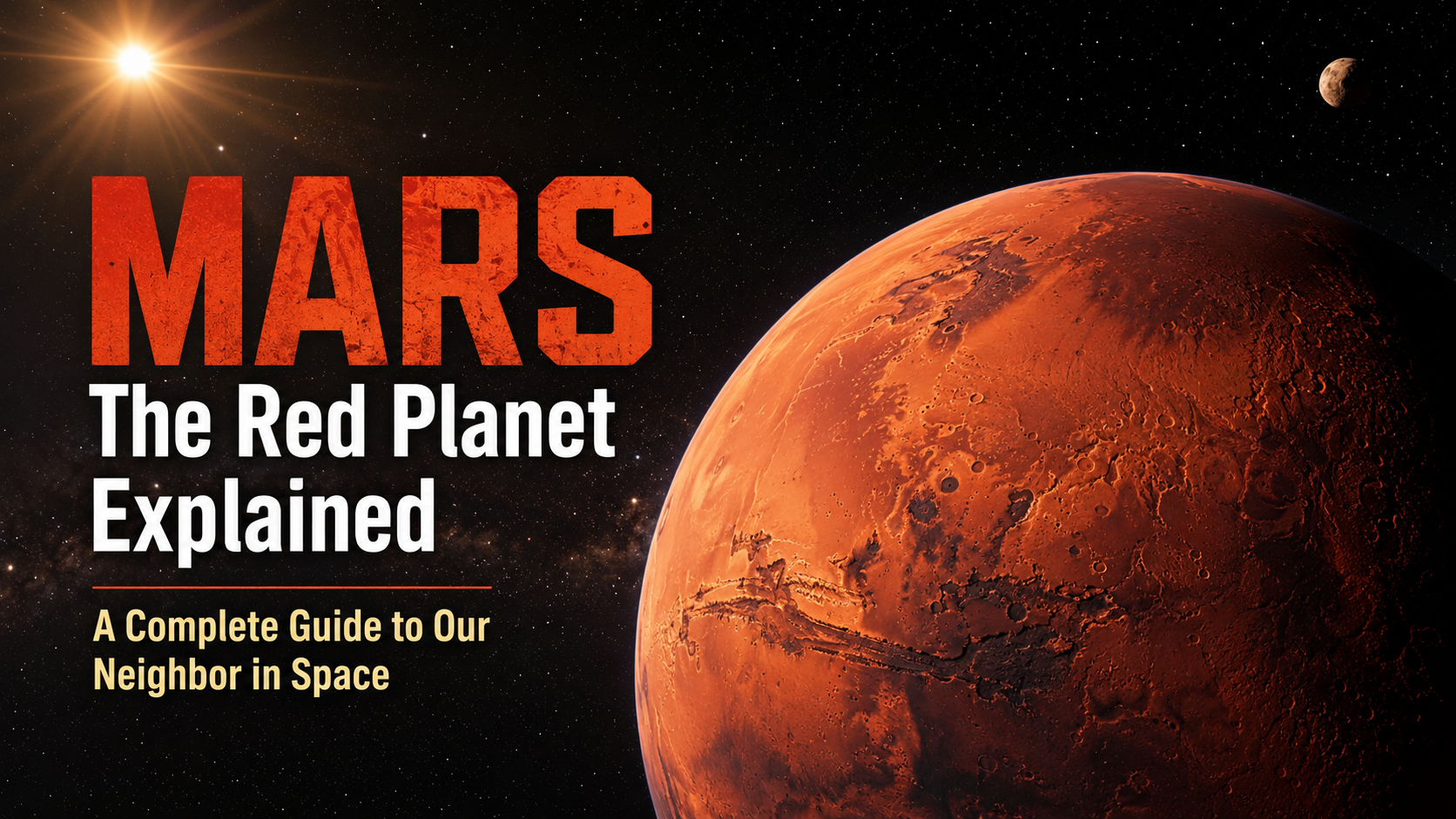
Mars, often called the Red Planet, has fascinated humanity for centuries. From ancient sky watchers to modern scientists, this mysterious world continues to spark curiosity and imagination. Its reddish appearance, shifting seasons, and potential to support life make it one of the most studied planets in our solar system.
In this comprehensive guide, we’ll explore everything about Mars—its structure, atmosphere, history, exploration missions, and the possibility of human colonization.
Contents
- 1 What is Mars?
- 2 Key Facts About Mars
- 3 Why is Mars Called the Red Planet?
- 4 Surface Features of Mars
- 5 Mars’ Atmosphere and Climate
- 6 Water on Mars: Past and Present
- 7 Possibility of Life on Mars
- 8 Exploration of Mars
- 9 Human Missions to Mars
- 10 Can Humans Live on Mars?
- 11 Interesting Facts About Mars
- 12 Why Mars Matters
- 13 Conclusion
- 14 FAQs About Mars
What is Mars?
Mars is the fourth planet from the Sun and the second smallest planet in our solar system, making it one of the most fascinating worlds in space. It belongs to the group of terrestrial planets, meaning it has a rocky surface similar to Earth.
The planet gets its distinctive red color from iron oxide (rust) covering its surface. This gives Mars its iconic dusty, reddish look visible even from Earth without a telescope.
Key Facts About Mars
| Feature | Details |
|---|---|
| Distance from Sun | ~227.9 million km |
| Diameter | ~6,779 km |
| Length of Day | 24.6 hours |
| Length of Year | 687 Earth days |
| Moons | Phobos and Deimos |
| Gravity | 38% of Earth’s |
These features make Mars one of the most Earth-like planets, which is why scientists consider it a prime candidate for future exploration and settlement.
Why is Mars Called the Red Planet?
The planet looks red because its surface is covered with iron-rich dust, which is similar to rust. Over billions of years, iron minerals on Mars reacted with oxygen, creating a dusty layer that reflects sunlight in a reddish hue.
This striking color made Mars easy to identify in the night sky, and ancient civilizations often associated it with war due to its blood-like appearance.
Surface Features of Mars
Mars has some of the most incredible landscapes in space, including giant volcanoes, deep valleys, and rocky deserts.
1. Olympus Mons – The Largest Volcano
Olympus Mons is the tallest volcano in the solar system, standing about 22 km high—nearly three times taller than Mount Everest.
2. Valles Marineris – A Giant Canyon
This massive canyon system stretches over 4,000 km, making it far larger than Earth’s Grand Canyon.
3. Polar Ice Caps
Mars has ice caps made of water and carbon dioxide (dry ice). These caps expand and shrink with the seasons.
Mars’ Atmosphere and Climate
Mars has a very thin atmosphere composed mostly of carbon dioxide (about 95%). This makes it difficult for the planet to retain heat, leading to cold temperatures.
- Average temperature: -60°C
- Can drop to: -125°C near the poles
- Dust storms: Can cover the entire planet
Despite harsh conditions, Mars experiences seasons similar to Earth due to its tilted axis.
Water on Mars: Past and Present
Scientists became very interested in Mars after discovering strong evidence that water once existed there.
Signs of Ancient Water
Scientists have found:
- Dry riverbeds
- Mineral deposits formed in water
- Ancient lake basins
Present-Day Water
Water still exists on Mars in the form of:
- Ice beneath the surface
- Polar ice caps
Some studies even suggest the possibility of salty liquid water flowing briefly under certain conditions.
Possibility of Life on Mars
Mars is a major focus in the search for extraterrestrial life.
Why Mars Could Support Life
- Evidence of past water
- Organic molecules detected
- Similar day length to Earth
Current Status
No confirmed life has been found yet. However, microbes may have existed in the past—or could still exist underground.
Exploration of Mars
Mars has been explored by numerous missions from different space agencies.
Early Missions
The first successful flyby was by NASA’s Mariner 4 in 1965, which sent back the first images of Mars.
Modern Missions
Some important missions include:
- NASA’s Perseverance Rover
- Curiosity Rover
- Mars Reconnaissance Orbiter
These missions have helped scientists understand Mars’ geology, climate, and potential for life.
Human Missions to Mars
Sending humans to Mars is one of the biggest goals in space exploration.
Challenges
- Long travel time (6–9 months)
- Radiation exposure
- Lack of breathable air
- Extreme temperatures
Future Plans
Organizations like NASA and private companies such as SpaceX are actively working on plans to send humans to Mars in the coming decades.
Can Humans Live on Mars?
Living on Mars would require advanced technology.
Requirements for Survival
- Oxygen production systems
- Water extraction methods
- Protective habitats
- Food production systems
Scientists are researching ways to terraform Mars, but this is still theoretical and would take hundreds or thousands of years.
Interesting Facts About Mars
- A sunset on Mars appears blue, not red.
- Mars experiences massive dust storms that can spread across the entire planet for weeks.
- Gravity on Mars is much lower than Earth’s, so objects weigh less and jumps would feel much higher.
- One year on Mars is much longer than on Earth and lasts about 687 Earth days.
- Mars has two small, irregularly shaped moons.
Why Mars Matters
Mars is more than just a neighboring planet—it’s a key to understanding the past and future of planetary evolution.
Studying Mars helps scientists:
- Learn about Earth’s history
- Understand climate change
- Search for life beyond Earth
- Prepare for future space missions
Conclusion
Mars continues to be one of the most intriguing planets in our solar system. With its Earth-like features, evidence of water, and potential for life, it stands as a gateway to the future of space exploration.
As technology advances, the dream of humans setting foot on Mars is becoming increasingly realistic. The Red Planet may one day transform from a distant mystery into humanity’s second home.
FAQs About Mars
1. Why is Mars red?
Mars is known as the Red Planet because its surface is covered with iron-rich dust that looks like rust.
2. Can humans breathe on Mars?
No, Mars has a thin atmosphere with very little oxygen, so humans cannot breathe without support systems.
3. Is there water on Mars?
Water still exists on Mars today in the form of frozen ice and possibly short-lived salty liquid water beneath the surface.
4. How long does it take to travel to Mars?
It typically takes about 6 to 9 months using current spacecraft technology.
5. Has life been found on Mars?
No confirmed life has been discovered yet, but scientists are still searching for signs of past or present microbial life.