
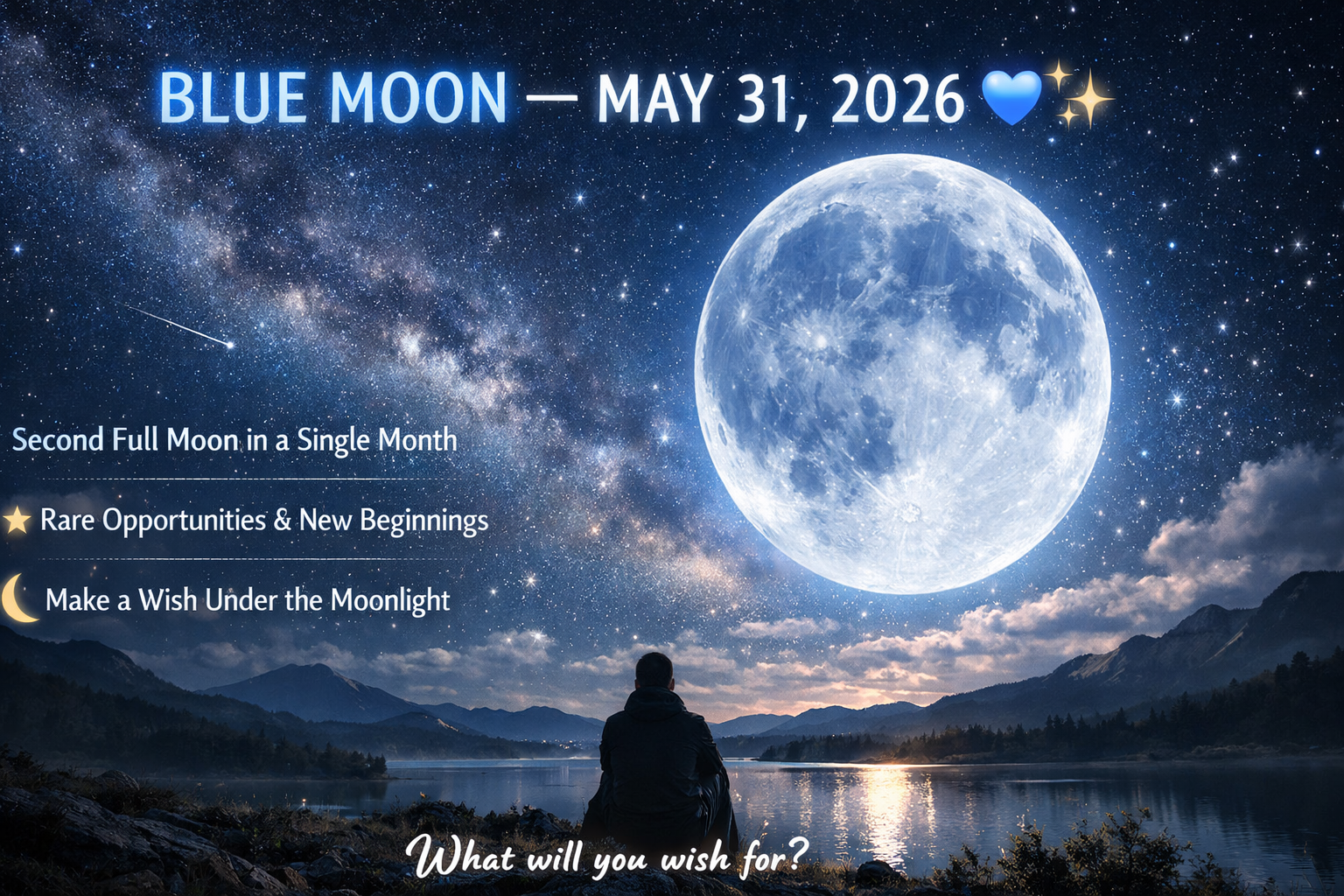
A rare and captivating celestial event is set to light up the night sky on May 31, 2026 — the Blue-Moon. While the name might sound magical, even mysterious, the truth behind it is just as fascinating. This isn’t a moon that glows blue in color, but rather a unique occurrence in the lunar calendar that has intrigued skywatchers, astronomers, and dreamers for generations.
In a world that moves quickly and often feels predictable, events like the Blue-Moon remind us that rarity still exists — and that sometimes, nature quietly offers us a chance to pause, reflect, and begin again.
Contents
- 1 🌌 What Is a Blue Moon?
- 2 💙 Why the May 31, 2026 Blue Moon Matters
- 3 ✨ What the Blue Moon Represents
- 4 🌙 A Night for Reflection
- 5 💫 Setting Intentions Under the Blue Moon
- 6 🌌 The Emotional and Cultural Connection
- 7 🔭 Best Way to Experience the Blue Moon
- 8 🌙 A Reminder from the Universe
- 9 💙 Don’t Miss It
- 10 🌟 Final Thought
- 11 ❓ FAQs About the Blue Moon
- 12 1. What exactly is a Blue Moon?
- 13 2. Will the moon actually appear blue on May 31, 2026?
- 14 3. Do I need a telescope to see the Blue Moon?
- 15 4. Is there any special meaning or significance behind a Blue Moon?
🌌 What Is a Blue Moon?
A “Blue Moon” refers to the second full moon within a single calendar of the month. Normally, full moons occur about every 29.5 days, which means most months have just one. However, because our calendar months don’t perfectly align with the lunar cycle, occasionally a month will host two full moons — and that’s when the second one earns the title “Blue Moon.”
This doesn’t happen often. In fact, a Blue Moon typically appears only once every 2 to 3 years. That’s where the popular phrase “once in a blue moon” comes from — describing something rare and unusual.
Despite its name, the moon will appear in its usual shades of white, silver, or pale gold. Only under very rare atmospheric conditions — like volcanic eruptions or heavy pollution — can the moon take on a bluish tint. But for this event, the magic lies in its timing, not its color.
💙 Why the May 31, 2026 Blue Moon Matters
The Blue-Moon on May 31, 2026, holds special significance simply because of its rarity. It’s not just another full moon — it’s an extra one, a bonus moment gifted by the natural rhythm of our planet and its satellite.
Events like this have always captured human imagination. Across cultures and centuries, full moons have been linked to myths, emotions, rituals, and spiritual beliefs. When a Blue-Moon appears, it feels like an amplified version of that energy — a moment that stands apart from the ordinary.
✨ What the Blue Moon Represents
Beyond astronomy, the Blue Moon carries deep symbolic meaning. People often associate it with transformation, reflection, and new beginnings.
Also Read : Black Holes: The Mysterious Giants of the Universe
🌠 Rare Opportunities
Just like the Blue Moon itself, certain chances in life don’t come often. This event is a reminder to recognize and embrace those rare moments when they appear.
🔄 Unexpected Changes
Life doesn’t always follow a predictable path. The Blue Moon reflects the beauty of the unexpected — the surprises that shift our direction and open new doors.
🌱 Reset and Realignment
A second full moon in a month can feel like a “cosmic reset button.” It offers a chance to pause, rethink your goals, and realign your priorities.
🌙 A Night for Reflection
The night of a Blue Moon is often seen as the perfect time to slow down and reconnect with yourself. In today’s fast-paced world, we rarely take a moment to reflect deeply — to think about where we’ve been and where we’re going.
Under the glow of the May 31 Blue Moon, you might consider:
- What have I learned recently?
- What habits or thoughts do I want to let go of?
- Where do I want to go in the future?
The stillness of the night sky has a way of making these questions feel more meaningful.
💫 Setting Intentions Under the Blue Moon
Many people use the energy of a full moon to set intentions — and a Blue Moon makes that practice even more powerful.
No need any special equipment or tools. Simply stepping outside, looking up at the moon, and taking a few quiet moments can be enough.
Here are a few simple ways to connect with the moment:
- Write down your goals for the coming months
- Let go of negativity by consciously releasing thoughts that no longer serve you
- Visualize your future — imagine where you want to be and how it feels
- Make a wish — something heartfelt and meaningful
The act itself isn’t about magic — it’s about clarity, focus, and intention.
🌌 The Emotional and Cultural Connection
Throughout history, full moons have been deeply connected to human emotions and cultural traditions. Farmers relied on them for planting cycles, storytellers wove myths around them, and spiritual practices often centered around lunar phases.
The Blue Moon, being rare, naturally became associated with heightened meaning. It’s often seen as a moment when emotions feel stronger, thoughts become clearer, and the connection between nature and self becomes more noticeable.
Even today, people across the world step outside during such events — not just to observe, but to feel something deeper.
🔭 Best Way to Experience the Blue Moon
One of the best things about this celestial event is how easy it is to witness. You don’t need expensive equipment or advanced knowledge.
To make the most of the Blue Moon on May 31, 2026:
- Find a place with minimal light pollution
- Look toward the open sky just after sunset or later at night
- Allow your eyes to adjust to the darkness
- Take your time — don’t rush the experience
Whether you’re alone or with loved ones, the moment can be surprisingly powerful.
🌙 A Reminder from the Universe
In many ways, the Blue Moon is more than just an astronomical event. It’s a reminder — quiet but profound.
It reminds us that:
- Time isn’t always linear
- Rare moments do exist
- Pausing is just as important as moving forward
In a life filled with routines, deadlines, and constant motion, something as simple as looking up at the moon can bring a sense of calm and perspective.
💙 Don’t Miss It
Moments like this don’t come often. The Blue Moon on May 31, 2026, is your chance to step outside, breathe deeply, and witness something rare.
No screens, no distractions — just you and the sky.
And maybe, just maybe, a quiet wish carried into the night.
🌟 Final Thought
If you could make one wish under this Blue Moon… what would it be?
❓ FAQs About the Blue Moon
1. What exactly is a Blue Moon?
A Blue Moon is the second full moon that occurs within a single calendar month. It doesn’t refer to the moon’s color but rather its timing.
2. Will the moon actually appear blue on May 31, 2026?
No, the moon will look like a typical full moon. The term “Blue Moon” is symbolic and not related to its actual color.
3. Do I need a telescope to see the Blue Moon?
No, the Blue Moon is easily visible to the naked eye. In fact, it’s best enjoyed without any equipment under a clear night sky.
4. Is there any special meaning or significance behind a Blue Moon?
While scientifically it’s just a calendar-based event, many people see it as a symbol of rare opportunities, reflection, and new beginnings.